



 Chat with AI
Exam 6: The Behavior of Proteins: Enzymes

Exam 1: Biochemistry and the Organization of Cells73 Questions
Exam 2: Water: the Solvent for Biochemical Reactions85 Questions
Exam 3: Amino Acids and Peptides75 Questions
Exam 4: The Three-Dimensional Structure of Proteins82 Questions
Exam 5: Protein Purification and Characterization Techniques67 Questions
Exam 6: The Behavior of Proteins: Enzymes83 Questions
Exam 7: The Behavior of Proteins: Enzymes, Mechanisms, and Control81 Questions
Exam 8: Lipids and Proteins Are Associated in Biological Membranes90 Questions
Exam 9: Nucleic Acids: How Structure Conveys Information66 Questions
Exam 10: Biosynthesis of Nucleic Acids: Replication86 Questions
Exam 11: Transcription of the Genetic Code: Biosynthesis of RNA98 Questions
Exam 12: Protein Synthesis: Translation of the Genetic Message85 Questions
Exam 13: Nucleic Acid Biotechnology Techniques94 Questions
Exam 14: Viruses, Cancer, and Immunology42 Questions
Exam 15: The Importance of Energy Changes and Electron Transfer in Metabolism60 Questions
Exam 16: Carbohydrates92 Questions
Exam 17: Glycolysis67 Questions
Exam 18: Storage Mechanisms and Control in Carbohydrate Metabolism82 Questions
Exam 19: The Citric Acid Cycle80 Questions
Exam 20: Electron Transport and Oxidative Phosphorylation66 Questions
Exam 21: Lipid Metabolism95 Questions
Exam 22: Photosynthesis74 Questions
Exam 23: The Metabolism of Nitrogen78 Questions
Exam 24: Integration of Metabolism: Cellular Signaling68 Questions
Select questions type


The amount of energy released during a reaction tells nothing about the rate at which that reaction will occur.
(True/False)
4.8/5  (79)
(79) What effect is seen on a Lineweaver-Burk graph when a competitive inhibitor is added?
(Multiple Choice)
4.8/5 (83)
(83) Most enzyme reactions display first order kinetics for the individual substrates when the substrate concentration is low.
(True/False)
4.9/5 (72)
(72) Inhibitors can have the following effects on enzyme kinetics:
(Multiple Choice)
4.9/5 (76)
(76) Which of the following is true about the enzyme chymotrypsin?
(Multiple Choice)
4.9/5 (62)
(62) The KM of hexokinase for glucose = 0.15 mM and for fructose, KM = 1.5 mM. Which is the preferred substrate?
(Multiple Choice)
4.8/5 (92)
(92) If an inhibitor changes the slope of the Lineweaver-Burk graph, but not the y-intercept, it is this type of inhibition:
(Multiple Choice)
4.8/5 (71)
(71) What effect is seen on a Lineweaver-Burk graph when a mixed-type inhibitor is added?
(Multiple Choice)
4.8/5 (78)
(78) To study the nature of an enzyme, Vmax is not as good a measurement as the catalytic rate constant kcat because:
(Multiple Choice)
4.8/5 (76)
(76) The rate of a reaction is always dependent on the concentration(s) of the reactant(s).
(True/False)
4.9/5 (89)
(89) It is important that at physiological conditions, enzymes work at Vmax.
(True/False)
4.8/5 (69)
(69) Exhibit 6A This is a reaction going on in your muscle cells right this very minute: The enzyme triose phosphate isomerase catalyzes this reaction in the forward direction as part of the glycolytic pathway. It follows simple Michaelis-Menten kinetics: Typical cellular concentrations: triose phosphate isomerase = 0.1 nM?dihydroxyacetone phosphate = 5 µM glyceraldehyde-3-phosphate = 2 µM

 -Refer to Exhibit 6A. "Restrainin" is an inhibitor of triose phosphate isomerase. When it is added to cells at a concentration of 0.4 nM, the enzyme's apparent KM for the substrate is altered to 100 µM, but the Vmax is unchanged. In the following graph, which line best represents the Lineweaver-Burk plot obtained in the presence of restrainin?
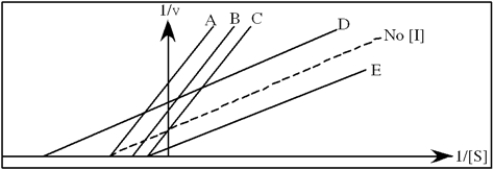
-Refer to Exhibit 6A. "Restrainin" is an inhibitor of triose phosphate isomerase. When it is added to cells at a concentration of 0.4 nM, the enzyme's apparent KM for the substrate is altered to 100 µM, but the Vmax is unchanged. In the following graph, which line best represents the Lineweaver-Burk plot obtained in the presence of restrainin? (Multiple Choice)
4.9/5 (83)
(83) The Michaelis-Menten approach to describing the kinetics of an enzyme-catalyzed reaction makes which of the following assumptions about the conversion of product into substrate?
(Multiple Choice)
4.8/5 (82)
(82) 
Filters
- Essay(0)
- Multiple Choice(0)
- Short Answer(0)
- True False(0)
- Matching(0)