



 Chat with AI
Exam 5: Competition and Monopoly: Virtues and Vices

Exam 1: Scarcity and Choice78 Questions
Exam 2: Market Transactions: Demand and Supply Analysis93 Questions
Exam 3: Demand and Supply Applications92 Questions
Exam 4: Production and the Costs of Production77 Questions
Exam 5: Competition and Monopoly: Virtues and Vices92 Questions
Exam 6: Imperfect Competition90 Questions
Exam 7: Labor Markets86 Questions
Exam 8: Government and Markets89 Questions
Exam 9: The Mixed Economy of the United States80 Questions
Exam 10: Gross Domestic Product and Economic Growth87 Questions
Exam 11: The Business Cycle, Unemployment, and Inflation87 Questions
Exam 12: Macroeconomic Instability: Aggregate Demand and Aggregate Supply78 Questions
Exam 13: Fiscal Policy and the Federal Budget90 Questions
Exam 14: Money and the Banking System92 Questions
Exam 15: The Federal Reserve and Monetary Policy84 Questions
Exam 16: The United States and the Global Economy84 Questions
Exam 17: International Finance70 Questions
Exam 18: Economic Systems and Developing Countries76 Questions
Select questions type


Agricultural and fishing industries provide approximations of perfect competition.
(True/False)
4.8/5  (93)
(93) Figure 5.1 Cost and Demand Conditions of a Perfectly Competitive Firm
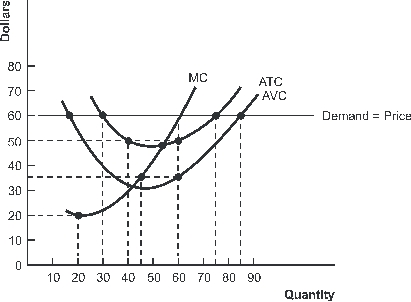 -Refer to Figure 5.1. The firm will maximize total economic profits by producing
 (Multiple Choice)
4.8/5 (96)
(96) If losses are being realized in a perfectly competitive industry, some firms will exit. This will shift the industry
(Multiple Choice)
5.0/5 (81)
(81) If total revenue exceeds total variable cost, a firm should continue to produce in the short run because all of its variable costs and some or all of its fixed costs can be paid out of revenue.
(True/False)
4.9/5 (74)
(74) Figure 5.1 Cost and Demand Conditions of a Perfectly Competitive Firm
-Refer to Figure 5.1. If the firm's price falls to $35, it will
-Refer to Figure 5.1. If the firm's price falls to $35, it will (Multiple Choice)
4.9/5 (72)
(72) Cable companies and satellite broadcasters have both been able to attract many new customers by offering video, telephone, and high-speed Internet access.
(True/False)
4.9/5 (91)
(91) Barriers to entry include patents, copyrights, control over essential inputs, and economies of scale.
(True/False)
4.8/5 (78)
(78) Proponents of vouchers say that a widespread system of vouchers will
(Multiple Choice)
4.9/5 (98)
(98) For a perfectly competitive firm, price is always identical to
(Multiple Choice)
4.8/5 (76)
(76) If economic profits are being earned in a perfectly competitive market, new firms will enter the market in the long run. Therefore, the market supply curve will shift leftward and the market price will increase.
(True/False)
5.0/5 (75)
(75) A perfectly competitive firm will maximize profits at that output level where marginal revenue equals
(Multiple Choice)
4.8/5 (85)
(85) Marginal revenue represents the increase in total revenue resulting from the sale of another unit of output.
(True/False)
5.0/5 (78)
(78) Opponents of vouchers say that a widespread system of vouchers will
(Multiple Choice)
4.9/5 (87)
(87) A monopoly will always charge the highest price that consumers will bear and thus realize an economic profit.
(True/False)
4.9/5 (90)
(90) Figure 5.1 Cost and Demand Conditions of a Perfectly Competitive Firm
-Refer to Figure 5.1. The firm will realize economic profits by producing and selling any output
-Refer to Figure 5.1. The firm will realize economic profits by producing and selling any output (Multiple Choice)
4.8/5 (87)
(87) Figure 5.1 Cost and Demand Conditions of a Perfectly Competitive Firm
-Refer to Figure 5.1. If the firm's price falls to $20, it will
-Refer to Figure 5.1. If the firm's price falls to $20, it will (Multiple Choice)
4.8/5 (82)
(82) Figure 5.1 Cost and Demand Conditions of a Perfectly Competitive Firm
-Refer to Figure 5.1. At the profit-maximizing output, the firm's total revenue equals
-Refer to Figure 5.1. At the profit-maximizing output, the firm's total revenue equals (Multiple Choice)
4.8/5 (63)
(63) 
Filters
- Essay(0)
- Multiple Choice(0)
- Short Answer(0)
- True False(0)
- Matching(0)