



 Chat with AI
Exam 5: Competition and Monopoly: Virtues and Vices

Exam 1: Scarcity and Choice78 Questions
Exam 2: Market Transactions: Demand and Supply Analysis93 Questions
Exam 3: Demand and Supply Applications92 Questions
Exam 4: Production and the Costs of Production77 Questions
Exam 5: Competition and Monopoly: Virtues and Vices92 Questions
Exam 6: Imperfect Competition90 Questions
Exam 7: Labor Markets86 Questions
Exam 8: Government and Markets89 Questions
Exam 9: The Mixed Economy of the United States80 Questions
Exam 10: Gross Domestic Product and Economic Growth87 Questions
Exam 11: The Business Cycle, Unemployment, and Inflation87 Questions
Exam 12: Macroeconomic Instability: Aggregate Demand and Aggregate Supply78 Questions
Exam 13: Fiscal Policy and the Federal Budget90 Questions
Exam 14: Money and the Banking System92 Questions
Exam 15: The Federal Reserve and Monetary Policy84 Questions
Exam 16: The United States and the Global Economy84 Questions
Exam 17: International Finance70 Questions
Exam 18: Economic Systems and Developing Countries76 Questions
Select questions type


Because a perfectly competitive firm supplies a negligible share of the market output, it has to take or accept the price that is determined in the market.
(True/False)
4.7/5  (79)
(79) Because of easy entry into and exit from a market, perfectly competitive firms operate at the lowest possible cost, charge the lowest price that they can without going out of business, and earn no economic profit in the long run.
(True/False)
4.7/5 (88)
(88) Figure 5.1 Cost and Demand Conditions of a Perfectly Competitive Firm
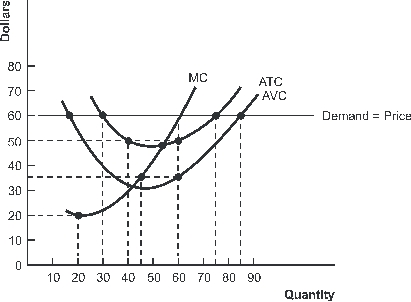 -Refer to Figure 5.1. At the profit-maximizing output, the firm's total costs equal
 (Multiple Choice)
4.9/5 (85)
(85) Like a perfectly competitive firm, a monopoly will maximize total profits by operating where marginal revenue equals marginal cost, provided that price exceeds average variable cost.
(True/False)
4.9/5 (87)
(87) The short-run supply curve of a perfectly competitive firm is the segment of its marginal cost curve that lies above the average total cost curve.
(True/False)
4.7/5 (89)
(89) Figure 5.2 Cost and Demand Conditions of a Monopolist
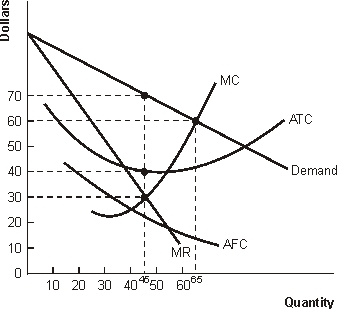 -Refer to Figure 5.2. At the profit-maximizing output, the monopolist's total revenue equals
 (Multiple Choice)
5.0/5 (72)
(72) All firms in all market structures produce where price equals marginal cost.
(True/False)
4.8/5 (72)
(72) The shut-down rule tells us that a firm will shut down in the short run when
(Multiple Choice)
4.8/5 (82)
(82) If economic profits are being realized in a perfectly competitive industry, some firms will enter. This will shift the industry
(Multiple Choice)
5.0/5 (70)
(70) Which of these markets best represents a perfectly competitive market?
(Multiple Choice)
4.9/5 (74)
(74) A perfectly competitive market is characterized by insignificant barriers to entry or exit, many sellers and buyers, a standardized product produced by firms in the market, and perfect information among sellers and buyers.
(True/False)
4.9/5 (87)
(87) At the point of long-run equilibrium for a perfectly competitive firm, price
(Multiple Choice)
4.8/5 (75)
(75) Alcoa was able to monopolize the U.S. aluminum industry from the early 1990s to the end of World War II because it
(Multiple Choice)
4.9/5 (89)
(89) If marginal cost exceeds marginal revenue for a perfectly competitive firm, it can maximize total profits by
(Multiple Choice)
4.8/5 (73)
(73) A perfectly competitive firm will maximize total profit when
(Multiple Choice)
4.9/5 (77)
(77) If a monopolist produces at that output level where marginal revenue exceeds marginal cost, to maximize profits the firm should
(Multiple Choice)
4.8/5 (82)
(82) All of the following are characteristics of a perfectly competitive market except
(Multiple Choice)
4.9/5 (71)
(71) A perfectly competitive firm differs from a monopoly in that the perfectly competitive firm's demand curve and marginal revenue curve are downward sloping rather than horizontal.
(True/False)
5.0/5 (74)
(74) 
Filters
- Essay(0)
- Multiple Choice(0)
- Short Answer(0)
- True False(0)
- Matching(0)