



 Chat with AI
Exam 13: Fiscal Policy and the Federal Budget

Exam 1: Scarcity and Choice78 Questions
Exam 2: Market Transactions: Demand and Supply Analysis93 Questions
Exam 3: Demand and Supply Applications92 Questions
Exam 4: Production and the Costs of Production77 Questions
Exam 5: Competition and Monopoly: Virtues and Vices92 Questions
Exam 6: Imperfect Competition90 Questions
Exam 7: Labor Markets86 Questions
Exam 8: Government and Markets89 Questions
Exam 9: The Mixed Economy of the United States80 Questions
Exam 10: Gross Domestic Product and Economic Growth87 Questions
Exam 11: The Business Cycle, Unemployment, and Inflation87 Questions
Exam 12: Macroeconomic Instability: Aggregate Demand and Aggregate Supply78 Questions
Exam 13: Fiscal Policy and the Federal Budget90 Questions
Exam 14: Money and the Banking System92 Questions
Exam 15: The Federal Reserve and Monetary Policy84 Questions
Exam 16: The United States and the Global Economy84 Questions
Exam 17: International Finance70 Questions
Exam 18: Economic Systems and Developing Countries76 Questions
Select questions type


Suppose the economy is in a recession and that the marginal propensity to consume is 0.75. Assuming that the price level is constant, by how much would the government have to increase its expenditures in order to increase real output by $200 billion?
(Multiple Choice)
4.7/5  (81)
(81) According to supply-side economists, the U.S. tax system tends to
(Multiple Choice)
4.7/5 (81)
(81) The Comprehensive Employment and Training Act provided public service jobs for unemployed workers and young people in the
(Multiple Choice)
4.9/5 (85)
(85) Figure 13.1 Aggregate Supply and Aggregate Demand
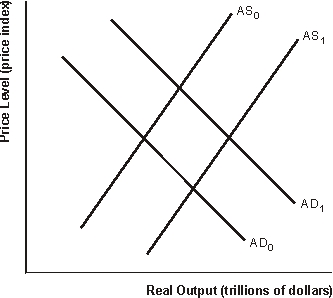 -Refer to Figure 13.1. A correct discretionary fiscal policy to enact when the economy is experiencing inflation is to
 (Multiple Choice)
5.0/5 (71)
(71) Which of the following is not true for the crowding-out effect?
(Multiple Choice)
4.7/5 (77)
(77) Figure 13.1 Aggregate Supply and Aggregate Demand
-Refer to Figure 13.1 The goal of a supply-side tax cut is to shift
-Refer to Figure 13.1 The goal of a supply-side tax cut is to shift (Multiple Choice)
4.7/5 (87)
(87) Figure 13.1 Aggregate Supply and Aggregate Demand
-Refer to Figure 13.1. A supply-side tax cut will be inflationary if when taxes decrease,
-Refer to Figure 13.1. A supply-side tax cut will be inflationary if when taxes decrease, (Multiple Choice)
4.9/5 (80)
(80) When government spending exceeds tax revenues during a given year, a budget deficit occurs, which the government finances by issuing securities such as Treasury bills, notes, and bonds.
(True/False)
4.9/5 (72)
(72) Economic theory suggests that a decrease in marginal tax rates will encourage individuals to substitute leisure for work and consumption for saving.
(True/False)
5.0/5 (88)
(88) Economists generally agree that the expanding economy of the early 200's can be attibuted to what economic policies?
(Multiple Choice)
4.7/5 (74)
(74) According to supply-side economists, a policy that ______ will cause productivity to increase, which shifts the aggregate supply curve to the right.
(Multiple Choice)
5.0/5 (76)
(76) To combat demand-pull inflation, fiscal policy would cut government expenditures and/or raise taxes, which causes the government's budget to move into a deficit.
(True/False)
4.9/5 (79)
(79) Among the problems facing fiscal policy are timing lags, irreversibility, deflationary bias, and the crowding-out effect.
(True/False)
4.8/5 (83)
(83) If the federal government implements public-works projects to combat downturns in the economy, this would be an example of
(Multiple Choice)
4.8/5 (88)
(88) The cumulative amount of outstanding government borrowing from the public is called
(Multiple Choice)
4.8/5 (82)
(82) A contractionary fiscal policy would most likely be adopted whne the economiy is experiencing high inflation.
(True/False)
4.8/5 (70)
(70) When in the Clinton years unemployment insurance was shortened to under 6 months
(Multiple Choice)
4.8/5 (87)
(87) 
Filters
- Essay(0)
- Multiple Choice(0)
- Short Answer(0)
- True False(0)
- Matching(0)