



 Chat with AI
Exam 13: Fiscal Policy and the Federal Budget

Exam 1: Scarcity and Choice78 Questions
Exam 2: Market Transactions: Demand and Supply Analysis93 Questions
Exam 3: Demand and Supply Applications92 Questions
Exam 4: Production and the Costs of Production77 Questions
Exam 5: Competition and Monopoly: Virtues and Vices92 Questions
Exam 6: Imperfect Competition90 Questions
Exam 7: Labor Markets86 Questions
Exam 8: Government and Markets89 Questions
Exam 9: The Mixed Economy of the United States80 Questions
Exam 10: Gross Domestic Product and Economic Growth87 Questions
Exam 11: The Business Cycle, Unemployment, and Inflation87 Questions
Exam 12: Macroeconomic Instability: Aggregate Demand and Aggregate Supply78 Questions
Exam 13: Fiscal Policy and the Federal Budget90 Questions
Exam 14: Money and the Banking System92 Questions
Exam 15: The Federal Reserve and Monetary Policy84 Questions
Exam 16: The United States and the Global Economy84 Questions
Exam 17: International Finance70 Questions
Exam 18: Economic Systems and Developing Countries76 Questions
Select questions type


To combat a recession, discretionary policy could result in a(n)
(Multiple Choice)
4.9/5  (88)
(88) According to the crowding-out effect, an increase in government spending will result in inflation, which reduces the purchasing power of the dollar and decreases investment spending.
(True/False)
4.9/5 (85)
(85) According to the concept of automatic stabilizers, tax receipts automatically increase and transfer payments automatically decrease during economic prosperity, thus slowing the growth of aggregate demand and controlling upward pressure on the price level when the economy is expanding.
(True/False)
4.9/5 (75)
(75) Suppose the economy is in a recession and that the marginal propensity to consume is 0.8. Assuming that the price level is constant, by how much would government have to decrease household taxes in order to increase real output by $200 billion?
(Multiple Choice)
4.8/5 (83)
(83) According to the Laffer Curve, when taxes are increased from 0 percent to a rate consistent with the maximum point on the curve, tax revenues will
(Multiple Choice)
4.7/5 (81)
(81) As national income increases, tax revenues increase and transfer payments decrease.
(True/False)
4.9/5 (85)
(85) Proponents of a balanced budget amendment believe this is needed because they feel
(Multiple Choice)
4.9/5 (78)
(78) Which combination of fiscal policies would have the greatest expansionary effect on the economy?
(Multiple Choice)
4.7/5 (76)
(76) Unlike discretionary fiscal policy, automatic stabilizers consist of
(Multiple Choice)
4.9/5 (78)
(78) Assume that the economy's marginal propensity to consume is 0.75 and that the price level is constant. If the government decreases household taxes by $100 billion, real output will increase by $300 billion.
(True/False)
4.8/5 (79)
(79) ______ is the use of government expenditures and taxes to promote full employment, stable prices, and economic growth.
(Multiple Choice)
4.8/5 (98)
(98) According to supply-side economists, a reduction in marginal tax rates causes take-home pay to increase, which increases consumption spending and the aggregate supply curve.
(True/False)
4.9/5 (80)
(80) Figure 13.1 Aggregate Supply and Aggregate Demand
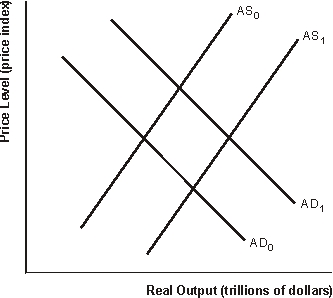 -Refer to Figure 13.1. Increased government spending, as a discretionary fiscal policy, would shift
 (Multiple Choice)
4.8/5 (85)
(85) Food stamps, unemployment compensation benefits, the federal personal income tax, and federal construction expenditures are automatic stabilizers.
(True/False)
4.7/5 (72)
(72) If the aggregate supply curve is horizontal, an expansionary fiscal policy will result in increased output, along with
(Multiple Choice)
4.7/5 (73)
(73) Discretionary fiscal policy is the deliberate use of changes in government expenditures and taxation to affect aggregate demand and influence the economy's performance in the short run.
(True/False)
4.8/5 (64)
(64) The crowding-out effect and the foreign-trade effect enhance the ability of fiscal policy to combat recession.
(True/False)
4.9/5 (85)
(85) 
Filters
- Essay(0)
- Multiple Choice(0)
- Short Answer(0)
- True False(0)
- Matching(0)