



 Chat with AI
Exam 2: Some Research Definitions


The group of people who are actually measured in a research study is called a population

 (89)
 Verified
False
Gender is an example of a continuous variable.
(87) VerifiedFalse
Illustrate the difference between a population and a sample.
(83)  Answered by Examlex AI Copilot
A population and a sample are two fundamental concepts in statistics and research that are used to draw conclusions about a group of subjects or items.
A population refers to the entire group of individuals or items that you are interested in studying. This could be the entire group of people in a country, all the trees in a forest, or all the transactions made by a company. The population is the complete set that includes all possible subjects that fit a particular set of specifications. When we talk about a population in statistics, we are often interested in measuring certain characteristics or parameters of this group, such as the average height of all adults in a city or the prevalence of a disease in a country.
A sample, on the other hand, is a subset of the population that is selected for the actual study. It is a smaller group, chosen from the population, that is used to represent the larger group. The sample should be representative of the population, meaning that it should reflect the characteristics of the population as closely as possible. This allows researchers to make inferences about the population based on the findings from the sample. For example, a researcher might select a sample of 1,000 adults from a city to estimate the average height of all adults in that city.
The main difference between a population and a sample is the scope. The population is the whole, while the sample is a part of that whole. Here are some key points that illustrate the differences:
1. Size: A population is typically much larger than a sample. In many cases, it is impractical or impossible to study the entire population due to constraints of time, cost, or accessibility.
2. Accessibility: Populations can be difficult or impossible to measure in their entirety, whereas samples are selected specifically because they can be measured and analyzed.
3. Purpose: The purpose of a sample is to gather data that can be generalized to the population. Researchers use statistical methods to ensure that the sample is as representative as possible so that the conclusions drawn from the sample can be applied to the population.
4. Variability: Since a sample is only a part of the population, there is a chance that it may not capture all the variability present in the population. This is known as sampling error. Researchers use various sampling techniques and larger sample sizes to minimize this error.
5. Parameters vs. Statistics: When we measure something in a population, we call it a parameter. When we measure something in a sample, we call it a statistic. Parameters are fixed and unknown values, while statistics are known values calculated from the sample and used to estimate the parameters.
In summary, a population is the entire group of interest, while a sample is a smaller group chosen from the population to represent it. Researchers analyze samples to make inferences about populations because it is often impractical to study every individual or item in the population.
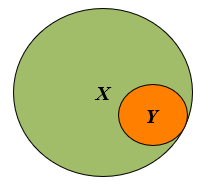 -In the figure alongside, X represents?
In research terminology, universe and population are two different concepts.
(69) Give an example of a continuous variable and a discrete variable.
(72) The group of people who actually are measured by the survey is called a __________.
(78) In an experiment the group for which things are held constant or unchanged is called
(86) Variables that are observed or measured in an experiment are referred to as __________.
(74) What is the difference between a hypothesis and a research question?
(71) Variables measured at nominal level are always discrete variables.
(74) The experimental group where things are held constant or unchanged in called the control group.
(71) The difference between a hypothesis and a research question is that hypotheses predict an outcome whereas research questions cannot
(81) The __________ asserts that the statistical differences (or relationship) being analyzed are due to chance or random error.
(91) 
Filters
- Essay(0)
- Multiple Choice(0)
- Short Answer(0)
- True False(0)
- Matching(0)