



 Chat with AI
Exam 4: Learning Words

Exam 1: Origins of Human Language50 Questions
Exam 2: Language and the Brain41 Questions
Exam 3: Learning Sound Patterns46 Questions
Exam 4: Learning Words53 Questions
Exam 5: Learning the Structure of Sentences45 Questions
Exam 6: Speech Perception40 Questions
Exam 7: Word Recognition43 Questions
Exam 8: Understanding Sentence Structure and Meaning46 Questions
Select questions type


Due to lack of experience with specific objects or situations, babies may refer to objects using subordinate-level categories such as
(Multiple Choice)
4.7/5  (73)
(73) _______ are sentence frames that help identify the number of objects or participants involved in the event or situation described by a sentence.
(Multiple Choice)
4.8/5 (75)
(75) How would you describe and explain the relationship between phonemes, morphemes, and affixes, using the word cat as an example?
(Essay)
4.8/5 (69)
(69) With respect to word mapping, high-functioning children diagnosed with Autism Spectrum Disorder (ASD) have
(Multiple Choice)
4.8/5 (71)
(71) After reading the findings of Xu and Carey (1996), you decide to test 9-month-old Charlie, whom you regularly babysit. First you bring a toy horse from behind a screen then hide it again, and then you bring a drum from behind the screen then hide it again. When you remove the screen that hid the toys, Charlie will be surprised if
(Multiple Choice)
4.8/5 (79)
(79) Which situation would be most likely to lead a young child to conclude that the word ball can be interpreted as a new basic-level category? During a study, the researcher uses the word ball to refer to
(Multiple Choice)
5.0/5 (79)
(79) If a child hears an adult say "bear" and point at a basketball several times, the child would
(Multiple Choice)
4.9/5 (76)
(76) Refer to the figure, in which the blue bars represent "same" trials and the red bars represent "switch" trials.
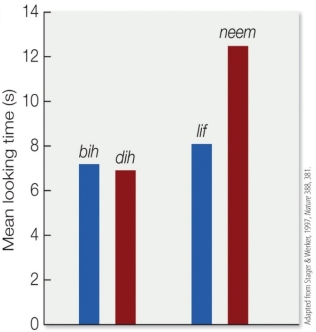 What is the best interpretation of Stager and Werker's 1997 data, represented by the four bars in the graph?
 (Multiple Choice)
4.9/5 (85)
(85) Based on the research in Chapter 5, how would you go about making sure that a 9-month-old child learns the names of objects that are made up of several parts (e.g., box for a box with a bottom and a lid, flute for a flute whose parts screw together, pen for a pen with a cap). Specifically, how would the child avoid thinking that words like box or pen refer to just the lid or the cap?
(Essay)
4.8/5 (68)
(68) Based on the research of Kellman and Spelke (1983), which scenario would be most likely?
(Multiple Choice)
4.7/5 (87)
(87) Based on the outcome of Hart and Risley's 1995 study, which conclusion is not valid?
(Multiple Choice)
5.0/5 (66)
(66) Defend the argument that babies are able to recognize that components of objects are related to a whole by citing empirical evidence described in the chapter.
(Essay)
4.8/5 (73)
(73) Defend the statement: "Associative learning does not entirely explain how children map words onto objects." Provide an example of empirical evidence in your argument.
(Essay)
4.9/5 (79)
(79) 
Filters
- Essay(0)
- Multiple Choice(0)
- Short Answer(0)
- True False(0)
- Matching(0)