



 Chat with AI
Exam 4: Learning Words

Exam 1: Origins of Human Language50 Questions
Exam 2: Language and the Brain41 Questions
Exam 3: Learning Sound Patterns46 Questions
Exam 4: Learning Words53 Questions
Exam 5: Learning the Structure of Sentences45 Questions
Exam 6: Speech Perception40 Questions
Exam 7: Word Recognition43 Questions
Exam 8: Understanding Sentence Structure and Meaning46 Questions
Select questions type


If you were a researcher testing a 12-month-old, which of the following would you expect the child to be able to recognize as a whole object?

Free
(Multiple Choice)
4.9/5  (74)
(74) Correct Answer: Verified
C
Explain the difference between linguistic input and linguistic intake. How might this difference influence a child's language development?
Free
(Essay)
4.8/5 (80)
(80) Correct Answer:Verified
VerifiedLinguistic input is all the information that a child is exposed to, whereas her linguistic intake is the information that she actually interprets correctly. We do not know the full extent of a child's intake based on the input she receives. If there is a large gap between the input and intake, the child's ability to learn from certain types of sentences may be severely hindered.
Which example indicates that a child has assigned an object to a superordinate level category?
Free
(Multiple Choice)
4.8/5 (83)
(83) Correct Answer:Verified
VerifiedD
Research on the linguistic interactions between robots and young children would predict that Sonny, an 18-month-old, would
(Multiple Choice)
4.7/5 (78)
(78) Why do we treat pastry chef as a single word unit, even though it appears to be composed of the two words pastry and chef, separated by a space? Explain your answer by comparing it to the word chef, which is very obviously a single word.
(Essay)
4.8/5 (70)
(70) In terms of babies' category formation, an example of over-extension would be
(Multiple Choice)
4.7/5 (76)
(76) Did Jean Berko Gleason's famous 1958 study, using bluebird-like creatures called wugs, show that young children are able to generalize rules of grammar to novel words? Why or why not? Support your answer.
(Essay)
4.8/5 (63)
(63) Baldwin et al. (1996) used auditory paired association to investigate children's word mapping. In their study the researchers played a word through a loudspeaker while the child played with a toy. What do the results of the study tell us about how children learn the names of objects?
(Essay)
4.8/5 (81)
(81) Gillette et al. (1999) exposed college students to several silent videos with a beep in the middle. What were their key findings? How does nonlinguistic context interact with spoken verbs? What does this research imply about the information we use to learn verbs?
(Essay)
4.7/5 (78)
(78) Based on a study of speaker intent (Baron-Cohen, Baldwin, & Crowson, 1997), a child with Autism Spectrum Disorder (ASD) would have a difficult time mapping meaning onto an object if
(Multiple Choice)
4.8/5 (89)
(89) What occurs when a baby has become habituated to an auditory stimulus?
(Multiple Choice)
4.8/5 (74)
(74) Rumelhart and McClelland's 1986 connectionist model would suggest that the best way to teach a young child the proper forms of regular and irregular verbs would be
(Multiple Choice)
4.8/5 (76)
(76) If 2-month-old infants can assign objects to different categories without knowing those objects' names, then you would predict that at this age, an infant would
(Multiple Choice)
4.8/5 (89)
(89) A child growing up in a bilingual Spanish/English environment
(Multiple Choice)
4.9/5 (66)
(66) Describe how the switch task is used to evaluate how babies map meaning onto the sounds contained in their language and what it tells us about infants' long-term memory storage.
(Essay)
4.8/5 (84)
(84) Refer to the images shown.
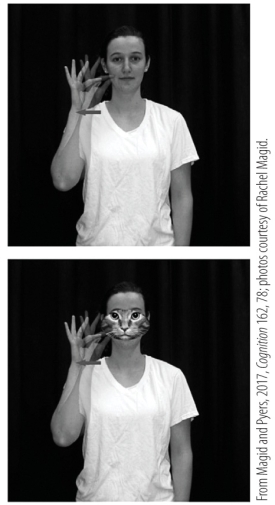 This ASL sign for cat illustrates the concept of
 (Multiple Choice)
4.9/5 (74)
(74) Refer to the figure.
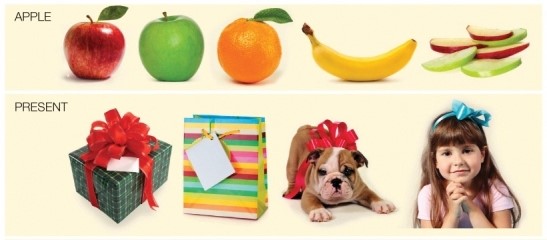 For each set of images, describe some of the challenges that children are faced with in deciding which features to use to form an understanding of which objects the names apple and present apply to.
 (Essay)
4.8/5 (83)
(83) 
Filters
- Essay(0)
- Multiple Choice(0)
- Short Answer(0)
- True False(0)
- Matching(0)