



 Chat with AI
Exam 4: Learning Words

Exam 1: Origins of Human Language50 Questions
Exam 2: Language and the Brain41 Questions
Exam 3: Learning Sound Patterns46 Questions
Exam 4: Learning Words53 Questions
Exam 5: Learning the Structure of Sentences45 Questions
Exam 6: Speech Perception40 Questions
Exam 7: Word Recognition43 Questions
Exam 8: Understanding Sentence Structure and Meaning46 Questions
Select questions type


Refer to the figure shown. The blue bar represents the "same" trial and the red bar represents the "switch" trial.
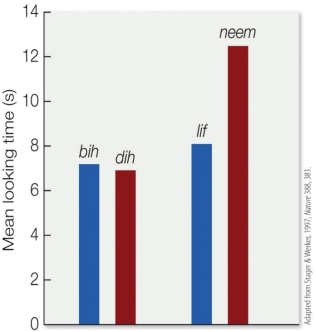 The figure refers to the Stager and Werker's 1997 study, in which researchers used the switch task with children 14 months or older. What does the bar graph suggest about children's ability to associate meaning with auditory stimuli?
 (Essay)
4.9/5  (74)
(74) Based on Baldwin and colleagues 1993 and 1996 studies on associative learning in very young children, in which scenario would a child be most likely to learn that a round object is a ball?
(Multiple Choice)
4.8/5 (72)
(72) Some words, like the Czech word lítost, have extremely abstract and subtle meanings. What is the most likely explanation for how children are able to learn such words?
(Multiple Choice)
4.9/5 (76)
(76) Based on the results of Hart and Risley's 1995 study about the number of words children hear on average per hour, describe the ideal conditions for a child's vocabulary and linguistic development and why that matters.
(Essay)
4.8/5 (83)
(83) When children begin to learn about word-object relationships, they usually learn this information when their parents
(Multiple Choice)
4.9/5 (84)
(84) Based on the results of Stager and Werker's 1997 study, which two words would a 14-month-old child be most likely to understand as having two different meanings?
(Multiple Choice)
4.8/5 (86)
(86) Evidence for similarity between adults' and children's lexical representation for sound and meaning is supported by White et al.'s 2013 study, using an artificial language, where
(Multiple Choice)
4.9/5 (72)
(72) According to the concept of contingency, you can enhance the quality of input received by a child by
(Multiple Choice)
4.9/5 (80)
(80) Derivational affixes help us transform categories of words; which addition is an example of such a transformation?
(Multiple Choice)
4.8/5 (66)
(66) How does Rumelhart and McClelland's 1986 connectionist model attempt to explain how children learn the proper forms of both regular and irregular verbs?
(Essay)
4.7/5 (74)
(74) _______ describes what happens over time when a specialized word, for example a brand name, becomes a commonplace and universal term for a category of things, such as using Band-Aid to describe a sticky, plastic wound covering.
(Multiple Choice)
4.8/5 (77)
(77) Which one of these might be considered a feature of referential transparency?
(Multiple Choice)
4.9/5 (93)
(93) Which example does not support the mutual exclusivity bias?
(Multiple Choice)
4.8/5 (90)
(90) Jean Berko Gleason's 1958 study is hailed as a pivotal investigation into children's word-form use. Based on her results, what prediction would you make about how complex word forms are learned by children of the same age as those in the study?
(Multiple Choice)
4.8/5 (80)
(80) Which of the following is the best example of a basic-level category?
(Multiple Choice)
4.9/5 (72)
(72) A child who, at an early age, used irregular verb forms correctly (using grow and its past tense grew) suddenly began using growed instead of grew. This child
(Multiple Choice)
4.9/5 (72)
(72) Human natural languages seem to follow a duality of patterning, meaning that
(Multiple Choice)
4.9/5 (79)
(79) As a neurolinguist, you would predict that a patient with Alzheimer's disease would have more trouble retrieving the past-tense verb _______ than would a patient suffering from Parkinson's disease.
(Multiple Choice)
4.7/5 (77)
(77) Which training technique would best help Timmy, a 12-month-old, to associate the word puzzle with a collection of puzzle pieces as well as the completed puzzle?
(Multiple Choice)
4.8/5 (76)
(76) 
Filters
- Essay(0)
- Multiple Choice(0)
- Short Answer(0)
- True False(0)
- Matching(0)