



 Chat with AI
Exam 7: Word Recognition


What prediction would the cohort model make about the activation of the word weaver when subjects hear the word cleaver? What prediction would the TRACE model make in the same scenario? Explain the mechanisms behind each model's predictions.

 (93)
 Verified
The cohort model predicts that weaver will be no more activated than an unrelated word that has no sound overlap at all with cleaver, such as tablet. This is because the cohort model states that activation is limited to words that have the same onset as the word being spoken. For example, upon hearing the first phoneme in cleaver, only words beginning with that phoneme (e.g., car, kiss, clover, cleats, etc.) will become activated; upon hearing the second phoneme, only words beginning with the same two phonemes will be activated (e.g., clover, cleats, etc.) and so on. In contrast, the TRACE model predicts that weaver will be activated to a greater degree than tablet upon hearing the word cleaver. This is because the TRACE model predicts activation to increase for any word that overlaps substantially with the word being spoken, regardless of whether this overlap occurs at the beginning, middle, or end of the word.
You are running a study similar to Duffy et al.'s 1988 experiment. You will present participants with the following sentence: The advisory _______ met once per week. The blank will be filled with either cabinet or group. Which word will take participants longer to read, and why?
(78) VerifiedD
You want to observe and measure lexical activation and describe the incremental dynamics of some process. What measurement tools might you use and why?
(84) VerifiedEye-tracking, EEG, fMRI, NIRS, etc. Each of the measurements will include some description emphasizing that there is better temporal resolution than other behavioral methods.
If you were to redesign the orthography of the English language to better correspond to pronunciation, what aspects would you change, and what challenges to a uniform pronunciation would you encounter?
(82) Using the lexical decision task, design an experiment to compare the effects of form versus semantic priming on word activation. Include the expected results in your answer.
(72) Yee and Sedivy's 2006 study used the eye-tracking technique to investigate auditory semantic priming. Provide an example of the kind of visual display that was used, describe their findings, and briefly relate these findings to investigations of the same phenomenon using a lexical decision task.
(69) Which word pair represents the closest cohort competitors of the word sandwich?
(85) Which of the following is not a reason the English language's system of spelling is very loosely connected to pronunciation?
(80) Describe how both excitatory and inhibitory connections can contribute to the process of recognizing the word stove.
(76) Consider the Berger and Fitzsimons (2008) study in which photographs of dogs were presented to people, after which they felt more positively about products with the Puma brand name. This is presumably because the semantic relationship between dogs and pumas made the brand name feel more familiar, a factor that is known to promote positive attitudes. Design an experiment involving brand names to further explore the link between familiarity and attitudes, but focus on familiarity related to the sounds of brand names rather than their meanings. Be sure to include examples of key stimuli and appropriate controls, and to specify which conditions you are comparing and the results you expect.
(78) Refer to the figure.
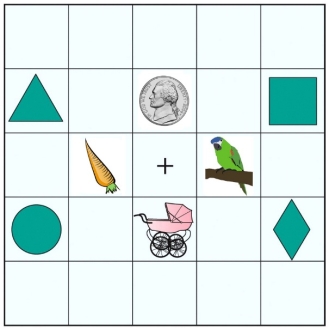 You are carrying out an eye-tracking experiment using this display, similar to one used in Allopenna et al. (1998). The longer eye fixation on the parrot compared to the nickel at the prompt Pick up the carrot is best explained by the
 (69) Use the connectionist model of reading to explain how we learn to read both irregularly spelled words (such as knock and enough) and phonetically regular ones (e.g., mint and stab).
(84) Considering models of reading, the word _______ is more likely to be activated via the direct route, whereas _______ would be activated by the assembled phonology route.
(76) If participants were asked to respond by pulling a lever toward or away from them, which of the following results might happen?
(78) Which example supports the idea that semantic information about cohort competitors may be activated during incremental language processing?
(83) Are words in memory isolated abstract representations of meaning, or are they linked to perceptual memories of our experiences of the meanings of words? Support your answer with evidence from the text.
(91) How does mediated semantic priming provide support for a spreading activation model of word activation?
(81) In Spivey and Marian's 1999 study, bilingual English-Russian speakers heard instructions such as Can you hand me the marker? At the same time, the subjects were shown a set of objects that included a stamp, which is pronounced /marka/ in Russian, and a marker. The results of the study support the conclusion that
(69) 
Filters
- Essay(0)
- Multiple Choice(0)
- Short Answer(0)
- True False(0)
- Matching(0)