



 Chat with AI
Exam 5: Mechanistic Analysis

Exam 1: Introduction21 Questions
Exam 2: Experimental Aspects5 Questions
Exam 3: Data Validation12 Questions
Exam 4: Data Analysis Equivalent Electrical Circuits21 Questions
Exam 5: Mechanistic Analysis53 Questions
Exam 6: Eis Other Physical Phenomena34 Questions
Exam 8: Nonlinear Eis27 Questions
Select questions type


Consider the reaction M + M+ ++
-In the same mechanism, the charge transfer resistance (Rt) is given by

Free
(Multiple Choice)
4.9/5  (90)
(90) Correct Answer: Verified
B
Consider the reaction
M + . Frumkin isotherm is used to describe the adsorption. The kinetic parameter values are k10 = 10-9 mol cm-2 s-1, b1 = 10 V-1, g = 15, 1 = -0.5 , k20 = 10-8 mol cm-2 s-1, 2 = +0.5 and = 10-8 mol cm-2.
-In the above question, the total number of electrical elements required to model the reaction (i.e., only the Faradaic part, without considering the double-layer capacitor or solution resistance) is ____
Free
(Short Answer)
5.0/5 (83)
(83) Correct Answer:Verified
Verified3 (exact)
Consider the reaction M + M+ ++
-For the above mechanism, the number of electrical elements (including polarization resistance) required to model the Faradaic impedance is _____
Free
(Short Answer)
4.9/5 (82)
(82) Correct Answer:Verified
Verified3(exact)
Consider the reaction M + M+ ++
-If EIS is acquired for the above mechanism, the maximum number of loops that can manifest in a complex plane plot is _____
(Short Answer)
4.8/5 (86)
(86) The polarization plot of an electrochemical system is given below.
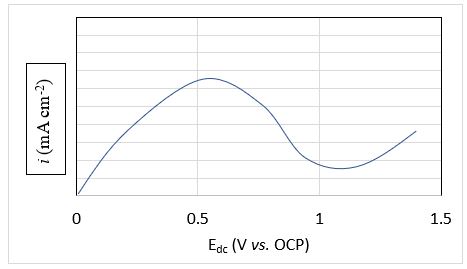 -If an impedance spectrum is acquired at Edc = 0.7 V vs. OCP, then the polarization resistance is expected to be.
 (Multiple Choice)
4.9/5 (91)
(91) Consider a reaction given by M + .
-In the same mechanism, the faradaic current is given by
(Multiple Choice)
4.7/5 (86)
(86) Consider a reaction given by M + .
-In the same mechanism, the faradaic impedance (ZF) is given by
(Multiple Choice)
4.9/5 (80)
(80) Consider the reaction + +
The kinetic parameters are given by k10 = 10-5 cm s-1, b1 = 20 V-1, k20 = 10-6 cm s-1, b2 = 20 V-1, k-20 =10-6 mol cm-2 s-1 , b-2 = -18 V-1 and = 10-8 mol cm-2. Solution species concentrations are given by [Psol] = [Qsol] =[
] = 100 mM.
-At the same potential (Edc = 0.25 V vs. OCP), the total Faradaic current is given by,
iF-dc = ______________ mA cm-2
(Short Answer)
4.8/5 (78)
(78) Consider the reaction
M + +M ++
The kinetic parameters are given by k10 = 10-9 mol cm-2 s-1, b1 = 10 V-1, k-10 = 10-8 mol cm-2 s-1, b-1 = -10 V-1, k20 = 10-8 mol cm-2 s-1, b2 = 10 V-1 and = 10-8 mol cm-2.
-At Edc = 0.1 V vs. OCP, the fractional surface coverage of Mads is given by,
ss = _________
(Short Answer)
4.9/5 (90)
(90) Consider the reaction + +
-In the same mechanism, the charge transfer resistance (Rt) is given by
(Multiple Choice)
4.8/5 (83)
(83) Consider the reaction + +
-In the same reaction, the faradaic current is given by
(Multiple Choice)
4.9/5 (83)
(83) Consider the reaction M + M+ ++
-Choose the mechanism(s), which, for appropriate values of kinetic parameters and dc potentials, can yield negative differential impedance.
(Multiple Choice)
4.8/5 (85)
(85) Consider the following mechanism.
M\rightarrow+ \rightarrow+ \rightarrow
The faradaic impedance of this system is to be modeled using the Maxwell type circuit with resistances and capacitances. Apart from polarization resistance, how many Maxwell pairs are necessary to adequately model an impedance spectrum from this system? ________
At how many potentials should EIS be acquired to eliminate the possibility of an infinite number of solutions _________
(Short Answer)
4.8/5 (78)
(78) Consider the following elementary reaction
where M is metal and
is metal ion in solution, F denotes Faraday constant. The net faradaic current density due to metal dissolution is
(Multiple Choice)
4.9/5 (76)
(76) Consider the reaction + +
-The mass balance equation for fractional surface coverage of Aads is given by
(Multiple Choice)
4.9/5 (82)
(82) Consider the reaction given by M + + .
-In the same mechanism, the value of
is given by
(Multiple Choice)
4.8/5 (70)
(70) Consider a reaction given by M + .
-In the same mechanism, the steady-state fractional surface coverage of the intermediate is given by
(Multiple Choice)
4.8/5 (74)
(74) Consider a reaction given by M + .
-In the above reaction, the rate constants are given by
where E is measured wrt equilibrium potential. Given that k10 = 10-7 mol cm-2 s-1, b1 = 20 V-1, b-1 = -18 V-1 , k2 = 10-5 mol cm-2 s-1, k-2 = 100 cm s-1 and the concentration of
as 25 mM, determine (i) k-10 = ___________ mol cm-2 s-1 . At E = 0.3 V vs. "Equilibrium. potential", (ii) value of k1dc = ___________mol cm-2 s-1, (iii) k-1dc = ___________mol cm-2 s-1, (iv) steady state fractional surface coverage of the intermediate is _______
Remember that 1 M = 1 mol/lit = 10-3 mol/ cm3.
(Short Answer)
4.9/5 (91)
(91) The polarization plot of an electrochemical system is given below. An impedance spectrum is acquired at some dc bias and shows hidden negative impedance. 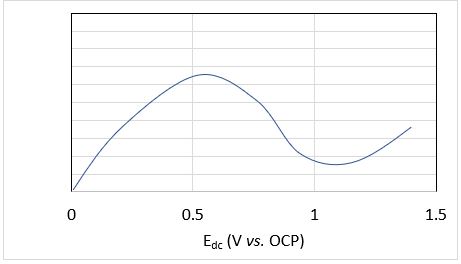 The dc bias at which the spectrum was acquired could be
 (Multiple Choice)
4.8/5 (79)
(79) 
Filters
- Essay(0)
- Multiple Choice(0)
- Short Answer(0)
- True False(0)
- Matching(0)