



 Chat with AI
Exam 1: Introduction

Exam 1: Introduction21 Questions
Exam 2: Experimental Aspects5 Questions
Exam 3: Data Validation12 Questions
Exam 4: Data Analysis Equivalent Electrical Circuits21 Questions
Exam 5: Mechanistic Analysis53 Questions
Exam 6: Eis Other Physical Phenomena34 Questions
Exam 8: Nonlinear Eis27 Questions
Select questions type


Given
, if a sinusoidal potential of angular frequency ( ) is applied, then the admittance of a capacitor with capacitance (C Farad) is given in complex notation as

Free
(Multiple Choice)
4.9/5  (64)
(64) Correct Answer: Verified
C
Consider three resistors, R1 = 150 , R2 = 200 and R3 = 250 . When they are connected in series, the net impedance is (i)__________ and when they are connected in parallel, the net impedance is (ii)___________
Free
(Short Answer)
4.9/5 (87)
(87) Correct Answer:Verified
Verified600 (exact), 63.8 (from 62 to 66)
The impedance of an ideal inductor will have a phase of
Free
(Multiple Choice)
4.8/5 (69)
(69) Correct Answer:Verified
VerifiedC
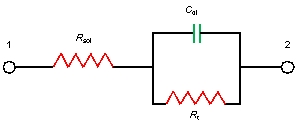
Using the circuit given below, calculate the impedance at a frequency of 10-5 Hz. Here, Rsol = 10 , Rt = 100 , Cdl = 10 F. Round the impedance values to one decimal. ZRe = (i) __________ and ZIm = (ii) ___________ .
(Short Answer)
4.8/5 (86)
(86) For an ideal reference electrode, the impedance should be very large.
(True/False)
4.9/5 (78)
(78) In the potentiodynamic polarization data of a simple electron transfer reaction (Fig. below), region (II) is 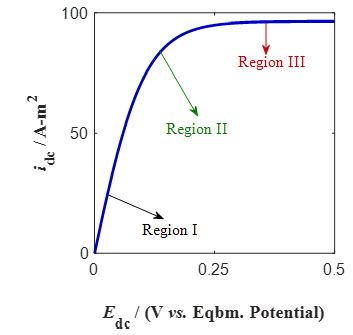
(Multiple Choice)
4.8/5 (83)
(83) When the concentration of ions in solution is very low, (< 1 mM) Helmholtz model offers a better description of the double layer capacitor.
(True/False)
4.8/5 (71)
(71) Given
, if a sinusoidal potential of angular frequency ( ) is applied, then the impedance of an inductor with an inductance (L Henry) is given in complex notation as
(Multiple Choice)
4.8/5 (86)
(86) In an electrochemical reaction, the change in Gibbs free energy ( G) is related to the potential drop across the electrode-electrolyte interface
(Multiple Choice)
4.8/5 (60)
(60) If a metal, such as Cu, is used as a working electrode, and another piece of the same metal is used as a reference electrode, then any potential applied is evenly divided between the working and reference electrode.
(True/False)
4.9/5 (84)
(84) Consider an electrical circuit shown below.
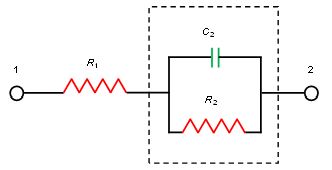 For a given value of R1, R2, and C2, the impedance at a wide range of frequencies can be calculated and plotted as a complex plane plot and Bode plots. If the capacitance C2 is changed,
 (Multiple Choice)
4.9/5 (77)
(77) A three-electrode system is used in lab experiments so that
(Multiple Choice)
4.9/5 (80)
(80) For a capacitor with a certain capacitance (C), the relationship between current(i) and potential (E) in time (t) domain is given by
(Multiple Choice)
4.7/5 (76)
(76) In chrono amperometry, ____________ is measured as a function of _____________
(Short Answer)
4.8/5 (94)
(94) A resistor with resistance (R) is connected in parallel with an inductor with an inductance (L). The net impedance of the circuit is given by
(Multiple Choice)
4.8/5 (85)
(85) An inductor of inductance (L) and a capacitor of capacitance (c) are connected in series. The net impedance of this circuit is
(Multiple Choice)
5.0/5 (92)
(92) As the potential is changed, the rate constant of a chemical reaction
(Multiple Choice)
4.9/5 (71)
(71) 
Filters
- Essay(0)
- Multiple Choice(0)
- Short Answer(0)
- True False(0)
- Matching(0)