



 Chat with AI
Exam 15: Liver, Gallbladder, and Biliary Tract

Exam 1: Cell Injury, Cell Death, and Adaptations9 Questions
Exam 2: Inflammation and Repair11 Questions
Exam 3: Hemodynamic Disorders, Thromboembolism, and Shock12 Questions
Exam 4: Diseases of the Immune System20 Questions
Exam 5: Neoplasia14 Questions
Exam 6: Genetic and Pediatric Diseases16 Questions
Exam 7: Environmental and Nutritional Diseases8 Questions
Exam 8: General Pathology of Infectious Diseases14 Questions
Exam 9: Blood Vessels6 Questions
Exam 10: Heart16 Questions
Exam 11: Hematopoietic and Lymphoid Systems21 Questions
Exam 12: Lung16 Questions
Exam 13: Kidney and Its Collecting System7 Questions
Exam 14: Oral Cavity and Gastrointestinal Tract22 Questions
Exam 15: Liver, Gallbladder, and Biliary Tract18 Questions
Exam 16: Pancreas4 Questions
Exam 17: Male Genital System and Lower Urinary Tract11 Questions
Exam 18: Female Genital System and Breast17 Questions
Exam 19: Endocrine System6 Questions
Exam 20: Bones, Joints, and Soft Tissue Tumors8 Questions
Exam 21: Peripheral Nerves and Muscles1 Questions
Exam 22: Central Nervous System4 Questions
Exam 23: Skin4 Questions
Select questions type


A 55-year-old man known to have drunk a half liter of gin daily for the past 15 years died due to ruptured esophageal varices and massive bleeding. At autopsy, the liver was nodular and

Free
(Multiple Choice)
5.0/5  (83)
(83) Correct Answer: Verified
D
Ascending cholangitis is most often caused by
Free
(Multiple Choice)
5.0/5 (90)
(90) Correct Answer:Verified
VerifiedC
HELLP syndrome (hemolysis, elevated liver enzymes, low platelets) occurs typically in
Free
(Multiple Choice)
4.9/5 (82)
(82) Correct Answer:Verified
VerifiedE
This liver tumor nodule, measuring 6 cm in diameter, was seen on a computerized tomography (CT) scan of a 40-year-old man. Initially, the nodule was considered to be benign, but when it became painful, the patient decided to have it removed. Histologically, it was composed of well-differentiated hepatocytes, whereas the central scar and the fibrous septa contained proliferating bile ducts. This nodule is most likely 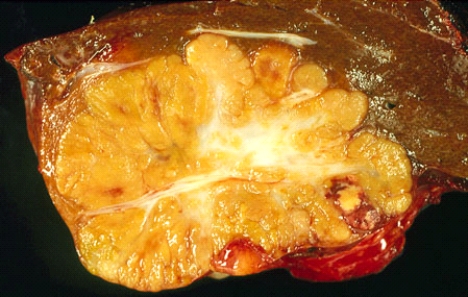
(Multiple Choice)
4.8/5 (77)
(77) Which of the following drugs causes microvesicular fatty change of the liver?
(Multiple Choice)
4.7/5 (75)
(75) These gallstones surgically removed along with the gallbladder of a 50-year-old obese woman are composed predominantly of 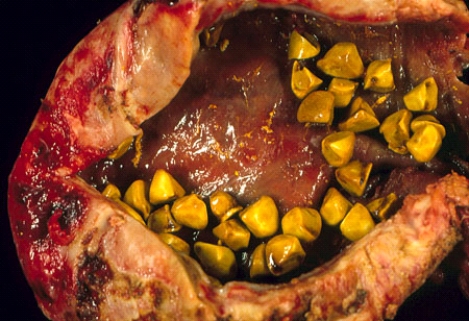
(Multiple Choice)
5.0/5 (72)
(72) Antibodies to mitochondrial dihydrolipoamide acetyltransferase are typically found in 90% of patients who have
(Multiple Choice)
4.8/5 (85)
(85) Copper accumulates in the liver in Wilson disease but stainable copper also can be seen in liver biopsies of patients who have
(Multiple Choice)
4.9/5 (69)
(69) Which of the following types of hepatocellular carcinoma occurs in young adults, is unrelated to cirrhosis, and has a much better prognosis (i.e., a 60% 5-year survival rate)?
(Multiple Choice)
4.8/5 (80)
(80) The most common cause of cirrhosis unrelated to alcohol, viral hepatitis, or metabolic diseases (i.e., the so-called "cryptogenic cirrhosis") is
(Multiple Choice)
4.8/5 (91)
(91) Transplacental infection of the fetus will most often occur in women who have been infected with which hepatotropic virus?
(Multiple Choice)
4.8/5 (80)
(80) An obese 50-year-old woman, whose height is 5 ft 4 in (160 cm) and weight is 220 lb (100 kg), decided to lose weight. She lost 45 lb (approximately 20 kg) over a period of 6 months, and then had an attack of biliary colic and required a cholecystectomy. The gallbladder stones identified by the pathologist were most likely
(Multiple Choice)
4.8/5 (85)
(85) Cryoglobulinemia is found in chronic hepatitis caused by which hepatotropic virus?
(Multiple Choice)
4.7/5 (94)
(94) A mutation of the gene encoding the hepatic enzyme bilirubin uridine diphosphate-glucuronyltransferase (UGT1A1) associated with congenital jaundice and a complete absence of UGT1A1 is called
(Multiple Choice)
4.8/5 (88)
(88) Peliosis hepatis is a form of primary hepatic sinusoidal dilatation and intrasinusoidal blood stagnation most often caused by
(Multiple Choice)
4.8/5 (78)
(78) Which genetic liver disease results from the mutation of multidrug resistance protein 2 (MRP2) and is characterized by massive accumulation of pigmentary granules in hepatocytes and dark discoloration of the liver?
(Multiple Choice)
4.8/5 (70)
(70) 
Filters
- Essay(0)
- Multiple Choice(0)
- Short Answer(0)
- True False(0)
- Matching(0)