



 Chat with AI
Exam 13: Tectonics, Earthquakes, and Volcanism

Exam 1: Essentials of Geography185 Questions
Exam 2: Solar Energy to Earth and the Seasons145 Questions
Exam 3: Earths Modern Atmosphere168 Questions
Exam 4: Atmosphere and Surface Energy Balances130 Questions
Exam 5: Global Temperatures135 Questions
Exam 6: Atmospheric and Oceanic Circulations181 Questions
Exam 7: Water and Atmospheric Moisture145 Questions
Exam 8: Weather157 Questions
Exam 9: Water Resources176 Questions
Exam 10: Global Climate Systems149 Questions
Exam 11: Climate Change141 Questions
Exam 12: The Dynamic Planet184 Questions
Exam 13: Tectonics, Earthquakes, and Volcanism169 Questions
Exam 14: Weathering, Karst Landscapes, and Mass Movement125 Questions
Exam 15: River Systems and Landforms154 Questions
Exam 16: The Oceans, Coastal Processes, and Wind Processes159 Questions
Exam 17: Glacial and Periglacial Processes and Landforms142 Questions
Exam 18: The Geography of Soils135 Questions
Exam 19: Ecosystem Essentials128 Questions
Exam 20: Terrestrial Biomes118 Questions
Select questions type


What are the different ways of measuring the intensity and/or effects of earthquakes? Which do you think is best, and why?
(Essay)
4.8/5  (87)
(87) The energy released by a magnitude 8 quake on the Richter scale is how many times greater than that of a magnitude 6 quake?
(Multiple Choice)
4.7/5 (61)
(61) 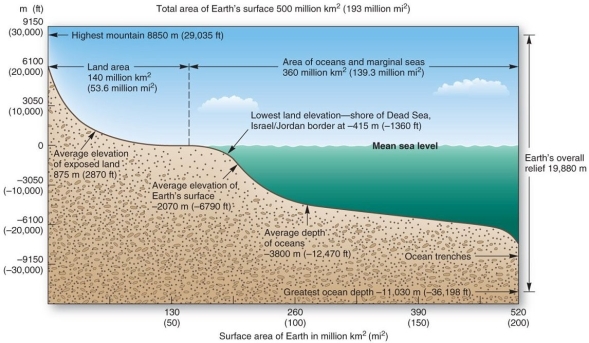 The average elevation of ocean depth is
Folded layers of rock can form a wavelike pattern of troughs and crests. The layers near the trough (i.e. downward fold) form
(Multiple Choice)
4.9/5 (82)
(82) Extensive plains are found in North and South America, Asia, and Australia.
(True/False)
4.9/5 (74)
(74) The most detailed order of relief applies to ________ order relief features.
(Multiple Choice)
4.8/5 (70)
(70) What is the expected number of an M 8.0 or Mercalli XII earthquakes per year?
(Multiple Choice)
5.0/5 (78)
(78) Draw and label a diagram of the three types of convergent plate boundaries and their typical orogenies.
(Essay)
4.9/5 (72)
(72) Compare and contrast explosive and effusive eruptions. Include their locations, the chemical composition of the magma, and the landforms they typically produce.
(Essay)
4.8/5 (86)
(86) Compressional forces associated with converging plates produce blocks that move upward relative to the footwall block; this is called a thrust or reverse fault.
(True/False)
4.8/5 (89)
(89) In a normal fault, the hanging wall drops (moves downward) relative to the footwall.
(True/False)
4.8/5 (85)
(85) 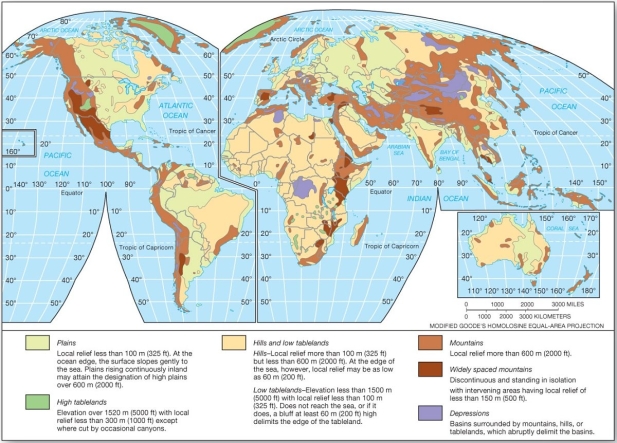 Africa is dominated by which topographic region?
Radon gas emissions and changes in the magnetic field are some of the phenomena that often occur prior to a quake.
(True/False)
4.9/5 (74)
(74) A seismic gap refers to ruptures in the land surface that result from an earthquake.
(True/False)
4.8/5 (80)
(80) Warping produces bends in rocks that are ________ those produced by folding.
(Multiple Choice)
5.0/5 (82)
(82) An orogeny is usually caused by large-scale deformation and uplift of crust.
(True/False)
5.0/5 (72)
(72) Which of the following is not one of the three types of tectonic activity that causes orogensis along convergent boundaries?
(Multiple Choice)
4.9/5 (83)
(83) 
Filters
- Essay(0)
- Multiple Choice(0)
- Short Answer(0)
- True False(0)
- Matching(0)