



 Chat with AI
Exam 5: Global Temperatures

Exam 1: Essentials of Geography185 Questions
Exam 2: Solar Energy to Earth and the Seasons145 Questions
Exam 3: Earths Modern Atmosphere168 Questions
Exam 4: Atmosphere and Surface Energy Balances130 Questions
Exam 5: Global Temperatures135 Questions
Exam 6: Atmospheric and Oceanic Circulations181 Questions
Exam 7: Water and Atmospheric Moisture145 Questions
Exam 8: Weather157 Questions
Exam 9: Water Resources176 Questions
Exam 10: Global Climate Systems149 Questions
Exam 11: Climate Change141 Questions
Exam 12: The Dynamic Planet184 Questions
Exam 13: Tectonics, Earthquakes, and Volcanism169 Questions
Exam 14: Weathering, Karst Landscapes, and Mass Movement125 Questions
Exam 15: River Systems and Landforms154 Questions
Exam 16: The Oceans, Coastal Processes, and Wind Processes159 Questions
Exam 17: Glacial and Periglacial Processes and Landforms142 Questions
Exam 18: The Geography of Soils135 Questions
Exam 19: Ecosystem Essentials128 Questions
Exam 20: Terrestrial Biomes118 Questions
Select questions type


Which of the following is incorrect regarding the differences in the heating of land and water?

Free
(Multiple Choice)
4.8/5  (76)
(76) Correct Answer: Verified
A
The largest average annual temperature ranges occur at subpolar locations within the continental of North America and Asia.
Free
(True/False)
4.8/5 (83)
(83) Correct Answer:Verified
VerifiedTrue
Discuss several ways in which global temperatures affects humans and how humans affect global temperatures.
(Essay)
4.9/5 (72)
(72) ________ is a prolonged period of abnormally high temperatures, usually in association with humid weather.
(Multiple Choice)
4.8/5 (82)
(82) 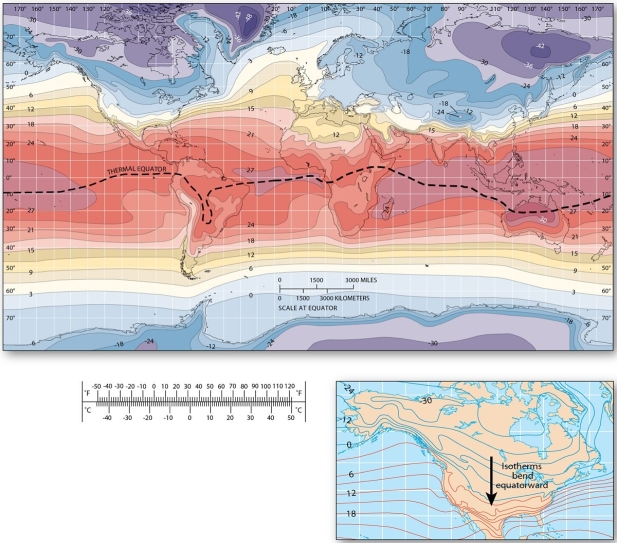 In January, the thermal equator
The last 15 years feature the warmest years in the climate record.
(True/False)
4.8/5 (81)
(81) Salvador, Brazil is located at 13° S (and at an elevation of 9 m). Based on its latitudinal position, which of the following likely best describes its temperature?
(Multiple Choice)
4.9/5 (82)
(82) As reported by the National Weather Service, the heat index
(Multiple Choice)
4.9/5 (86)
(86) On average, the illuminated zone in oceans is to a depth of ________, but in some oceans may be as deep as ________.
(Multiple Choice)
4.8/5 (71)
(71) During summer, cities located near the coast are ________ than those in the interior at the same latitude, while in the winter they are ________.
(Multiple Choice)
5.0/5 (83)
(83) The intensity of solar radiation decreases away from the equator and poleward.
(True/False)
4.9/5 (79)
(79) The subsolar point migrates annually between 47° N and 47° S latitude.
(True/False)
4.9/5 (76)
(76) The highest temperatures on Earth are associated with the intense heating in subtropical deserts.
(True/False)
4.9/5 (77)
(77) As it pertains to differences in land-water heating, transparency
(Multiple Choice)
4.7/5 (73)
(73) Present carbon dioxide levels in the atmosphere are higher now than any time in the last 800,000 years.
(True/False)
4.9/5 (86)
(86) The Southern Hemisphere is dominated by maritime influences, whereas the Northern Hemisphere is dominated by continentality.
(True/False)
4.8/5 (89)
(89) 
Filters
- Essay(0)
- Multiple Choice(0)
- Short Answer(0)
- True False(0)
- Matching(0)