



 Chat with AI
Exam 5: Global Temperatures

Exam 1: Essentials of Geography185 Questions
Exam 2: Solar Energy to Earth and the Seasons145 Questions
Exam 3: Earths Modern Atmosphere168 Questions
Exam 4: Atmosphere and Surface Energy Balances130 Questions
Exam 5: Global Temperatures135 Questions
Exam 6: Atmospheric and Oceanic Circulations181 Questions
Exam 7: Water and Atmospheric Moisture145 Questions
Exam 8: Weather157 Questions
Exam 9: Water Resources176 Questions
Exam 10: Global Climate Systems149 Questions
Exam 11: Climate Change141 Questions
Exam 12: The Dynamic Planet184 Questions
Exam 13: Tectonics, Earthquakes, and Volcanism169 Questions
Exam 14: Weathering, Karst Landscapes, and Mass Movement125 Questions
Exam 15: River Systems and Landforms154 Questions
Exam 16: The Oceans, Coastal Processes, and Wind Processes159 Questions
Exam 17: Glacial and Periglacial Processes and Landforms142 Questions
Exam 18: The Geography of Soils135 Questions
Exam 19: Ecosystem Essentials128 Questions
Exam 20: Terrestrial Biomes118 Questions
Select questions type


You would expect a tropical island to have a high degree of continentality.
(True/False)
4.8/5  (88)
(88) Official temperatures are measured using thermometers placed in shelters that are
(Multiple Choice)
4.9/5 (73)
(73) Because water has a higher specific heat than land, it cools more quickly.
(True/False)
4.8/5 (83)
(83) Which of the following is true regarding the specific heat of land and water?
(Multiple Choice)
4.7/5 (62)
(62) 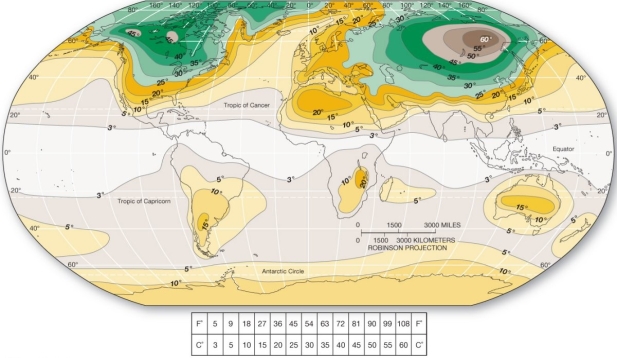 Which is true for global annual temperature ranges?
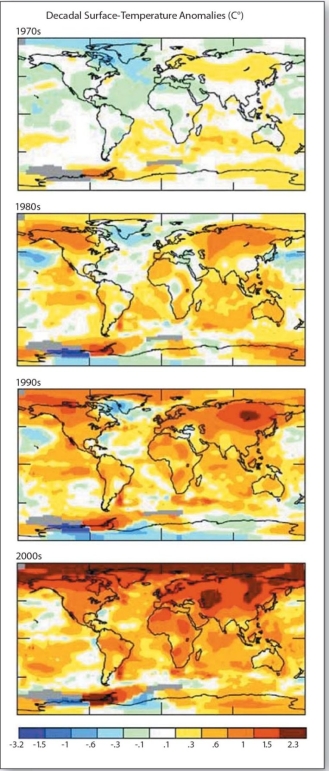 Based on the maps, which of the following is true?
Average air temperatures at higher elevations are generally higher, with smaller differences between areas of direct sunlight and shadow.
(True/False)
4.9/5 (85)
(85) Which of the following is true regarding locations at high elevations?
(Multiple Choice)
4.8/5 (81)
(81) Annual mean temperatures are rarely taken and have little utility to scientists.
(True/False)
4.8/5 (73)
(73) How does evaporation effect land-water heating differences?
(Multiple Choice)
4.9/5 (66)
(66) Elevation typically refers to ________ whereas altitude refers to ________.
(Multiple Choice)
4.8/5 (78)
(78) Strong winds and low humidity accompanying high temperatures result in higher heat index than low winds and high humidity.
(True/False)
4.9/5 (89)
(89) Temperatures are usually quite uniform and unchanging with altitude.
(True/False)
4.7/5 (87)
(87) The climate of Iceland, located at 65° N, is dictated mostly by its latitudinal position just below the Arctic Circle.
(True/False)
4.7/5 (80)
(80) 
Filters
- Essay(0)
- Multiple Choice(0)
- Short Answer(0)
- True False(0)
- Matching(0)