



 Chat with AI
Exam 5: Global Temperatures

Exam 1: Essentials of Geography185 Questions
Exam 2: Solar Energy to Earth and the Seasons145 Questions
Exam 3: Earths Modern Atmosphere168 Questions
Exam 4: Atmosphere and Surface Energy Balances130 Questions
Exam 5: Global Temperatures135 Questions
Exam 6: Atmospheric and Oceanic Circulations181 Questions
Exam 7: Water and Atmospheric Moisture145 Questions
Exam 8: Weather157 Questions
Exam 9: Water Resources176 Questions
Exam 10: Global Climate Systems149 Questions
Exam 11: Climate Change141 Questions
Exam 12: The Dynamic Planet184 Questions
Exam 13: Tectonics, Earthquakes, and Volcanism169 Questions
Exam 14: Weathering, Karst Landscapes, and Mass Movement125 Questions
Exam 15: River Systems and Landforms154 Questions
Exam 16: The Oceans, Coastal Processes, and Wind Processes159 Questions
Exam 17: Glacial and Periglacial Processes and Landforms142 Questions
Exam 18: The Geography of Soils135 Questions
Exam 19: Ecosystem Essentials128 Questions
Exam 20: Terrestrial Biomes118 Questions
Select questions type


The cool ocean currents, such as the Humboldt Current, that flow along the west coasts of continents promote ________ when conditions in these regions are warm and moist.
(Multiple Choice)
4.8/5  (81)
(81) Distinguish between temperature and heat. Then describe the important characteristics of the three main temperature scales.
(Essay)
4.9/5 (88)
(88) Surface temperature anomalies maps from the past four decades show an overall positive warming trend.
(True/False)
4.8/5 (65)
(65) On a cold, windy day, the air feels ________ because the wind ________.
(Multiple Choice)
4.9/5 (77)
(77) Areas expensing continentality, such as Verkhoyansk, Russia, can have exceptionally large annual temperature ranges (e.g. a range of 105 C° (189 F°)).
(True/False)
4.9/5 (80)
(80) 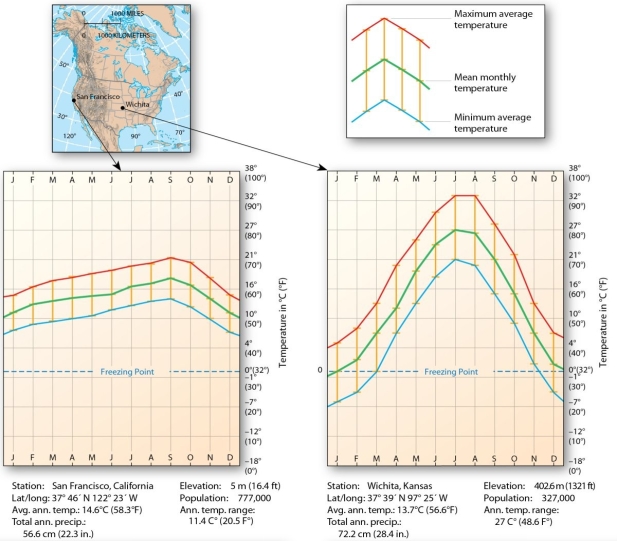 San Francisco, CA and Wichita, KS are located at approximately the same latitude. Which of the following is true?
 (Multiple Choice)
4.9/5 (81)
(81) Clouds moderate temperatures producing lower daily maximums and higher nightly minimums.
(True/False)
4.8/5 (77)
(77) Which of the following is not true of the freezing point of water?
(Multiple Choice)
4.8/5 (79)
(79) What are the various factors that can affect the apparent temperature?
(Essay)
4.8/5 (69)
(69) ________ refers to the greater range between maximum and minimum temperatures that occurs in inland areas distant from large bodies of water.
(Multiple Choice)
4.9/5 (83)
(83) Imagine two hypothetical cities, both located at 12° N latitude. However, one is located near sea level, while the other at an elevation of 4,000 m (13,123 ft) above sea level. Which of the following is likely true?
(Multiple Choice)
4.9/5 (84)
(84) The moving of currents results in the mixing of cooler and warmer waters.
(True/False)
4.9/5 (76)
(76) Which of the following U.S. cities would experience the least continentality?
(Multiple Choice)
4.8/5 (95)
(95) Most evaporation occurs over large land masses influenced by continentality.
(True/False)
4.8/5 (91)
(91) The specific heat of land is ________ than water and, therefore, land heats more ________ than water.
(Multiple Choice)
4.7/5 (76)
(76) 
Filters
- Essay(0)
- Multiple Choice(0)
- Short Answer(0)
- True False(0)
- Matching(0)