



 Chat with AI
Exam 10: Global Climate Systems

Exam 1: Essentials of Geography185 Questions
Exam 2: Solar Energy to Earth and the Seasons145 Questions
Exam 3: Earths Modern Atmosphere168 Questions
Exam 4: Atmosphere and Surface Energy Balances130 Questions
Exam 5: Global Temperatures135 Questions
Exam 6: Atmospheric and Oceanic Circulations181 Questions
Exam 7: Water and Atmospheric Moisture145 Questions
Exam 8: Weather157 Questions
Exam 9: Water Resources176 Questions
Exam 10: Global Climate Systems149 Questions
Exam 11: Climate Change141 Questions
Exam 12: The Dynamic Planet184 Questions
Exam 13: Tectonics, Earthquakes, and Volcanism169 Questions
Exam 14: Weathering, Karst Landscapes, and Mass Movement125 Questions
Exam 15: River Systems and Landforms154 Questions
Exam 16: The Oceans, Coastal Processes, and Wind Processes159 Questions
Exam 17: Glacial and Periglacial Processes and Landforms142 Questions
Exam 18: The Geography of Soils135 Questions
Exam 19: Ecosystem Essentials128 Questions
Exam 20: Terrestrial Biomes118 Questions
Select questions type


Which of the following is not true of marine west-coast climates?

Free
(Multiple Choice)
4.8/5  (83)
(83) Correct Answer: Verified
C
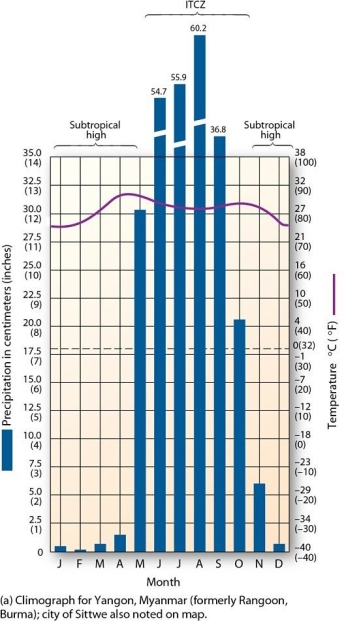 This climograph is characteristic of which climate type?
Free
(Multiple Choice)
4.9/5 (82)
(82) Correct Answer:Verified
VerifiedB
Which of the following is an element of weather and climate?
Free
(Multiple Choice)
4.8/5 (86)
(86) Correct Answer:Verified
VerifiedE
Annual temperature ranges near the southern tip of Greenland, in the Bearing Sea, northern Iceland, South Georgia Island, and northern Norway are low despite their high latitude because
(Multiple Choice)
4.9/5 (68)
(68) Tropical monsoon climates have a dry season that lasts one month or more.
(True/False)
4.8/5 (86)
(86) The largest percentage of Earth's population lives within the
(Multiple Choice)
4.9/5 (80)
(80) Which climate is characterized by the largest change in monthly average temperatures; i.e., the greatest change in temperatures from one month to the next?
(Multiple Choice)
4.8/5 (73)
(73) Marine west coast climates are unusually mild for their latitude.
(True/False)
4.8/5 (78)
(78) Humid subtropical climates experience convectional showers in the summer and frontal showers in the fall, winter and spring, creating year-round precipitation.
(True/False)
4.7/5 (77)
(77) Tropical, subtropical hot steppe climates experience seasons characterized by dry summers and somewhat wetter winters brought about by the shifting of the subtropical high.
(True/False)
4.8/5 (81)
(81) Which of the following is false regarding the tropical monsoon climate?
(Multiple Choice)
4.9/5 (75)
(75) Describe the weather components that combine to produce climate of the area in which you live.
(Essay)
4.9/5 (74)
(74) Areas dominated by maritime air masses will be relatively ________, and that those dominated by cT air masses will be relatively ________.
(Multiple Choice)
4.9/5 (77)
(77) Despite very high latitudes, polar marine climates have low annual temperature ranges due to the moderating effects of the marine environment.
(True/False)
4.9/5 (68)
(68) Which air masses influence the humid continental hot-summer climates in North America?
(Multiple Choice)
4.8/5 (88)
(88) Shifting maritime and continental air masses are a causal factor of mesothermal climates.
(True/False)
4.8/5 (74)
(74) Subarctic climate with very cold winters are common in the Southern Hemisphere.
(True/False)
4.8/5 (78)
(78) Snow melt is an important component to soil-moisture recharge in humid continental mild-summer climates.
(True/False)
4.9/5 (74)
(74) A genetic classification system can be based on, among other factors,
(Multiple Choice)
4.8/5 (75)
(75) 
Filters
- Essay(0)
- Multiple Choice(0)
- Short Answer(0)
- True False(0)
- Matching(0)