



 Chat with AI
Exam 9: Examining Populations and Samples in Research

Exam 1: Introduction to Nursing Research and Evidence-Based Practice27 Questions
Exam 2: Introduction to the Quantitative Research Process40 Questions
Exam 3: Introduction to the Qualitative Research Process45 Questions
Exam 4: Examining Ethics in Nursing Research34 Questions
Exam 5: Research Problems, Purposes, and Hypotheses40 Questions
Exam 6: Understanding the Literature Review in Published Studies34 Questions
Exam 7: Understanding Theory and Research Frameworks22 Questions
Exam 8: Clarifying Quantitative Research Designs33 Questions
Exam 9: Examining Populations and Samples in Research45 Questions
Exam 10: Clarifying Measurement and Data Collection in Quantitative Research42 Questions
Exam 11: Understanding Statistics in Research55 Questions
Exam 12: Critical Appraisal of Quantitative and Qualitative Research for Nursing Practice59 Questions
Exam 13: Building an Evidence-Based Nursing Practice19 Questions
Exam 14: Introduction to Outcomes Research23 Questions
Select questions type


Subjects who participate in a study of patients with inflammatory bowel disease are described as the:
(Multiple Choice)
4.8/5  (85)
(85) A researcher wants to obtain a sample of individuals who are HIV positive. Which of the following sampling methods would be the most effective way to obtain a sample?
(Multiple Choice)
4.9/5 (70)
(70) Which of the following study types would require the largest sample size?
(Multiple Choice)
5.0/5 (85)
(85) Which type of sampling will get the largest number of subjects in the shortest period of time?
(Multiple Choice)
4.9/5 (81)
(81) A sample that accurately reflects the characteristics of the population from which it is drawn is a:
(Multiple Choice)
4.8/5 (86)
(86) In a study investigating nurses' attitudes toward taking care of respiratory disease patients who had a long history of smoking, the researcher randomly selected a sample from a list of all the registered nurses from a randomly selected list of four states in the Southeast. Because the sample was drawn randomly, to what population can the findings of the study be generalized? Registered nurses in the:
(Multiple Choice)
5.0/5 (66)
(66) Which of the following are not correctly paired as similar types of sampling methods?
(Multiple Choice)
5.0/5 (67)
(67) Findings of an intervention study with a convenience sample:
(Multiple Choice)
4.8/5 (74)
(74) The Crohn's and Colitis Foundation of America referred the interested researcher to a local chapter of the organization. The local chapter agreed to send out letters on behalf of the researcher inviting potential subjects to contact the researcher if they are willing to participate in a study. Potential subjects in this situation would be described as the:
(Multiple Choice)
4.9/5 (68)
(68) Which of the following sets of terms represents an appropriate pairing of a probability sampling method and a corresponding nonprobability sampling one?
(Multiple Choice)
4.8/5 (74)
(74) Which of the following is an example of purposive sampling?
(Multiple Choice)
4.8/5 (81)
(81) In a study investigating nurses' attitudes toward taking care of respiratory disease patients who had a long history of smoking, the researcher randomly selected a sample from a list of all the registered nurses from a randomly selected list of four states in the Southeast. If the researcher also selected the sample by randomly selecting nurses who smoke and those who do not, what sampling technique is being used?
(Multiple Choice)
4.9/5 (77)
(77) The researcher is to select a set of five subjects using a random numbers table. The selected population is 50. The researcher's pencil was initially placed on the second column from the left and third row down. The decision is to move across the columns to the right.
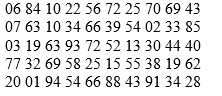 The subject numbers will be:
 (Multiple Choice)
4.8/5 (75)
(75) The population from which the researcher selects the actual study sample is referred to as the:
(Multiple Choice)
4.8/5 (72)
(72) 
Filters
- Essay(0)
- Multiple Choice(0)
- Short Answer(0)
- True False(0)
- Matching(0)