



 Chat with AI
Exam 13: Monetary Policy

Exam 1: The Wealth of Nations: Ownership and Economic Freedom87 Questions
Exam 2: Scarcity and Opportunity Costs87 Questions
Exam 3: The Market and Price System96 Questions
Exam 4: The Aggregate Economy61 Questions
Exam 5: National Income Accounting104 Questions
Exam 6: An Introduction to the Foreign Exchapterange Market and the Balance of Payments99 Questions
Exam 7: Unemployment and Inflation129 Questions
Exam 8: Macroeconomic Equilibrium: Aggregate Demand and Supply122 Questions
Exam 9: Aggregate Expenditures120 Questions
Exam 10: Income and Expenditures Equilibrium134 Questions
Exam 11: Fiscal Policy94 Questions
Exam 12: Money and Banking125 Questions
Exam 13: Monetary Policy141 Questions
Exam 14: Macroeconomic Policy: Tradeoffs, Expectations, Credibility, and Sources of Business Cycles117 Questions
Exam 15: Macroeconomic Viewpoints: New Keynesian, Monetarist, and New Classical103 Questions
Exam 16: Economic Growth95 Questions
Exam 17: Development Economics105 Questions
Exam 18: Globalization85 Questions
Exam 19: World Trade Equilibrium112 Questions
Exam 20: International Trade Restrictions109 Questions
Exam 21: Exchapterange Rates and Financial Links Between Countries132 Questions
Select questions type


If funds are being loaned from one commercial bank's excess reserves on deposit with the Federal Reserve to another commercial bank's deposit account at the Fed, the transaction is taking place in:
(Multiple Choice)
4.8/5  (79)
(79) Scenario 13.2?Assume the following conditions hold.
Now the Federal Reserve engages in an open market operation by purchasing $1 billion worth of government bonds from private bond dealers, who then deposit the $1 billion in the banks. This acts to lower the equilibrium interest rate by 2 percent.
a.At all banks, excess reserves are zero.
b.The deposit expansion multiplier is 3.
c.The spending multiplier is 5.
d.The initial equilibrium level of national income is $500 billion.
e.The initial equilibrium interest rate equals 6 percent.
f.The investment spending function is as illustrated in the figure below.
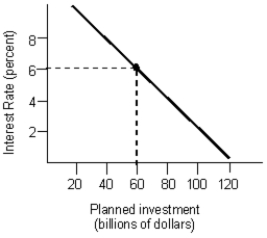 -Refer to Scenario 13.1. What is the change in investment spending following the open market operation by the Fed?
 (Multiple Choice)
4.9/5 (82)
(82) The rate of interest that the Federal Reserve charges on loans to member banks is the:
(Multiple Choice)
4.8/5 (79)
(79) The President of which of the following district banks of the Fed is perpetually present on the Federal Open Market Committee?
(Multiple Choice)
4.9/5 (71)
(71) The sale of U.S. currency and purchase of foreign currency by the Federal Reserve would shift the demand curve for U.S. dollars to the left.
(True/False)
4.7/5 (74)
(74) When the Federal Open Market Committee buys government securities:
(Multiple Choice)
4.9/5 (79)
(79) The use of domestic open market operations to counteract the effects of a foreign exchange market intervention on the domestic money supply is known as:
(Multiple Choice)
4.8/5 (84)
(84) The monetary policy decisions made by the Federal Reserve must be approved by the Congress before they are enacted.
(True/False)
4.8/5 (76)
(76) There is an inverse relationship between the interest rate and the quantity of money demanded.
(True/False)
4.8/5 (87)
(87) The table given below shows the assets and liabilities of the National Bank. Assume that this is the only bank in the economy.?
 -Refer to Table 13.2. If the reserve requirement is 10 percent, calculate the maximum amount of loanable funds available with the bank.
 (Multiple Choice)
4.9/5 (75)
(75) Which of the following statements about inflation targeting is true?
(Multiple Choice)
4.7/5 (97)
(97) The table given below shows the assets and liabilities of the National Bank. Assume that this is the only bank in the economy.?
-Refer to Table 13.2. Calculate the change in the bank's excess reserves if the reserve requirement is decreased from 10% to 5%.
-Refer to Table 13.2. Calculate the change in the bank's excess reserves if the reserve requirement is decreased from 10% to 5%. (Multiple Choice)
4.8/5 (84)
(84) If you buy for $100 a bond that pays 4.57 percent in annual interest and the current interest yield on the bond rises to 5.13 percent, then the price of the bond has fallen.
(True/False)
4.9/5 (81)
(81) The FOMC carries out its policies through directives to the bond-trading desk at the:
(Multiple Choice)
4.8/5 (68)
(68) Which of the following will be observed if the Fed raises the reserve requirement?
(Multiple Choice)
4.8/5 (74)
(74) Assume that there is an unexpected increase in the demand for U.S. dollars in Switzerland. If the foreign currency price of the U.S. dollar is fixed, the U.S. Federal Reserve must intervene in the foreign exchange market such that:
(Multiple Choice)
4.7/5 (74)
(74) The supply of the U.S. dollar on the foreign exchange market is generated by:
(Multiple Choice)
4.9/5 (86)
(86) Assume that the yen price of one U.S. dollar rises to 80 yen and that the Bank of Japan has a target exchange rate of 75 yen per dollar. As a result, the Bank of Japan will intervene in the foreign exchange market by:
(Multiple Choice)
4.9/5 (82)
(82) 
Filters
- Essay(0)
- Multiple Choice(0)
- Short Answer(0)
- True False(0)
- Matching(0)