



 Chat with AI
Exam 10: Income and Expenditures Equilibrium

Exam 1: The Wealth of Nations: Ownership and Economic Freedom87 Questions
Exam 2: Scarcity and Opportunity Costs87 Questions
Exam 3: The Market and Price System96 Questions
Exam 4: The Aggregate Economy61 Questions
Exam 5: National Income Accounting104 Questions
Exam 6: An Introduction to the Foreign Exchapterange Market and the Balance of Payments99 Questions
Exam 7: Unemployment and Inflation129 Questions
Exam 8: Macroeconomic Equilibrium: Aggregate Demand and Supply122 Questions
Exam 9: Aggregate Expenditures120 Questions
Exam 10: Income and Expenditures Equilibrium134 Questions
Exam 11: Fiscal Policy94 Questions
Exam 12: Money and Banking125 Questions
Exam 13: Monetary Policy141 Questions
Exam 14: Macroeconomic Policy: Tradeoffs, Expectations, Credibility, and Sources of Business Cycles117 Questions
Exam 15: Macroeconomic Viewpoints: New Keynesian, Monetarist, and New Classical103 Questions
Exam 16: Economic Growth95 Questions
Exam 17: Development Economics105 Questions
Exam 18: Globalization85 Questions
Exam 19: World Trade Equilibrium112 Questions
Exam 20: International Trade Restrictions109 Questions
Exam 21: Exchapterange Rates and Financial Links Between Countries132 Questions
Select questions type


The table given below reports the value of real GDP and its components consumption (C), investment (I), exports, and imports for two consecutive years in an economy.?
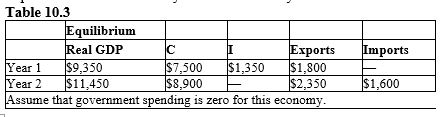 -Refer to Table 10.3. What will be the value of the spending multiplier?
Free
(Multiple Choice)
4.9/5  (84)
(84) Correct Answer: Verified
E
The figure given below represents the macroeconomic equilibrium in the aggregate income and aggregate expenditure framework. Assume that MPI is equal to zero.
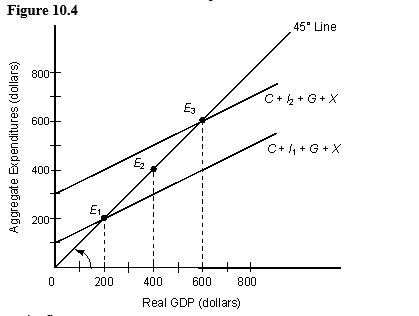 -If the spending multiplier equals 5 and equilibrium income is $2 billion below potential GDP, then _____ to reach the potential real GDP level.
Free
(Multiple Choice)
4.8/5 (84)
(84) Correct Answer:Verified
VerifiedE
Assume we are at an income level where the C+I+G+X (consumption+investment+government spending+net exports) function lies above the 45-degree line. We can conclude that at this income level:
Free
(Multiple Choice)
4.9/5 (73)
(73) Correct Answer:Verified
VerifiedE
The table given below shows the real GDP, aggregate expenditures, saving, and imports of an economy.?
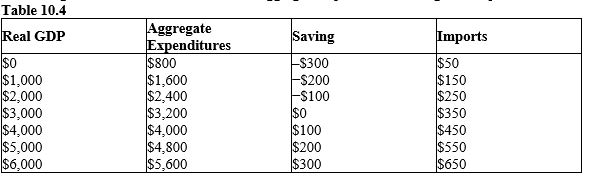 -Calculate the spending multiplier from the information given in Table 10.4.
 (Multiple Choice)
4.7/5 (89)
(89) In an economy that has no foreign trade, if real GDP declines by $160 million following a decline in investment spending of $40 million, then the marginal propensity to consume must be equal to _____.
(Multiple Choice)
4.8/5 (75)
(75) Consider an economy that is in equilibrium with real GDP = $5,000, MPS = 1/4 and MPI = 1/5. What will be the new equilibrium level of income if planned investment spending increases by $500?
(Multiple Choice)
4.8/5 (74)
(74) Assume that an economy is in equilibrium with a budget deficit of $130 billion, positive net exports of $453 billion, and savings equal to $1,550 billion. If taxes are zero, then planned investment spending must be equal to:
(Multiple Choice)
4.9/5 (67)
(67) Which of the following will not increase aggregate expenditures?
(Multiple Choice)
4.8/5 (78)
(78) If German imports of French products are very important in determining the volume of German exports to France, we would expect the actual German spending multiplier to be larger than 1/(marginal propensity to save + marginal propensity to import).
(True/False)
4.8/5 (78)
(78) The figure given below shows the macroeconomic equilibrium of a country.
Figure 10.7
In the figure,
C: Consumption
I: Investment
G: Government expenditure
X: Net Exports
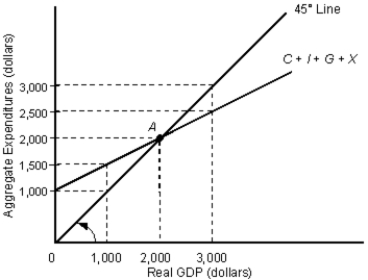 -Given a potential GDP level of $3,000, the recessionary gap in Figure 10.7 equals _____.
 (Multiple Choice)
4.8/5 (77)
(77) Wealth is considered to be a nonincome determinant of consumption.
(True/False)
4.9/5 (81)
(81) The figure given below represents the macroeconomic equilibrium in the aggregate income and aggregate expenditure framework. Assume that MPI is equal to zero.
-Refer to Figure 10.4. If autonomous government expenditures increase by $250 billion, equilibrium real GDP will:
-Refer to Figure 10.4. If autonomous government expenditures increase by $250 billion, equilibrium real GDP will: (Multiple Choice)
4.9/5 (85)
(85) The table given below states the value of the GDP and the different components of aggregate expenditure for two years.?
 -Refer to Table 10.1. What is the equilibrium level of real GDP in year 1?
 (Multiple Choice)
4.8/5 (98)
(98) According to economists, the fixed-price model of macroeconomic equilibrium depicts the modern economy most closely because it assumes that aggregate supply is independent of price.
(True/False)
4.8/5 (74)
(74) The spending multiplier equals 1/marginal propensity to save if an economy:
(Multiple Choice)
5.0/5 (81)
(81) The table given below reports the value of real GDP and its components consumption (C), investment (I), exports, and imports for two consecutive years in an economy.?
-Refer to Table 10.3. To increase the equilibrium real GDP to $12,000 in year 3 in this economy, all else equal to that in year 2, investment would have to increase by:
-Refer to Table 10.3. To increase the equilibrium real GDP to $12,000 in year 3 in this economy, all else equal to that in year 2, investment would have to increase by: (Multiple Choice)
4.8/5 (70)
(70) Assume that an increase of $300 in exports leads to an increase of $750 in equilibrium income. If the marginal propensity to import equals 1/10, the marginal propensity to save must be _____.
(Multiple Choice)
4.9/5 (83)
(83) The figure given below represents the macroeconomic equilibrium in the aggregate income and aggregate expenditure framework. Assume that MPI is equal to zero.
-Assume that a GDP gap can be closed by a $200 initial change in planned spending. The MPS is 0.3 and the MPI equals 0.1. If the economy is currently in equilibrium with an income level of $600, potential GDP equals:
-Assume that a GDP gap can be closed by a $200 initial change in planned spending. The MPS is 0.3 and the MPI equals 0.1. If the economy is currently in equilibrium with an income level of $600, potential GDP equals: (Multiple Choice)
4.8/5 (67)
(67) A horizontal aggregate supply curve indicates that equilibrium real GDP is determined by aggregate supply.
(True/False)
4.9/5 (69)
(69) 
Filters
- Essay(0)
- Multiple Choice(0)
- Short Answer(0)
- True False(0)
- Matching(0)