



 Chat with AI
Exam 10: Income and Expenditures Equilibrium

Exam 1: The Wealth of Nations: Ownership and Economic Freedom87 Questions
Exam 2: Scarcity and Opportunity Costs87 Questions
Exam 3: The Market and Price System96 Questions
Exam 4: The Aggregate Economy61 Questions
Exam 5: National Income Accounting104 Questions
Exam 6: An Introduction to the Foreign Exchapterange Market and the Balance of Payments99 Questions
Exam 7: Unemployment and Inflation129 Questions
Exam 8: Macroeconomic Equilibrium: Aggregate Demand and Supply122 Questions
Exam 9: Aggregate Expenditures120 Questions
Exam 10: Income and Expenditures Equilibrium134 Questions
Exam 11: Fiscal Policy94 Questions
Exam 12: Money and Banking125 Questions
Exam 13: Monetary Policy141 Questions
Exam 14: Macroeconomic Policy: Tradeoffs, Expectations, Credibility, and Sources of Business Cycles117 Questions
Exam 15: Macroeconomic Viewpoints: New Keynesian, Monetarist, and New Classical103 Questions
Exam 16: Economic Growth95 Questions
Exam 17: Development Economics105 Questions
Exam 18: Globalization85 Questions
Exam 19: World Trade Equilibrium112 Questions
Exam 20: International Trade Restrictions109 Questions
Exam 21: Exchapterange Rates and Financial Links Between Countries132 Questions
Select questions type


The figure given below depicts macroeconomic equilibrium in a closed economy. Assume that the spending multiplier in this economy is 1.5.?Figure 10.5
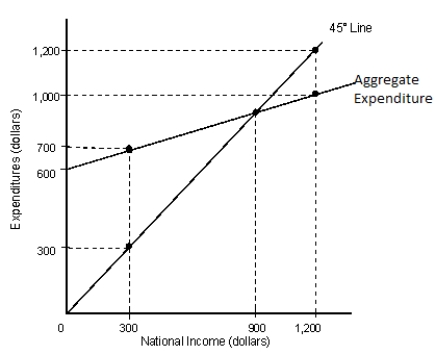 -Refer to Figure 10.5. If the target or potential level of real GDP is $1,200, then at an equilibrium real GDP level of $900:
 (Multiple Choice)
4.8/5  (75)
(75) The figure given below represents the leakages and injections in an economy.?Figure 10.3??In the figure:?S₁ and S₂: Saving functions?I: Investment?G: Government spending?EX: Net exports
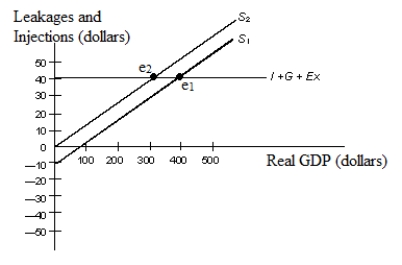 -Refer to Figure 10.3. The paradox of thrift might not be a problem if:
 (Multiple Choice)
4.8/5 (82)
(82) The table given below reports the value of real GDP and its components consumption (C), investment (I), exports, and imports for two consecutive years in an economy.?
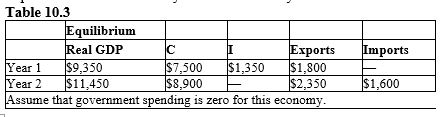 -According to the information provided in Table 10.3, the MPI equals _____.
 (Multiple Choice)
4.9/5 (76)
(76) The table given below shows the real GDP, aggregate expenditures, saving, and imports of an economy.?
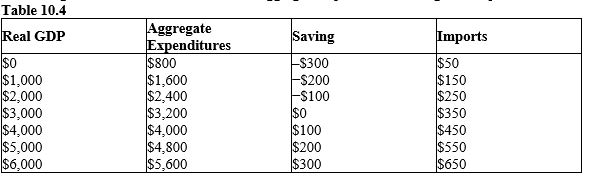 -Refer to Table 10.4. Suppose the economy is currently in equilibrium and has a potential GDP of $6,000. The current GDP gap equals _____.
 (Multiple Choice)
4.8/5 (72)
(72) If equilibrium in the economy is merely a function of aggregate demand, the aggregate supply curve must be:
(Multiple Choice)
4.9/5 (85)
(85) A rise in the price level that reduces the real wealth of people who hold financial assets is an illustration of the:
(Multiple Choice)
4.9/5 (87)
(87) If Saving+Tax+Import > Investment+Government spending+Export, then _____ must fall to establish macroeconomic equilibrium.
(Multiple Choice)
4.8/5 (78)
(78) The table given below states the value of the GDP and the different components of aggregate expenditure for two years.?
 -Refer to Table 10.1. If real GDP equals $1,000 in year 1, then:
 (Multiple Choice)
4.7/5 (77)
(77) The table given below reports the value of real GDP and its components consumption (C), investment (I), exports, and imports for two consecutive years in an economy.?
-Refer to Table 10.3. The equilibrium value of imports in year 1 is:
-Refer to Table 10.3. The equilibrium value of imports in year 1 is: (Multiple Choice)
4.8/5 (85)
(85) Scenario 10.1
Imagine an economy that does not have international trade and is initially in equilibrium. Later the government increases the level of spending by $350 million because it received a gift from abroad. In this economy, only 65 cents of every dollar is spent, and the rest is saved.
-Refer to Scenario 10.1. What is the marginal propensity to save for this economy?
(Multiple Choice)
4.9/5 (83)
(83) Foreign repercussions of changes in domestic imports cause the true domestic spending multiplier to be less than 1/(MPS+MPI)
(True/False)
4.9/5 (81)
(81) A major drawback of the Keynesian approach to macroeconomic equilibrium is the assumption that the supply of goods and services in the economy always adjusts to aggregate expenditures
(True/False)
4.9/5 (85)
(85) Everything else constant, the international trade effect indicates that aggregate expenditures in the domestic economy fall when:
(Multiple Choice)
5.0/5 (64)
(64) An increase in U.S. imports from Mexico will cause a decrease in income for Mexican individuals and businesses.
(True/False)
4.9/5 (81)
(81) If total planned expenditures exceed real GDP, the economy will contract, causing production of goods and services to decrease and unplanned inventories to rise.
(True/False)
4.7/5 (81)
(81) A depreciation of the U.S. dollar will result in an increase in aggregate expenditures in the country.
(True/False)
4.8/5 (77)
(77) The interest rate effect states that an increase in the price level will cause:
(Multiple Choice)
4.9/5 (75)
(75) The Keynesian region of the aggregate supply curve represents an economy with:
(Multiple Choice)
4.9/5 (65)
(65) A decrease in the general price level is associated with an upward shift in the aggregate expenditures function.
(True/False)
4.8/5 (72)
(72) The figure given below represents the macroeconomic equilibrium in the aggregate income and aggregate expenditure framework. Assume that MPI is equal to zero.
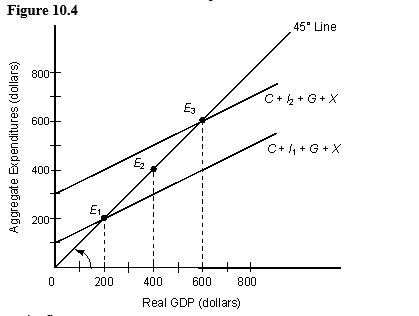 -Assume that potential GDP is $200 billion and the multiplier equals 5. The recessionary gap is $10 billion. What is the actual level of equilibrium income?
 (Multiple Choice)
4.8/5 (75)
(75) 
Filters
- Essay(0)
- Multiple Choice(0)
- Short Answer(0)
- True False(0)
- Matching(0)