



 Chat with AI
Exam 13: Monetary Policy

Exam 1: The Wealth of Nations: Ownership and Economic Freedom87 Questions
Exam 2: Scarcity and Opportunity Costs87 Questions
Exam 3: The Market and Price System96 Questions
Exam 4: The Aggregate Economy61 Questions
Exam 5: National Income Accounting104 Questions
Exam 6: An Introduction to the Foreign Exchapterange Market and the Balance of Payments99 Questions
Exam 7: Unemployment and Inflation129 Questions
Exam 8: Macroeconomic Equilibrium: Aggregate Demand and Supply122 Questions
Exam 9: Aggregate Expenditures120 Questions
Exam 10: Income and Expenditures Equilibrium134 Questions
Exam 11: Fiscal Policy94 Questions
Exam 12: Money and Banking125 Questions
Exam 13: Monetary Policy141 Questions
Exam 14: Macroeconomic Policy: Tradeoffs, Expectations, Credibility, and Sources of Business Cycles117 Questions
Exam 15: Macroeconomic Viewpoints: New Keynesian, Monetarist, and New Classical103 Questions
Exam 16: Economic Growth95 Questions
Exam 17: Development Economics105 Questions
Exam 18: Globalization85 Questions
Exam 19: World Trade Equilibrium112 Questions
Exam 20: International Trade Restrictions109 Questions
Exam 21: Exchapterange Rates and Financial Links Between Countries132 Questions
Select questions type


The Fed has set a uniform reserve requirement of 3 percent for all deposits in the U.S. banking system.
(True/False)
4.8/5  (74)
(74) Which of the following people is most likely to demand U.S. dollars in the foreign exchange market?
(Multiple Choice)
4.7/5 (77)
(77) The transactions demand for money increases when more people want to hold some of their wealth in the form of money to reduce the risks associated with unexpected emergencies.
(True/False)
4.8/5 (84)
(84) Scenario 13.2?Assume the following conditions hold.
Now the Federal Reserve engages in an open market operation by purchasing $1 billion worth of government bonds from private bond dealers, who then deposit the $1 billion in the banks. This acts to lower the equilibrium interest rate by 2 percent.
a.At all banks, excess reserves are zero.
b.The deposit expansion multiplier is 3.
c.The spending multiplier is 5.
d.The initial equilibrium level of national income is $500 billion.
e.The initial equilibrium interest rate equals 6 percent.
f.The investment spending function is as illustrated in the figure below.
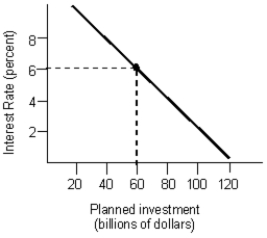 -Refer to Scenario 13.1. What is the ultimate change in the money supply following the open market operation by the Fed?
 (Multiple Choice)
4.8/5 (74)
(74) The buying and selling of government bonds by the FOMC constitutes:
(Multiple Choice)
4.8/5 (77)
(77) The Fed controls the money supply to achieve the policy goals set by the United States International Trade Commission.
(True/False)
4.9/5 (77)
(77) The Federal Reserve System divides the U.S. into _____ districts.
(Multiple Choice)
4.8/5 (68)
(68) Increased demand for U.S. products by foreign residents will lead to a depreciation of the U.S. dollar relative to foreign currencies.
(True/False)
5.0/5 (67)
(67) When the Fed uses money growth rates as an intermediate target, it implicitly assumes that the velocity of money is constant over time, at least in the short run.
(True/False)
4.8/5 (81)
(81) The figure given below depicts the equilibrium exchange rate between the U.S dollar and the Mexican peso.?Figure 13.2
 -Refer to Figure 13.2. Assume that the exchange rate is fixed at MXP 11 = $1 and the free market equilibrium rate is MXP 10 = $1. This means that at MXP 11 = $1,
 (Multiple Choice)
4.9/5 (82)
(82) Inflation targeting usually increases the uncertainty about the course of action of central banks, as perceived by the general public.
(True/False)
4.9/5 (80)
(80) Suppose a bank has $850 million in vault cash and a deposit in the Fed of $100 million. If the bank's required reserves equal $500 million, then the bank has excess reserves of:
(Multiple Choice)
4.8/5 (83)
(83) When the FOMC sets a monetary policy, it first identifies its intermediate target and then works accordingly to achieve its ultimate goal.
(True/False)
4.8/5 (84)
(84) When the government raises spending to promote economic growth, the Fed sells government bonds on the open market. This implies that the Federal Reserve and the federal government are following different policy goals.
(True/False)
4.8/5 (85)
(85) Suppose the U.S. dollar appreciates in value against the Australian dollar, and the Fed intervenes in the foreign exchange market by using U.S. dollars to buy Australian dollars. The Fed could sterilize the expansionary effect of this intervention by:
(Multiple Choice)
4.8/5 (88)
(88) In the figure given below panel A represents money market equilibrium, panel B represents investment demand, and panel C represents equilibrium real GDP.?Figure 13.3
 -Assume the economy is in equilibrium as illustrated by Figure 13.3. Based on the equation of exchange, what is the velocity of money?
 (Multiple Choice)
4.8/5 (75)
(75) Suppose the interest rate on a bond is 12.5 percent and that bond pays $90 a year in interest and sells for $720. If the supply of bonds increases and the price of the bond falls to $600, the interest rate will ____ to ____.
(Multiple Choice)
4.8/5 (72)
(72) The figure given below depicts the equilibrium exchange rate between the U.S dollar and the Mexican peso.?Figure 13.2
-Refer to Figure 13.2. When the Mexican demand for U.S. dollars rises from D₂ to D₁ and the relevant supply curve is S₁:
-Refer to Figure 13.2. When the Mexican demand for U.S. dollars rises from D₂ to D₁ and the relevant supply curve is S₁: (Multiple Choice)
4.8/5 (77)
(77) 
Filters
- Essay(0)
- Multiple Choice(0)
- Short Answer(0)
- True False(0)
- Matching(0)