



 Chat with AI
Exam 13: Monetary Policy

Exam 1: The Wealth of Nations: Ownership and Economic Freedom87 Questions
Exam 2: Scarcity and Opportunity Costs87 Questions
Exam 3: The Market and Price System96 Questions
Exam 4: The Aggregate Economy61 Questions
Exam 5: National Income Accounting104 Questions
Exam 6: An Introduction to the Foreign Exchapterange Market and the Balance of Payments99 Questions
Exam 7: Unemployment and Inflation129 Questions
Exam 8: Macroeconomic Equilibrium: Aggregate Demand and Supply122 Questions
Exam 9: Aggregate Expenditures120 Questions
Exam 10: Income and Expenditures Equilibrium134 Questions
Exam 11: Fiscal Policy94 Questions
Exam 12: Money and Banking125 Questions
Exam 13: Monetary Policy141 Questions
Exam 14: Macroeconomic Policy: Tradeoffs, Expectations, Credibility, and Sources of Business Cycles117 Questions
Exam 15: Macroeconomic Viewpoints: New Keynesian, Monetarist, and New Classical103 Questions
Exam 16: Economic Growth95 Questions
Exam 17: Development Economics105 Questions
Exam 18: Globalization85 Questions
Exam 19: World Trade Equilibrium112 Questions
Exam 20: International Trade Restrictions109 Questions
Exam 21: Exchapterange Rates and Financial Links Between Countries132 Questions
Select questions type


The quantity of excess reserves in the banking system and the federal funds rate can serve as short-run operating targets for the FOMC and help it perform the open market operation.
(True/False)
4.9/5  (75)
(75) Scenario 13.1?Assume the following conditions hold.
Now the Federal Reserve engages in an open market operation by purchasing $1 billion worth of government bonds from private bond dealers, who then deposit the $1 billion in the banks. This acts to lower the equilibrium interest rate by 2 percent.
a.At all banks, excess reserves are zero.
b.The deposit expansion multiplier is 3.
c.The investment spending function is as illustrated in the figure below.
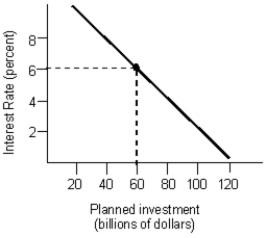 -Refer to Scenario 13.1. What is the change in required reserves following the open market operation by the Fed?
 (Multiple Choice)
4.9/5 (82)
(82) The figure given below depicts the equilibrium in the foreign exchange market.?Figure 13.1
 -Refer to Figure 13.1. If the exchange rate is fixed at E2 but the free market equilibrium rate is E1 then:
 (Multiple Choice)
5.0/5 (74)
(74) Other things equal, an increase in the general price level causes the money demand function to shift to the left.
(True/False)
4.9/5 (74)
(74) Sterilization occurs when a central bank offsets the effects of expansionary monetary policy through foreign exchange market intervention.
(True/False)
4.9/5 (62)
(62) Which of the following is the latest short run operating target specified to the New York Fed by the FOMC directives?
(Multiple Choice)
4.8/5 (87)
(87) If a bond pays a fixed return of $500 a year and the current interest rate has risen from 5 percent to 10 percent, then the bond price must have:
(Multiple Choice)
4.9/5 (88)
(88) In foreign exchange markets, a U.S. resident who imports New Zealand apples is:
(Multiple Choice)
4.8/5 (71)
(71) Suppose that the Fed decides to decrease the money supply by 0.87 percent. If the velocity of money is constant, then the quantity theory of money predicts that:
(Multiple Choice)
4.8/5 (81)
(81) According to the equation of exchange, a contractionary monetary policy must be adopted to offset any decrease in the velocity of money.
(True/False)
4.9/5 (80)
(80) The figure given below depicts the equilibrium in the foreign exchange market.?Figure 13.1
-Refer to Figure 13.1. If the current equilibrium exchange rate is E1 what action would the Fed have to take to achieve a target exchange rate of E2?
-Refer to Figure 13.1. If the current equilibrium exchange rate is E1 what action would the Fed have to take to achieve a target exchange rate of E2? (Multiple Choice)
5.0/5 (88)
(88) In the figure given below panel A represents money market equilibrium, panel B represents investment demand, and panel C represents equilibrium real GDP.?Figure 13.3
 -Refer to Figure 13.3. Other things equal, if the interest rate is greater than 6 percent, then:
 (Multiple Choice)
4.9/5 (75)
(75) An excess demand for money will result in all the following, except:
(Multiple Choice)
4.9/5 (80)
(80)  -Refer to Table 13.1. Given a reserve requirement of 8 percent, what is the maximum potential increase in the money supply?
 (Multiple Choice)
4.9/5 (76)
(76) The process of buying financial assets to stimulate the economy when the central bank target interest rate is near or at zero and the interest rate cannot be lowered further is called:
(Multiple Choice)
4.9/5 (87)
(87) Which of the following monetary policies will increase money supply?
(Multiple Choice)
4.8/5 (71)
(71) When more than one central bank attempts to shift the equilibrium exchange rate, we refer to this as:
(Multiple Choice)
4.9/5 (87)
(87) 
Filters
- Essay(0)
- Multiple Choice(0)
- Short Answer(0)
- True False(0)
- Matching(0)