



 Chat with AI
Exam 8: Heart and Blood Vessels

Exam 1: Human Biology, Science, and Society69 Questions
Exam 2: The Chemistry of Living Things100 Questions
Exam 3: Structure and Function of Cells107 Questions
Exam 4: From Cells to Organ Systems88 Questions
Exam 5: The Skeletal System74 Questions
Exam 6: The Muscular System83 Questions
Exam 7: Blood95 Questions
Exam 8: Heart and Blood Vessels107 Questions
Exam 9: The Immune System and Mechanisms of Defense102 Questions
Exam 10: The Respiratory System: Exchange of Gases81 Questions
Exam 11: The Nervous System: Integration and Control100 Questions
Exam 12: Sensory Mechanisms83 Questions
Exam 13: The Endocrine System82 Questions
Exam 14: The Digestive System and Nutrition80 Questions
Exam 15: The Urinary System70 Questions
Exam 16: Reproductive Systems89 Questions
Exam 17: Cell Reproduction and Differentiation78 Questions
Exam 18: Cancer: Uncontrolled Cell Division and Differentiation77 Questions
Exam 19: Genetics and Inheritance71 Questions
Exam 20: DNA Technology and Genetic Engineering71 Questions
Exam 21: Development and Aging72 Questions
Exam 22: Evolution and the Origins of Life78 Questions
Exam 23: Ecosystems and Populations74 Questions
Exam 24: Human Impacts, Biodiversity, and Environmental Issues71 Questions
Select questions type


Fluid that "escapes" from the circulatory system due to high pressure is referred to as
(Multiple Choice)
4.7/5  (80)
(80) Risk factors for atherosclerosis include factors that can raise the levels of blood cholesterol, such as
(Multiple Choice)
4.8/5 (73)
(73) Using the figure below, determine which side of the capillary is being described in each of the following statements.
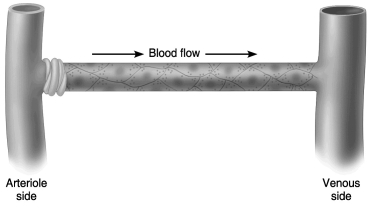 A) arteriole side
B) venous side
-carbon dioxide diffuses into the blood
A) arteriole side
B) venous side
-carbon dioxide diffuses into the blood (Short Answer)
4.8/5 (73)
(73) Which one of the following is TRUE regarding the lymphatic system?
(Multiple Choice)
4.9/5 (88)
(88) The lumen of capillaries is so small that red blood cells must travel through these blood vessels in single file or sometimes actually squeeze through.
(True/False)
4.7/5 (83)
(83) The left ventricle has a more muscular wall than the other three chambers of the heart because the left ventricle
(Multiple Choice)
4.8/5 (81)
(81) Permanently swollen veins, common in the legs and feet, are known as ________.
(Short Answer)
4.8/5 (92)
(92) A record of the electrical impulses characteristic of the cardiac conduction system is known as a(n) ________.
(Short Answer)
4.9/5 (73)
(73) The electrical signal causing contraction of the heart is carried from the atrioventricular bundle to the myocardium of the ventricles by ________ fibers.
(Short Answer)
4.9/5 (85)
(85) Blood pressure is measured with a(n) ________ and a stethoscope.
(Short Answer)
5.0/5 (86)
(86) Which response would be characteristic of the parasympathetic nervous system?
(Multiple Choice)
4.7/5 (77)
(77) A cerebral embolism blocks an artery carrying blood to the ________.
(Short Answer)
4.9/5 (89)
(89) After blood flows through the right atrium of the heart, its next major destination is the
(Multiple Choice)
4.8/5 (87)
(87) Blood pressure is typically recorded as two numbers; the higher number corresponds to the ________ pressure.
(Short Answer)
4.9/5 (79)
(79) The rapid expansion and recoil of the wall of an artery close to the skin's surface is a(n) ________.
(Short Answer)
4.7/5 (79)
(79) Each of the following is part of the systemic circuit EXCEPT the
(Multiple Choice)
4.9/5 (84)
(84) Lymphatic vessels are structurally different from the arteries in that
(Multiple Choice)
4.8/5 (75)
(75) Fluid in the lymphatic system, as well as interstitial fluid, is
(Multiple Choice)
4.9/5 (88)
(88) 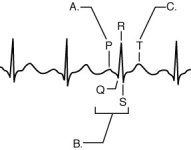 The figure above shows a normal ECG recording. Match each part, A, B, or C, of the recording to its description.
-represents the end of electrical activity in the ventricles
The figure above shows a normal ECG recording. Match each part, A, B, or C, of the recording to its description.
-represents the end of electrical activity in the ventricles (Short Answer)
4.8/5 (76)
(76) 
Filters
- Essay(0)
- Multiple Choice(0)
- Short Answer(0)
- True False(0)
- Matching(0)