



 Chat with AI
Exam 15: The Urinary System

Exam 1: Human Biology, Science, and Society69 Questions
Exam 2: The Chemistry of Living Things100 Questions
Exam 3: Structure and Function of Cells107 Questions
Exam 4: From Cells to Organ Systems88 Questions
Exam 5: The Skeletal System74 Questions
Exam 6: The Muscular System83 Questions
Exam 7: Blood95 Questions
Exam 8: Heart and Blood Vessels107 Questions
Exam 9: The Immune System and Mechanisms of Defense102 Questions
Exam 10: The Respiratory System: Exchange of Gases81 Questions
Exam 11: The Nervous System: Integration and Control100 Questions
Exam 12: Sensory Mechanisms83 Questions
Exam 13: The Endocrine System82 Questions
Exam 14: The Digestive System and Nutrition80 Questions
Exam 15: The Urinary System70 Questions
Exam 16: Reproductive Systems89 Questions
Exam 17: Cell Reproduction and Differentiation78 Questions
Exam 18: Cancer: Uncontrolled Cell Division and Differentiation77 Questions
Exam 19: Genetics and Inheritance71 Questions
Exam 20: DNA Technology and Genetic Engineering71 Questions
Exam 21: Development and Aging72 Questions
Exam 22: Evolution and the Origins of Life78 Questions
Exam 23: Ecosystems and Populations74 Questions
Exam 24: Human Impacts, Biodiversity, and Environmental Issues71 Questions
Select questions type


Renin stimulates the secretion of aldosterone.

Free
(True/False)
4.9/5  (83)
(83) Correct Answer: Verified
False
Which of the following groupings of organs is responsible for the maintenance of water balance in the body?
Free
(Multiple Choice)
4.7/5 (70)
(70) Correct Answer:Verified
VerifiedC
The major nitrogenous waste product in urine is the ammonium ion.
Free
(True/False)
4.9/5 (76)
(76) Correct Answer:Verified
VerifiedFalse
During times of stress, the autonomic nervous system causes the afferent and efferent arterioles to constrict, resulting in an increase in the amount of urine produced.
(True/False)
4.9/5 (83)
(83) 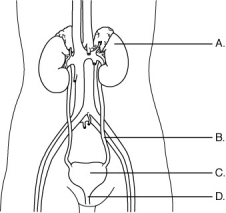 Using the letter choices on the figure above, identify the organs of the urinary system.
-muscular tube that passes urine out of the body
Using the letter choices on the figure above, identify the organs of the urinary system.
-muscular tube that passes urine out of the body (Short Answer)
4.9/5 (77)
(77) Impairments of the kidney that are considered short term and possibly can be overcome by medication or other treatments are called chronic renal failure.
(True/False)
4.7/5 (84)
(84) Chloride ions passively follow sodium that has been actively transported out of tubular cells, due to the attraction of negatively charged ions to positively charged ions.
(True/False)
4.9/5 (89)
(89) Urine formation initiates with glomerular filtration, a process that relies on filtering large quantities of protein-free plasma into the Bowman's capsule by
(Multiple Choice)
5.0/5 (80)
(80) The steroid hormone ________ regulates the reabsorption of sodium across the collecting duct and distal tubule.
(Short Answer)
4.8/5 (92)
(92) 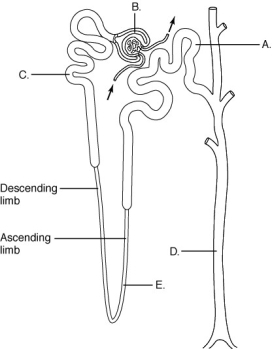 Using the letters on the figure above, identify the sections of the nephron.
-relies on countercurrent exchange to move ions and water
Using the letters on the figure above, identify the sections of the nephron.
-relies on countercurrent exchange to move ions and water (Short Answer)
5.0/5 (67)
(67) Osmotic concentration in the descending limb of the loop of Henle increases as water moves out.
(True/False)
4.8/5 (84)
(84) Countercurrent exchange is used primarily in the ________ portion of the nephron.
(Short Answer)
4.9/5 (81)
(81) Match each of the following disorders associated with the urinary system to its description.
Correct Answer:Verified
VerifiedPremises:
Responses:
(Matching)
4.9/5 (75)
(75) Considering the following events reflecting how vitamin D is synthesized and activated, which one of the following answers best represents the order in which these events occur?
A. Inactive vitamin D is transported to the liver where it is modified.
B. Inactive vitamin D is transported to the kidneys.
C. UV light strikes the skin and converts a steroid molecule into an inactive form of vitamin D.
D. Vitamin D is activated under the influence of PTH.
(Multiple Choice)
4.8/5 (76)
(76) The hairpin design of the loop of Henle allows events on one side of the loop to influence the events on the other side, by a process referred to as
(Multiple Choice)
4.9/5 (87)
(87) The initial filtrate entering the proximal tubule is isotonic in relation to the surrounding cells; however, the final urine leaving the collecting ducts is highly concentrated in terms of solutes.
(True/False)
4.8/5 (66)
(66)
Using the letters on the figure above, identify the sections of the nephron.
-filtrate in lumen contains solutes smaller than proteins
Using the letters on the figure above, identify the sections of the nephron.
-filtrate in lumen contains solutes smaller than proteins (Short Answer)
4.8/5 (80)
(80) Each kidney is made up of a million ________, the functional units of a kidney.
(Short Answer)
4.8/5 (77)
(77) 
Filters
- Essay(0)
- Multiple Choice(0)
- Short Answer(0)
- True False(0)
- Matching(0)