



 Chat with AI
Exam 15: The Urinary System

Exam 1: Human Biology, Science, and Society69 Questions
Exam 2: The Chemistry of Living Things100 Questions
Exam 3: Structure and Function of Cells107 Questions
Exam 4: From Cells to Organ Systems88 Questions
Exam 5: The Skeletal System74 Questions
Exam 6: The Muscular System83 Questions
Exam 7: Blood95 Questions
Exam 8: Heart and Blood Vessels107 Questions
Exam 9: The Immune System and Mechanisms of Defense102 Questions
Exam 10: The Respiratory System: Exchange of Gases81 Questions
Exam 11: The Nervous System: Integration and Control100 Questions
Exam 12: Sensory Mechanisms83 Questions
Exam 13: The Endocrine System82 Questions
Exam 14: The Digestive System and Nutrition80 Questions
Exam 15: The Urinary System70 Questions
Exam 16: Reproductive Systems89 Questions
Exam 17: Cell Reproduction and Differentiation78 Questions
Exam 18: Cancer: Uncontrolled Cell Division and Differentiation77 Questions
Exam 19: Genetics and Inheritance71 Questions
Exam 20: DNA Technology and Genetic Engineering71 Questions
Exam 21: Development and Aging72 Questions
Exam 22: Evolution and the Origins of Life78 Questions
Exam 23: Ecosystems and Populations74 Questions
Exam 24: Human Impacts, Biodiversity, and Environmental Issues71 Questions
Select questions type


Many different ions are taken into the body with each meal or produced during cellular metabolism. The kidneys are important in regulating the amount of each of these ions in the body. Match each ion to its function.
Correct Answer: Verified
Premises:
Responses:
(Matching)
4.9/5  (82)
(82) Blood containing metabolic waste is transported to the kidneys by the renal vein; the renal artery removes blood from the kidneys once the waste has been removed.
(True/False)
4.8/5 (79)
(79) Match each region of the nephron to its description.
Correct Answer:Verified
VerifiedPremises:
Responses:
(Matching)
4.8/5 (69)
(69) ADH ________ the permeability of the cells of the collecting duct to water.
(Short Answer)
4.8/5 (95)
(95) If the Bowman's capsule could be surgically removed so that the end (closed) of the proximal tubule was in contact with the glomerulus, what would be the impact on glomerular filtration?
(Essay)
4.9/5 (87)
(87) Three organs in the human body are involved in the production of vitamin D; they are the ________, ________, and ________.
(Short Answer)
4.8/5 (67)
(67) 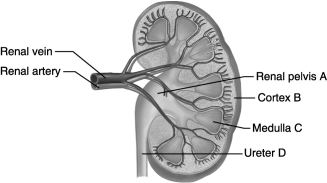 -Using the figure above, identify in which one of the following locations a nephron would be found.
 (Multiple Choice)
4.8/5 (93)
(93) The glomerulus of each nephron is enclosed by a portion of the nephron known as ________.
(Short Answer)
4.8/5 (84)
(84) Energy drinks contain several components, including caffeine, that are advertised to boost your energy levels. If you drink several of these caffeine-containing energy drinks in a short period of time, you feel the sensation to urinate. Why?
(Essay)
4.7/5 (82)
(82) An individual has been diagnosed with persistent proteinuria. This condition is due to damage in which one of the following regions of the nephron?
(Multiple Choice)
4.8/5 (83)
(83) 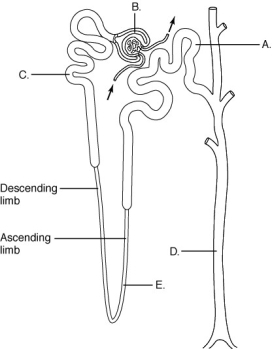 Using the letters on the figure above, identify the sections of the nephron.
-functions in ion reabsorption into blood
Using the letters on the figure above, identify the sections of the nephron.
-functions in ion reabsorption into blood (Short Answer)
4.8/5 (85)
(85) Minerals that crystallize in the renal pelvis are referred to as
(Multiple Choice)
4.9/5 (90)
(90) As urine moves through a nephron, it is modified by ions, water, and other materials either being secreted into the fluid or by efflux of substances out of the urine. However, such modifications do not occur in which one of the following regions of the nephron?
(Multiple Choice)
4.9/5 (82)
(82) Tubular reabsorption occurs when most of the fluid and solutes move back into the ________.
(Short Answer)
4.9/5 (73)
(73) Alcohol has diuretic effects, increasing urine output. By which one of the following is this mediated?
(Multiple Choice)
4.9/5 (89)
(89) The function of the kidneys to concentrate urine is under the control of a negative feedback loop.
(True/False)
4.9/5 (77)
(77) The loop of Henle relies on a countercurrent exchange mechanism to promote movement of water and solutes. Explain the significance of this mechanism to the composition of urine.
(Essay)
4.9/5 (86)
(86) The kidneys function to maintain homeostasis in all of the following ways EXCEPT which one?
(Multiple Choice)
4.8/5 (76)
(76) 
Filters
- Essay(0)
- Multiple Choice(0)
- Short Answer(0)
- True False(0)
- Matching(0)