



 Chat with AI
Exam 8: Heart and Blood Vessels

Exam 1: Human Biology, Science, and Society69 Questions
Exam 2: The Chemistry of Living Things100 Questions
Exam 3: Structure and Function of Cells107 Questions
Exam 4: From Cells to Organ Systems88 Questions
Exam 5: The Skeletal System74 Questions
Exam 6: The Muscular System83 Questions
Exam 7: Blood95 Questions
Exam 8: Heart and Blood Vessels107 Questions
Exam 9: The Immune System and Mechanisms of Defense102 Questions
Exam 10: The Respiratory System: Exchange of Gases81 Questions
Exam 11: The Nervous System: Integration and Control100 Questions
Exam 12: Sensory Mechanisms83 Questions
Exam 13: The Endocrine System82 Questions
Exam 14: The Digestive System and Nutrition80 Questions
Exam 15: The Urinary System70 Questions
Exam 16: Reproductive Systems89 Questions
Exam 17: Cell Reproduction and Differentiation78 Questions
Exam 18: Cancer: Uncontrolled Cell Division and Differentiation77 Questions
Exam 19: Genetics and Inheritance71 Questions
Exam 20: DNA Technology and Genetic Engineering71 Questions
Exam 21: Development and Aging72 Questions
Exam 22: Evolution and the Origins of Life78 Questions
Exam 23: Ecosystems and Populations74 Questions
Exam 24: Human Impacts, Biodiversity, and Environmental Issues71 Questions
Select questions type


Which one of the following symptoms is most typical of hypertension?
(Multiple Choice)
4.7/5  (86)
(86) Using the figure below, determine which side of the capillary is being described in each of the following statements.
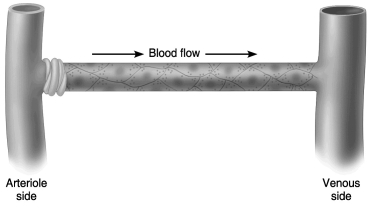 A) arteriole side
B) venous side
-blood pressure is higher
A) arteriole side
B) venous side
-blood pressure is higher (Short Answer)
4.9/5 (81)
(81) Vasoconstriction causes an increase in the diameter of blood vessels, thus causing an increase in blood flow to the tissues.
(True/False)
4.9/5 (83)
(83) Each of the following statements accurately describes a feature of arteries EXCEPT which one?
(Multiple Choice)
4.8/5 (78)
(78) Which one of the following statements is TRUE regarding arterioles and arteries?
(Multiple Choice)
4.8/5 (82)
(82) A person's blood pressure has fallen below normal as the person has quickly jumped out of his or her chair where he or she had been relaxing. All of the following reflect events in restoring the blood pressure to normal EXCEPT which one?
(Multiple Choice)
4.9/5 (85)
(85) The amount of blood leaving the heart with every contraction is known as ________.
(Short Answer)
4.7/5 (76)
(76) The condition that results when an endothelium becomes damaged and blood leaks below the endothelium, causing the wall of the blood vessel to bulge, is a(n)________.
(Short Answer)
4.7/5 (70)
(70) In the ________ circuit, blood leaving the ________ ultimately delivers oxygen and nutrients to all of the body's tissues and organs.
(Multiple Choice)
4.8/5 (77)
(77) All of the following are features of capillaries that promote exchange between blood and interstitial fluid EXCEPT which one?
(Multiple Choice)
4.8/5 (93)
(93) The endothelium of the heart and blood vessels is composed of a smooth layer of connective tissue that reduces friction, which helps keep blood flowing smoothly.
(True/False)
4.8/5 (89)
(89) When an athlete trains for a marathon, the goal is to increase cardiovascular output. What does that actually mean in terms of heart function?
(Essay)
4.8/5 (73)
(73) Artificial hearts are used routinely today to replace damaged hearts when a donor heart is not available for transplant.
(True/False)
4.8/5 (65)
(65) The two upper chambers of the heart are called ________; the two lower chambers of the heart are called ________.
(Short Answer)
4.8/5 (91)
(91) Oxygenated blood can be found in the following chambers of the heart: ________ and ________.
(Short Answer)
4.9/5 (88)
(88) 
Filters
- Essay(0)
- Multiple Choice(0)
- Short Answer(0)
- True False(0)
- Matching(0)