



 Chat with AI
Exam 2: The Chemistry of Living Things

Exam 1: Human Biology, Science, and Society69 Questions
Exam 2: The Chemistry of Living Things100 Questions
Exam 3: Structure and Function of Cells107 Questions
Exam 4: From Cells to Organ Systems88 Questions
Exam 5: The Skeletal System74 Questions
Exam 6: The Muscular System83 Questions
Exam 7: Blood95 Questions
Exam 8: Heart and Blood Vessels107 Questions
Exam 9: The Immune System and Mechanisms of Defense102 Questions
Exam 10: The Respiratory System: Exchange of Gases81 Questions
Exam 11: The Nervous System: Integration and Control100 Questions
Exam 12: Sensory Mechanisms83 Questions
Exam 13: The Endocrine System82 Questions
Exam 14: The Digestive System and Nutrition80 Questions
Exam 15: The Urinary System70 Questions
Exam 16: Reproductive Systems89 Questions
Exam 17: Cell Reproduction and Differentiation78 Questions
Exam 18: Cancer: Uncontrolled Cell Division and Differentiation77 Questions
Exam 19: Genetics and Inheritance71 Questions
Exam 20: DNA Technology and Genetic Engineering71 Questions
Exam 21: Development and Aging72 Questions
Exam 22: Evolution and the Origins of Life78 Questions
Exam 23: Ecosystems and Populations74 Questions
Exam 24: Human Impacts, Biodiversity, and Environmental Issues71 Questions
Select questions type


One of the most important buffer pairs in blood is carbonic acid and bicarbonate because they regulate the pH of blood by absorbing and releasing hydrogen ions as needed.
(True/False)
4.7/5  (85)
(85) Alpha helices and beta sheets are characteristic of protein
(Multiple Choice)
5.0/5 (85)
(85) Which one of the following forms a bilayer structure that is found in cell membranes?
(Multiple Choice)
4.8/5 (91)
(91) ________ is the capacity to do work, the capacity to cause some change in matter.
(Multiple Choice)
4.9/5 (71)
(71) The most important physical characteristic of lipids with regard to living organisms is that they
(Multiple Choice)
4.9/5 (72)
(72) The acidity or alkalinity of a solution can be measured in terms of ________.
(Short Answer)
4.9/5 (78)
(78) A solution with a pH of 6 has ________ times as many hydrogen ions as a solution with a pH of 8.
(Multiple Choice)
4.9/5 (75)
(75) 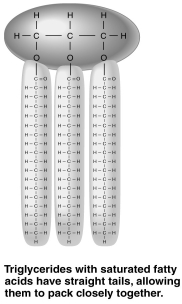 -The figure above shows a triglyceride that contains unsaturated fatty acids.
 (True/False)
4.9/5 (64)
(64) The process by which cells break down organic macromolecules into their subunits is ________.
(Short Answer)
4.8/5 (69)
(69) Which one of the following is TRUE regarding macromolecules?
(Multiple Choice)
5.0/5 (88)
(88) Atoms with either more or fewer neutrons than the usual number for an element are referred to as isotopes.
(True/False)
4.7/5 (86)
(86) Carbohydrates have which one of the following characteristics?
(Multiple Choice)
4.9/5 (87)
(87) Which one of the following characteristics applies to both living organisms and nonliving things?
(Multiple Choice)
4.9/5 (78)
(78) A polypeptide is generally referred to as a(n) ________ if it has more than 100 amino acids and has folded into a complex structure with a specific function.
(Short Answer)
5.0/5 (79)
(79) 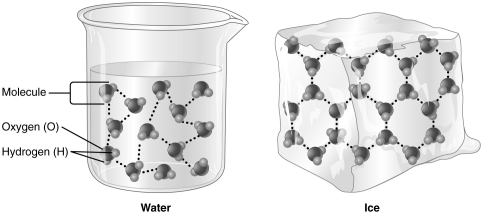 -The type of bond indicated by the dotted lines in the figure above is a hydrogen bond.
 (True/False)
4.9/5 (82)
(82) During intense exercise, you produce a lot of heat energy, yet your body temperature rises only in small increments. This temperature stability is because water in body fluids releases the heat very quickly.
(True/False)
4.7/5 (84)
(84) 
Filters
- Essay(0)
- Multiple Choice(0)
- Short Answer(0)
- True False(0)
- Matching(0)