



 Chat with AI
Exam 2: The Chemistry of Living Things

Exam 1: Human Biology, Science, and Society69 Questions
Exam 2: The Chemistry of Living Things100 Questions
Exam 3: Structure and Function of Cells107 Questions
Exam 4: From Cells to Organ Systems88 Questions
Exam 5: The Skeletal System74 Questions
Exam 6: The Muscular System83 Questions
Exam 7: Blood95 Questions
Exam 8: Heart and Blood Vessels107 Questions
Exam 9: The Immune System and Mechanisms of Defense102 Questions
Exam 10: The Respiratory System: Exchange of Gases81 Questions
Exam 11: The Nervous System: Integration and Control100 Questions
Exam 12: Sensory Mechanisms83 Questions
Exam 13: The Endocrine System82 Questions
Exam 14: The Digestive System and Nutrition80 Questions
Exam 15: The Urinary System70 Questions
Exam 16: Reproductive Systems89 Questions
Exam 17: Cell Reproduction and Differentiation78 Questions
Exam 18: Cancer: Uncontrolled Cell Division and Differentiation77 Questions
Exam 19: Genetics and Inheritance71 Questions
Exam 20: DNA Technology and Genetic Engineering71 Questions
Exam 21: Development and Aging72 Questions
Exam 22: Evolution and the Origins of Life78 Questions
Exam 23: Ecosystems and Populations74 Questions
Exam 24: Human Impacts, Biodiversity, and Environmental Issues71 Questions
Select questions type


Radioisotopes have a number of uses in science and medicine. These uses include which one of the following?
(Multiple Choice)
4.8/5  (78)
(78) Isotopes that give off energy and emit particles are known as ________.
(Short Answer)
4.8/5 (80)
(80) The structure of a cell membrane includes a modified form of lipid called a(n) ________.
(Short Answer)
4.8/5 (82)
(82) Electrons are smaller than protons, are negatively charged, and orbit the nucleus.
(True/False)
4.8/5 (79)
(79) Describe how denaturing a protein alters the function of that protein.
(Essay)
4.8/5 (63)
(63) Use the letters from the figure below to answer the following questions.
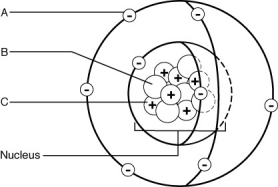 -The subatomic particles ________ and ________ have approximately the same mass.
 (Short Answer)
4.8/5 (80)
(80) When a protein is heated, it may unfold, losing its secondary, tertiary, and even quaternary structure. This process is known as ________.
(Short Answer)
4.9/5 (75)
(75) Plants produce a polysaccharide made of glucose known as ________, which is virtually indigestible by most animals.
(Short Answer)
4.8/5 (74)
(74) A research student is analyzing the nucleic acid of a virus. He finds that the nucleic acid contains thymine. From this it can be concluded that the nucleic acid
(Multiple Choice)
4.8/5 (73)
(73) Which one of the following is a very important source of energy for nearly all cells?
(Multiple Choice)
4.9/5 (86)
(86) Evaporation of water from the skin results in a(n) ________ in body temperature.
(Short Answer)
4.9/5 (89)
(89) Explain how water in the human body helps to regulate body temperature following a long-distance bike ride.
(Essay)
4.9/5 (84)
(84) Lipid molecules composed of four joined carbon rings are known as ________.
(Short Answer)
4.8/5 (90)
(90) A student has isolated a large compound (macromolecule) from cells. Chemical analysis of the compound shows that it is made up of the following elements: carbon, hydrogen, oxygen, nitrogen, and sulfur. To which group of macromolecules does this compound most likely belong?
(Multiple Choice)
4.8/5 (80)
(80) In the atom, electrons are located in clouds, with negative charges around the nucleus; these are called ________.
(Short Answer)
4.8/5 (81)
(81) Pancreatic cells make insulin, which is a type of protein. These cells use ________ in order to synthesize insulin by the process of ________.
(Multiple Choice)
4.7/5 (83)
(83) Molecules such as water are referred to as ________ because they are electrically neutral overall but still have partially charged regions.
(Multiple Choice)
4.8/5 (83)
(83) The pure form of matter that cannot be broken down into a simpler form is a(n) ________.
(Short Answer)
4.9/5 (72)
(72) 
Filters
- Essay(0)
- Multiple Choice(0)
- Short Answer(0)
- True False(0)
- Matching(0)