



 Chat with AI
Exam 15: Fiscal Policy

Exam 1: Foundations of Economics100 Questions
Exam 1: Extension: Understanding Graphs27 Questions
Exam 2: Markets and Economies104 Questions
Exam 3: Demand116 Questions
Exam 4: Supply118 Questions
Exam 5: Market Equilibrium118 Questions
Exam 6: Elasticity126 Questions
Exam 7: Consumer Behavior104 Questions
Exam 8: Production Costs125 Questions
Exam 9: Perfect Competition117 Questions
Exam 10: Market Power102 Questions
Exam 11: Factor Markets105 Questions
Exam 12: Market Failure and Government Failure82 Questions
Exam 13: Measuring an Economys Performance103 Questions
Exam 14: Aggregate Demand and Aggregate Supply105 Questions
Exam 15: Fiscal Policy105 Questions
Exam 16: Money and Banking74 Questions
Exam 17: Monetary Policy103 Questions
Exam 18: Economic Growth and Development49 Questions
Exam 19: International Trade and Finance110 Questions
Select questions type


The delay between the recognition that the economy is in a recession and the implementation of a policy response is known as the _____ lag.
(Multiple Choice)
4.8/5  (90)
(90) Supply-side fiscal policies focus on increasing output and decreasing inflation rate by _____ supply.
(Multiple Choice)
4.8/5 (67)
(67) Which of the following economists is one of the founders of monetarist theory?
(Multiple Choice)
4.8/5 (74)
(74) _____ fiscal policy shifts the aggregate demand curve left and therefore can be used to close _____ gap.
(Multiple Choice)
4.9/5 (74)
(74) If government spending is less than the tax revenue, then the government has a budget _____. In this case, the overall debt of the government will:
(Multiple Choice)
4.7/5 (70)
(70) The expenditures of the U.S. federal government that are required by law are known as _____ spending.
(Multiple Choice)
4.7/5 (81)
(81) The government's influence over the economy via taxes and expenditure is known as _____ policy.
(Multiple Choice)
4.8/5 (79)
(79) A tax system in which low-income people pay a higher proportion of their income in taxes than high-income people is known as _____ tax system.
(Multiple Choice)
4.9/5 (71)
(71) If there is an inflationary gap in the economy, then it is producing _____ than its full employment level of output, and the government can _____ spending to close the gap.
(Multiple Choice)
4.9/5 (76)
(76) If government spending is greater than the tax revenue, then the government has a budget _____. In this case, the overall debt of the government will:
(Multiple Choice)
4.9/5 (86)
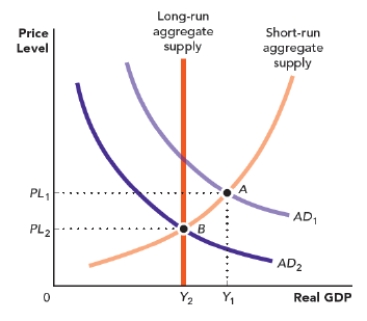
(86) Use Figure: Fiscal Policy II. If the economy is operating at point A, then there is _____ gap, and the government can _____ spending to close this gap.
Fiscal Policy II
(Multiple Choice)
4.9/5 (85)
(85) Suppose that the total debt of the U.S. federal government at the end of 2017 was $19 trillion. In 2018, the government spends $3.2 trillion and collects $2.2 trillion in taxes. What will be the total debt at the end of 2018?
(Multiple Choice)
4.9/5 (82)
(82) The inverted U-shaped relationship between tax rates and tax revenue is known as the _____ curve.
(Multiple Choice)
4.9/5 (83)
(83) _____ lag refers to the delay that occurs between when a recession begins and when the government recognizes it, and _____ lag refers to the delay between the policy change in response and the resulting effect.
(Multiple Choice)
4.9/5 (90)
(90) Because individuals are incentivized to work _____ when tax rates decrease, the Laffer curve suggests that _____ tax rates when they are very high can increase the tax revenue.
(Multiple Choice)
4.8/5 (72)
(72) If the full employment level of output for an economy is 1,000 units and it is currently producing 1,100 units, then there is _____ gap, and the government can _____ transfer payments to close the gap.
(Multiple Choice)
4.9/5 (90)
(90) If there is a recessionary gap in the economy, then it is producing _____ than its full employment level of output, and the government can _____ spending to close the gap.
(Multiple Choice)
4.8/5 (80)
(80) An increase in the government spending that is financed though borrowing _____ the interest rate, which can lead to ______ in private investment.
(Multiple Choice)
4.8/5 (74)
(74) 
Filters
- Essay(0)
- Multiple Choice(0)
- Short Answer(0)
- True False(0)
- Matching(0)