



 Chat with AI
Exam 10: Designing Cisco Enterprise Networks (ENSLD)

Exam 1: Supporting Cisco Data Center System Devices (DCTECH)128 Questions
Exam 2: Cisco Certified Technician Routing & Switching (RSTECH)48 Questions
Exam 3: Understanding Cisco Cybersecurity Operations Fundamentals (CBROPS)141 Questions
Exam 4: Cisco Certified Network Associate (CCNA)411 Questions
Exam 5: Managing Industrial Networks with Cisco Networking Technologies (IMINS)36 Questions
Exam 6: DevNet Associate (DEVASC)134 Questions
Exam 7: Conducting Forensic Analysis and Incident Response Using Cisco CyberOps Technologies (CBRFIR)25 Questions
Exam 8: Implementing Cisco Enterprise Advanced Routing and Services (ENARSI)114 Questions
Exam 9: Implementing Cisco SD-WAN Solutions (ENSDWI)147 Questions
Exam 10: Designing Cisco Enterprise Networks (ENSLD)109 Questions
Exam 11: Designing Cisco Enterprise Wireless Networks (300-425 ENWLSD)106 Questions
Exam 12: Implementing Cisco Enterprise Wireless Networks (300-430 ENWLSI)101 Questions
Exam 13: Automating Cisco Enterprise Solutions (ENAUTO)84 Questions
Exam 14: Implementing Cisco Service Provider Advanced Routing Solutions (SPRI)74 Questions
Exam 15: Implementing Cisco Service Provider VPN Services (SPVI)49 Questions
Exam 16: Designing Cisco Data Center Infrastructure (DCID)73 Questions
Exam 17: Troubleshooting Cisco Data Center Infrastructure (DCIT)84 Questions
Exam 18: Implementing Cisco Application Centric Infrastructure (DCACI)101 Questions
Exam 19: Configuring Cisco MDS 9000 Series Switches (DCSAN)65 Questions
Exam 20: Implementing Cisco Application Centric Infrastructure - Advanced36 Questions
Exam 21: Automating Cisco Data Center Solutions (DCAUTO)36 Questions
Exam 22: Securing Networks with Cisco Firepower (300-710 SNCF)65 Questions
Exam 23: Implementing and Configuring Cisco Identity Services Engine (300-715 SISE)130 Questions
Exam 24: Securing Email with Cisco Email Security Appliance (300-720 SESA)65 Questions
Exam 25: Securing the Web with Cisco Web Security Appliance (300-725 SWSA)75 Questions
Exam 26: Implementing Secure Solutions with Virtual Private Networks (SVPN 300-730)49 Questions
Exam 27: Automating Cisco Security Solutions (SAUTO)75 Questions
Exam 28: Implementing Cisco Collaboration Applications (CLICA)39 Questions
Exam 29: Implementing Cisco Advanced Call Control and Mobility Services (CLASSM)86 Questions
Exam 30: Implementing Cisco Collaboration Cloud and Edge Solutions90 Questions
Exam 31: Implementing Cisco Collaboration Conferencing65 Questions
Exam 32: Automating Cisco Collaboration Solutions (CLAUTO)27 Questions
Exam 33: Implementing DevOps Solutions and Practices using Cisco Platforms (DEVOPS)66 Questions
Exam 34: Developing Solutions Using Cisco IoT and Edge Platforms (DEVIOT)33 Questions
Exam 35: Developing Applications for Cisco Webex and Webex Devices (DEVWBX)41 Questions
Exam 36: Performing CyberOps Using Core Security Technologies (CBRCOR)37 Questions
Exam 37: Implementing Cisco Enterprise Network Core Technologies (ENCOR)106 Questions
Exam 38: Implementing and Operating Cisco Service Provider Network Core Technologies (SPCOR)260 Questions
Exam 39: Implementing and Operating Cisco Data Center Core Technologies (DCCOR)116 Questions
Exam 40: Implementing and Operating Cisco Security Core Technologies208 Questions
Exam 41: Implementing Cisco Collaboration Core Technologies (CLCOR)213 Questions
Exam 42: Developing Applications using Cisco Core Platforms and APIs (DEVCOR)131 Questions
Exam 43: CCDE Design Written145 Questions
Exam 44: Deploying Cisco Unified Contact Center Express660 Questions
Exam 45: Cisco Meraki Solutions Specialist101 Questions
Exam 46: Securing Cisco Networks with Sourcefire FireAMP Endpoints24 Questions
Exam 47: Designing Cisco Unified Contact Center Enterprise (UCCED)227 Questions
Exam 48: Implementing and Supporting Cisco Unified Contact Center Enterprise (UCCEIS)55 Questions
Exam 49: Cisco Collaboration SaaS Authorization Exam47 Questions
Exam 50: Cisco Security Architecture for System Engineers56 Questions
Exam 51: Adopting The Cisco Business Architecture Approach (DTBAA)239 Questions
Exam 52: Cisco Customer Success Manager (CSM)44 Questions
Exam 53: Mastering The Cisco Business Architecture Discipline (DTBAD)36 Questions
Select questions type


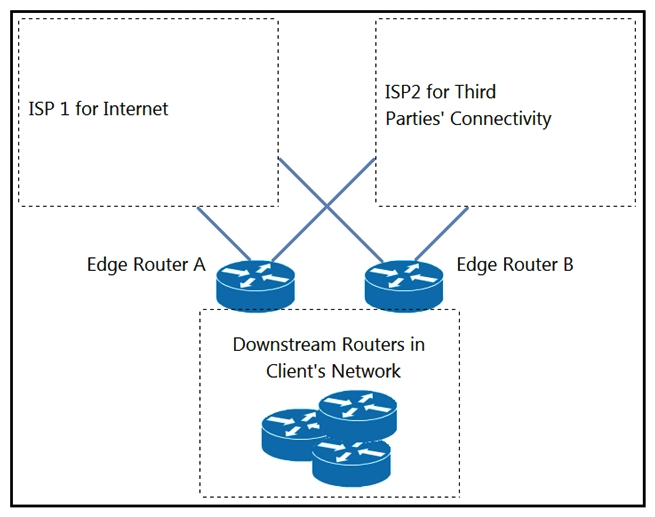 Refer to the exhibit. An engineer is designing a BGP solution for a client that peers with ISP1 for full Internet connectivity and with ISP2 for direct exchange of routes for several third parties. Which action, when implemented on the edge routers, enables the client network to reach the Internet through ISP1?
 (Multiple Choice)
4.7/5  (66)
(66) Which NETCONF operation creates filtering that is specific to the session notifications?
(Multiple Choice)
4.8/5 (73)
(73) Refer to the exhibit. An IPv6 network was just deployed in the environment and the help desk has reported that R3 is not able to SSH to R2's Loopback interface. Which sequence number of the filter is preventing access? 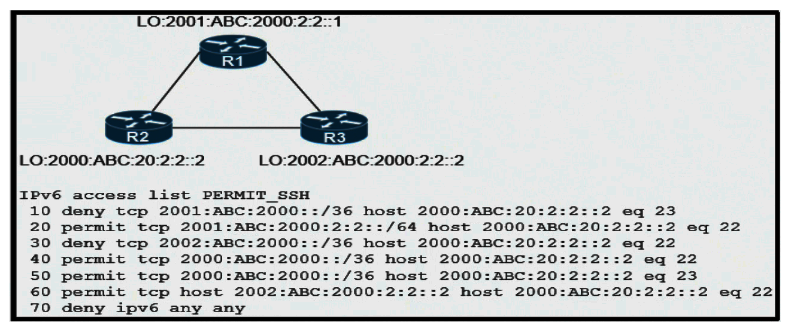
(Multiple Choice)
4.7/5 (76)
(76) 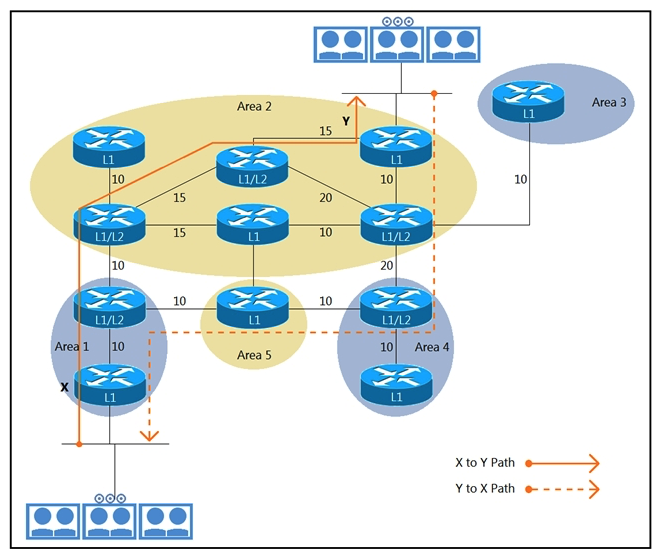 Refer to the exhibit. Customers report low video quality and delays when having point-to-point telepresence video calls between the two locations. An architect must optimize a design so that traffic follows the same path for egress and ingress traffic flows. Which technique optimizes the design?
 (Multiple Choice)
4.9/5 (77)
(77) A company is running BGP on a single router, which has two connections to the same ISP. Which BGP feature ensures traffic is load balanced across the two links to the ISP?
(Multiple Choice)
4.8/5 (74)
(74) 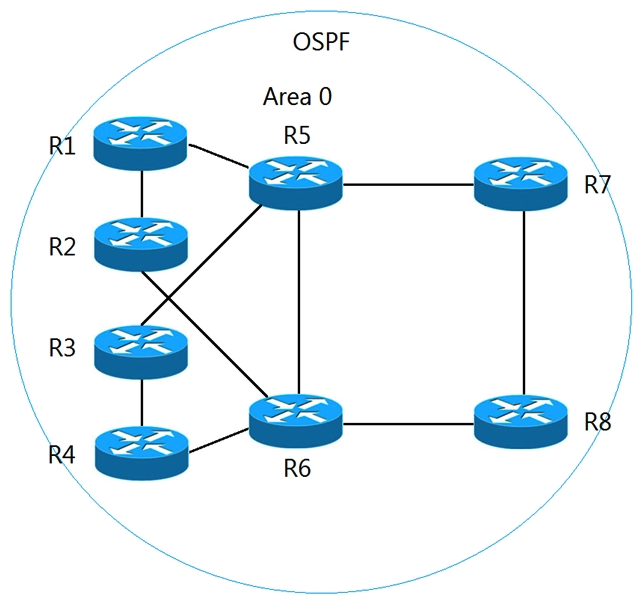 Refer to the exhibit. All routers currently reside in OSPF area 0. The network manager recently used R1 and R2 as aggregation routers for remote branch locations and R3 and R4 for aggregation routers for remote office locations. The network has since been suffering from outages, which are causing frequent SPF runs. To enhance stability and introduce areas to the OSPF network with the minimal number of ABRs possible, which two solutions should the network manager recommend? (Choose two.)
 (Multiple Choice)
5.0/5 (97)
(97) A company with multiple service providers wants to speed up BGP convergence time in the event a failure occurs with their primary link. Which approach achieves this goal and does not impact router CPU utilization?
(Multiple Choice)
4.8/5 (80)
(80) Which feature is required for graceful restart to recover from a processor failure?
(Multiple Choice)
4.8/5 (79)
(79) Which design consideration must be made when dual vEdge routers are deployed at a branch site?
(Multiple Choice)
4.8/5 (85)
(85) Instructions The main screen consists of two parts; the Main scenario and the Topology tabs. The main scenario describes TSHOOT.com test bed. The Topology tabs allow you to display the appropriate and select the trouble ticket. To complete the item, you will first need to familiarize yourself with the TSHOOT.com test bed by clicking on the master scenario first and then the topologies tabs. Once you are familiar with the test bed and the topologies, you should start evaluating the trouble ticket. You will be presented with a Trouble Ticket scenario that will describe the fault condition. You will need to determine on which device the fault condition is located, to which technology the fault condition is related, and the solution to each trouble ticket. This will be done by answering three questions. Ticket Selection To begin, click on the Ticket on the Topology tabs. Please note. Some of the questions will require you to use the scroll bar to see all options. Fault Isolation Read the ticket scenario to understand the fault condition. Open the appropriate topology, based upon the ticket scenario. Open the console of the desired device by clicking on that device in the topology, based upon your troubleshooting methodology. Use the supported show, ping and trace commands to begin your fault isolation process. Move to other devices as need by clicking on those devices within the topology. Fault Identification The trouble ticket will include three questions that you will need to answer, 1. Which device contains the fault 2. Which technology the fault condition is related to 3. What is the solution to the issue To advance to the next question within the ticket click on " Next Question ". When you click " DONE ", the trouble ticket will turn RED and will no longer be accessible. You may also use the " Previous Question " button to review questions within that specific ticket. To complete a trouble ticket, answer all three questions and click " ". This will store your response to the questions. Do not click on " " unless you have answered all questions within the ticket. Item Completion Click the NEXT button on the bottom of the screen once a ticket is . This action moves you to the next item. Scenario The company has created the test bed network shown in the layer 2 and layer 3 topology exhibits. This network consists of four routers, two layer 3 switches and two layer 2 switches. In the IPv4 layer 3 topology, R1, R2, R3, and R4 are running OSPF with an OSPF process number 1. DSW1, DSW2 and R4 are running EIGRP with an AS of 10. Redistribution is enabled where necessary. R1 is running a BGP AS with a number of 65001. This AS has an eBGP connection to AS 65002 in the ISP's network. Because the company's address space is in the private range, R1 is also providing NAT translations between the inside (10.1.0.0/16 & 10.2.0.0/16) networks and the outside (209.65.200.0/24) network. ASW1 and ASW2 are layer 2 switches. NTP is enabled on all devices with 209.65.200.226 serving as the master clock source. The client workstations receive their IP address and default gateway via R4's DHCP server. The default gateway address of 10.2.1.254 is the IP address of HSRP group 10 which is running on DSW1 and DSW2. In the IPv6 layer 3 topology R1, R2, and R3 are running OSPFv3 with an OSPF process number 6. DSW1, DSW2 and R4 are running RIPng process name RIP_ZONE. The two IPv6 routing domains, OSPF 6 and RIPng are connected via GRE tunnel running over the underlying IPv4 OSPF domain. Redistribution is enabled where necessary. Recently the implementation group has been using the test bed to do a 'proof-of-concept' on several implementations. This involved changing the configuration on one or more of the devices. You will be presented with a series of trouble tickets related to issues introduced during these configurations. 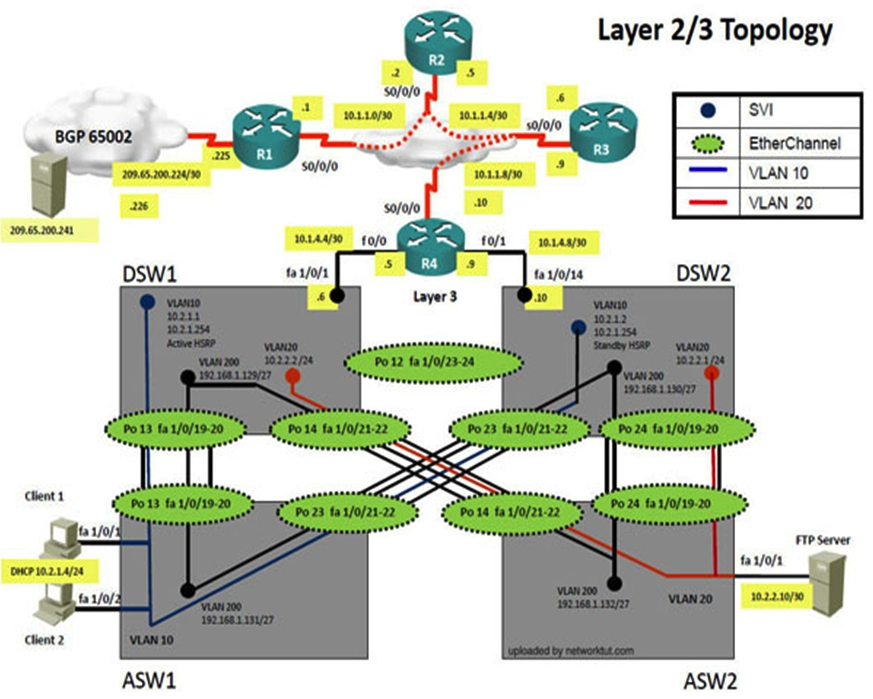 The implementation group has been using the test bed to do a 'proof-of-concept' that requires both Client 1 and Client 2 to access the WEB Server at 209.65.200.241. After several changes to the network addressing, routing schemes, DHCP services, NTP services, and FHRP services, a trouble ticket has been opened indicating that Client 1 cannot ping the 209.65.200.241 address. Use the supported commands to isolate the cause of this fault and answer the following questions. The fault condition is related to which technology?
 (Multiple Choice)
4.7/5 (83)
(83) Which design consideration must be made when using IPv6 overlay tunnels?
(Multiple Choice)
4.8/5 (83)
(83) 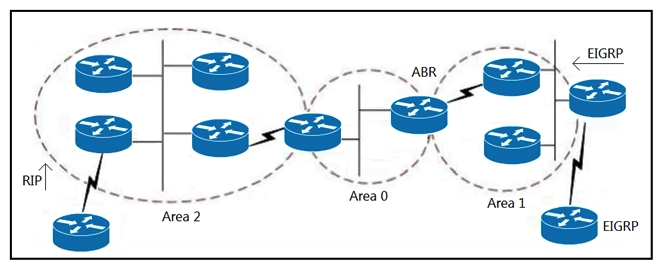 Refer to the exhibit. An engineer is designing an OSPF network for a client. Requirements dictate that the routers in Area 1 should receive all routes belonging to the network, including EIGRP, except the ones originated in the RIP domain. Which action should the engineer take?
 (Multiple Choice)
4.8/5 (101)
(101) How do endpoints inside an SD-Access network reach resources outside the fabric?
(Multiple Choice)
4.8/5 (75)
(75) Refer to the exhibit. MTU has been configured as shown, and no MTU command has been configured on the tunnel interfaces. It has been found that fragmentation is occurring when tunneled packets are placed onto the IPv6 underlay network. Which configuration change will resolve this problem? 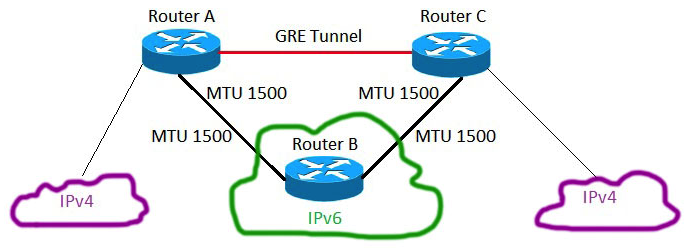
(Multiple Choice)
4.8/5 (69)
(69) Which feature must be incorporated into the campus LAN design to enable Wake on LAN?
(Multiple Choice)
4.9/5 (76)
(76) An engineer is designing an enterprise campus network. The LAN infrastructure consists of switches from multiple vendors, and Spanning Tree must be used as a Layer 2 loop prevention mechanism. All configured VLANs must be grouped in two SIP instances. Which standards-based Spanning Tree technology supports this design solution?
(Multiple Choice)
4.8/5 (82)
(82) When designing interdomain multicast, which two protocols are deployed to achieve communication between multicast sources and receivers? (Choose two.)
(Multiple Choice)
4.8/5 (68)
(68) Which OSPF area blocks LSA Type 3, 4 and 5, but allows a default summary route?
(Multiple Choice)
4.9/5 (82)
(82) When provisioning bandwidth for an IP telephony network, which elements are unique to an IP telephony call? (Choose two.)
(Multiple Choice)
4.9/5 (76)
(76) 
Filters
- Essay(0)
- Multiple Choice(0)
- Short Answer(0)
- True False(0)
- Matching(0)