



 Chat with AI
Exam 10: Designing Cisco Enterprise Networks (ENSLD)

Exam 1: Supporting Cisco Data Center System Devices (DCTECH)128 Questions
Exam 2: Cisco Certified Technician Routing & Switching (RSTECH)48 Questions
Exam 3: Understanding Cisco Cybersecurity Operations Fundamentals (CBROPS)141 Questions
Exam 4: Cisco Certified Network Associate (CCNA)411 Questions
Exam 5: Managing Industrial Networks with Cisco Networking Technologies (IMINS)36 Questions
Exam 6: DevNet Associate (DEVASC)134 Questions
Exam 7: Conducting Forensic Analysis and Incident Response Using Cisco CyberOps Technologies (CBRFIR)25 Questions
Exam 8: Implementing Cisco Enterprise Advanced Routing and Services (ENARSI)114 Questions
Exam 9: Implementing Cisco SD-WAN Solutions (ENSDWI)147 Questions
Exam 10: Designing Cisco Enterprise Networks (ENSLD)109 Questions
Exam 11: Designing Cisco Enterprise Wireless Networks (300-425 ENWLSD)106 Questions
Exam 12: Implementing Cisco Enterprise Wireless Networks (300-430 ENWLSI)101 Questions
Exam 13: Automating Cisco Enterprise Solutions (ENAUTO)84 Questions
Exam 14: Implementing Cisco Service Provider Advanced Routing Solutions (SPRI)74 Questions
Exam 15: Implementing Cisco Service Provider VPN Services (SPVI)49 Questions
Exam 16: Designing Cisco Data Center Infrastructure (DCID)73 Questions
Exam 17: Troubleshooting Cisco Data Center Infrastructure (DCIT)84 Questions
Exam 18: Implementing Cisco Application Centric Infrastructure (DCACI)101 Questions
Exam 19: Configuring Cisco MDS 9000 Series Switches (DCSAN)65 Questions
Exam 20: Implementing Cisco Application Centric Infrastructure - Advanced36 Questions
Exam 21: Automating Cisco Data Center Solutions (DCAUTO)36 Questions
Exam 22: Securing Networks with Cisco Firepower (300-710 SNCF)65 Questions
Exam 23: Implementing and Configuring Cisco Identity Services Engine (300-715 SISE)130 Questions
Exam 24: Securing Email with Cisco Email Security Appliance (300-720 SESA)65 Questions
Exam 25: Securing the Web with Cisco Web Security Appliance (300-725 SWSA)75 Questions
Exam 26: Implementing Secure Solutions with Virtual Private Networks (SVPN 300-730)49 Questions
Exam 27: Automating Cisco Security Solutions (SAUTO)75 Questions
Exam 28: Implementing Cisco Collaboration Applications (CLICA)39 Questions
Exam 29: Implementing Cisco Advanced Call Control and Mobility Services (CLASSM)86 Questions
Exam 30: Implementing Cisco Collaboration Cloud and Edge Solutions90 Questions
Exam 31: Implementing Cisco Collaboration Conferencing65 Questions
Exam 32: Automating Cisco Collaboration Solutions (CLAUTO)27 Questions
Exam 33: Implementing DevOps Solutions and Practices using Cisco Platforms (DEVOPS)66 Questions
Exam 34: Developing Solutions Using Cisco IoT and Edge Platforms (DEVIOT)33 Questions
Exam 35: Developing Applications for Cisco Webex and Webex Devices (DEVWBX)41 Questions
Exam 36: Performing CyberOps Using Core Security Technologies (CBRCOR)37 Questions
Exam 37: Implementing Cisco Enterprise Network Core Technologies (ENCOR)106 Questions
Exam 38: Implementing and Operating Cisco Service Provider Network Core Technologies (SPCOR)260 Questions
Exam 39: Implementing and Operating Cisco Data Center Core Technologies (DCCOR)116 Questions
Exam 40: Implementing and Operating Cisco Security Core Technologies208 Questions
Exam 41: Implementing Cisco Collaboration Core Technologies (CLCOR)213 Questions
Exam 42: Developing Applications using Cisco Core Platforms and APIs (DEVCOR)131 Questions
Exam 43: CCDE Design Written145 Questions
Exam 44: Deploying Cisco Unified Contact Center Express660 Questions
Exam 45: Cisco Meraki Solutions Specialist101 Questions
Exam 46: Securing Cisco Networks with Sourcefire FireAMP Endpoints24 Questions
Exam 47: Designing Cisco Unified Contact Center Enterprise (UCCED)227 Questions
Exam 48: Implementing and Supporting Cisco Unified Contact Center Enterprise (UCCEIS)55 Questions
Exam 49: Cisco Collaboration SaaS Authorization Exam47 Questions
Exam 50: Cisco Security Architecture for System Engineers56 Questions
Exam 51: Adopting The Cisco Business Architecture Approach (DTBAA)239 Questions
Exam 52: Cisco Customer Success Manager (CSM)44 Questions
Exam 53: Mastering The Cisco Business Architecture Discipline (DTBAD)36 Questions
Select questions type


A network solution is being designed for a company that connects to multiple Internet service providers. Which Cisco proprietary BGP path attribute will influence outbound traffic flow?
(Multiple Choice)
4.9/5  (71)
(71) A network engineer must segregate three interconnected campus networks using IS-IS routing. A two-layer hierarchy must be used to support large routing domains and to avoid more specific routes from each campus network being advertised to other campus network routers automatically. Which two actions does the engineer take to accomplish this segregation? (Choose two.)
(Multiple Choice)
4.9/5 (76)
(76) An engineer must design a VPN solution for a company that has multiple branches connecting to a main office. What are two advantages of using DMVPN instead of IPsec tunnels to accomplish this task? (Choose two.)
(Multiple Choice)
4.8/5 (82)
(82) A customer's current Layer 2 infrastructure is running Spanning Tree 802.1d, and all configuration changes are manually implemented on each switch. An architect must redesign the Layer 2 domain to achieve these goals: • reduce the impact of topology changes • reduce the time spent on network administration • reduce manual configuration errors Which two solutions should the architect include in the new design? (Choose two.)
(Multiple Choice)
4.9/5 (80)
(80) A company is using OSPF between its HQ location and a branch office. HQ is assigned area 0 and the branch office is assigned area 1. The company purchases a second branch office, but due to circuit delays to HQ, it decides to connect the new branch office to the existing branch office as a temporary measure. The new branch office is assigned to area 2. Which OSPF configuration enables all three locations to exchange routes?
(Multiple Choice)
4.8/5 (77)
(77) What is the function of the multicast Reverse Path Forwarding check?
(Multiple Choice)
4.9/5 (91)
(91) An engineer is designing a QoS policy that queues excess packets for later transmission. Which mechanism must be included in the design?
(Multiple Choice)
4.7/5 (79)
(79) Which control-plane technology allows the same subnet to exist across multiple network locations?
(Multiple Choice)
4.8/5 (71)
(71) Which two tasks must you perform to configure DHCP snooping on a device? (Choose two.)
(Multiple Choice)
4.7/5 (87)
(87) Which statement describes what happens if all VSL connections between the virtual switch members are lost?
(Multiple Choice)
4.8/5 (77)
(77) Which switch feature prevents traffic on a LAN from being overwhelmed by continuous multicast or broadcast traffic?
(Multiple Choice)
4.9/5 (85)
(85) Which authentication service is needed to configure 802.1x?
(Multiple Choice)
4.9/5 (87)
(87) Company A recently acquired another company. Users of the newly acquired company must be able to access a server that exists on Company A's network, both companies use overlapping IP address ranges. Which action conserves IP address space and provides access to the server?
(Multiple Choice)
4.9/5 (72)
(72) Which consideration must be taken into account when using the DHCP relay feature in a Cisco SD-Access Architecture?
(Multiple Choice)
4.9/5 (81)
(81) When vEdge router redundancy is designed, which FHRP is supported?
(Multiple Choice)
4.9/5 (86)
(86) Instructions The main screen consists of two parts the Main scenario and the Topology tabs. The main scenario describes TSHOOT.com test bed. The Topology tabs allow you to display the appropriate and select the trouble ticket. To complete the item, you will first need to familiarize yourself with the TSHOOT.com test bed by clicking on the master scenario first and then the topologies tabs. Once you are familiar with the test bed and the topologies, you should start evaluating the trouble ticket. You will be presented with a Trouble Ticket scenario that will describe the fault condition. You will need to determine on which device the fault condition is located, to which technology the fault condition is related, and the solution to each trouble ticket. This will be done by respnsing three questions. Ticket Selection To begin, click on the Ticket on the Topology tabs. Please note. Some of the questions will require you to use the scroll bar to see all options. Fault Isolation Read the ticket scenario to understand the fault condition. Open the appropriate topology, based upon the ticket scenario. Open the console of the desired device by clicking on that device in the topology, based upon your troubleshooting methodology. Use the supported show, ping and trace commands to begin your fault isolation process. Move to other devices as need by clicking on those devices within the topology. Fault Identification The trouble ticket will include three questions that you will need to answer, 1. Which device contains the fault 2. Which technology the fault condition is related to 3. What is the solution to the issue To advance to the next question within the ticket click on " Next Question ". When you click " DONE ", the trouble ticket will turn RED and will no longer be accessible. You may also use the " Previous Question " button to review questions within that specific ticket. To complete a trouble ticket, answer all three questions and click " ". This will store your response to the questions. Do not click on " " unless you have responsed all questions within the ticket. Item Completion Click the NEXT button on the bottom of the screen once a ticket is . This action moves you to the next item. Scenario The company has created the test bed network shown in the layer 2 and layer 3 topology exhibits. This network consists of four routers, two layer 3 switches and two layer 2 switches. In the IPv4 layer 3 topology, R1, R2, R3, and R4 are running OSPF with an OSPF process number 1. DSW1, DSW2 and R4 are running EIGRP with an AS of 10. Redistribution is enabled where necessary. R1 is running a BGP AS with a number of 65001. This AS has an eBGP connection to AS 65002 in the ISP's network. Because the company's address space is in the private range, R1 is also providing NAT translations between the inside (10.1.0.0/16 & 10.2.0.0/16) networks and the outside (209.65.200.0/24) network. ASW1 and ASW2 are layer 2 switches. NTP is enabled on all devices with 209.65.200.226 serving as the master clock source. The client workstations receive their IP address and default gateway via R4's DHCP server. The default gateway address of 10.2.1.254 is the IP address of HSRP group 10 which is running on DSW1 and DSW2. In the IPv6 layer 3 topology R1, R2, and R3 are running OSPFv3 with an OSPF process number 6. DSW1, DSW2 and R4 are running RIPng process name RIP_ZONE. The two IPv6 routing domains, OSPF 6 and RIPng are connected via GRE tunnel running over the underlying IPv4 OSPF domain. Redistribution is enabled where necessary. Recently the implementation group has been using the test bed to do a 'proof-of-concept' on several implementations. This involved changing the configuration on one or more of the devices. You will be presented with a series of trouble tickets related to issues introduced during these configurations. 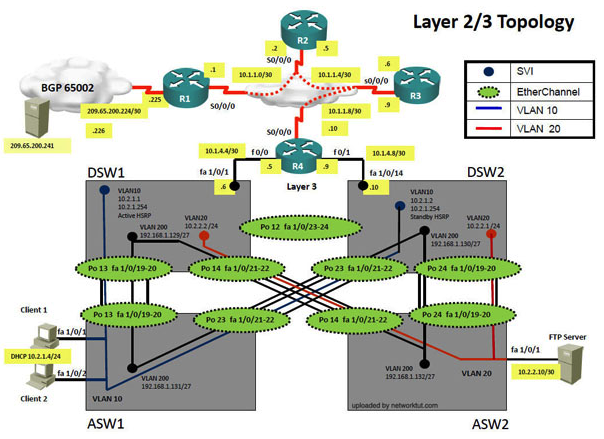 The implementation group has been using the test bed to do a 'proof-of-concept' that requires both Client 1 and Client 2 to access the WEB Server at 209.65.200.241. After several changes to the network addressing, routing scheme, DHCP services, NTP services, and FHRP services, a trouble ticket has been opened indicating that Client 1 cannot ping the 209.65.200.241 address. Use the supported commands to isolate the cause of this fault and answer the following questions. What is the solution to the fault condition?
 (Multiple Choice)
4.7/5 (76)
(76) Which two best practices must be followed when designing an out-of-band management network? (Choose two.)
(Multiple Choice)
4.8/5 (95)
(95) Which two statements describe source trees in a multicast environment? (Choose two.)
(Multiple Choice)
5.0/5 (73)
(73) How is end-to-end microsegmentation enforced in a Cisco SD-Access architecture?
(Multiple Choice)
4.9/5 (78)
(78) When a first hop redundancy solution is designed, which protocol ensures that load balancing occurs over multiple routers using a single virtual IP address and multiple virtual MAC addresses?
(Multiple Choice)
4.9/5 (83)
(83) 
Filters
- Essay(0)
- Multiple Choice(0)
- Short Answer(0)
- True False(0)
- Matching(0)