



 Chat with AI
Exam 15: Introduction to the Analysis of Variance

Exam 1: Statistics and Scientific Method102 Questions
Exam 2: Basic Mathematical and Measurement Concepts110 Questions
Exam 3: Frequency Distributions116 Questions
Exam 4: Measures of Central Tendency and Variability125 Questions
Exam 5: The Normal Curve and Standard Scores105 Questions
Exam 6: Correlation139 Questions
Exam 7: Linear Regression101 Questions
Exam 8: Random Sampling and Probability123 Questions
Exam 9: Binomial Distribution121 Questions
Exam 10: Introduction to Hypothesis Testing: Using the Sign Test141 Questions
Exam 11: Power103 Questions
Exam 12: Sampling Distributions, Sampling Distribution of the Mean: the Normal Deviate Z Test135 Questions
Exam 13: Students T Test for Single Samples121 Questions
Exam 14: Students T Test for Correlated and Independent Groups145 Questions
Exam 15: Introduction to the Analysis of Variance218 Questions
Exam 16: Introduction to the Two-Way Analysis of Variance115 Questions
Exam 17: Chi-Square and Other Nonparametric Tests170 Questions
Select questions type


A researcher is interested in knowing if different types of treatments have an effect on the number of relapses for clients with the diagnosis of alcoholism. He randomly selects a group of 24 clients from a waiting list at a local mental health center who consent to the study. Then he randomly assigns 6 subjects to each treatment group. Group 1 is a waiting list control group. They are given no treatment. Group 2 receives a medication that causes illness when alcohol is consumed. Group 3 gets cognitive behavior therapy, and Group 4 gets cognitive behavior therapy plus the drug. The researcher then records the number of relapses in the next 12 months. The following data are obtained.
a. State the alternative hypothesis.
b. State the null hypothesis.
c. What is the value of SS within ?
d. What is the value of SS between ?
e. What is the value of SS total ?
f. What is the value of F obt ?
g. What do you conclude, using a = 0.05?
h. What is the size of the effect, using  ?
i. What is the size of the effect, using 2?
?
i. What is the size of the effect, using 2? (Not Answered)
This question doesn't have any answer yet
An experimental psychologist used 5 different methods to teach rats to run a maze. The ANOVA results are shown below along with the sample means.  *With a = 0.01 F crit = 4.98, therefore reject H0 . = 13.75, = 7.75 , = 13.25 , = 12.50 , = 5.75 (seconds)
a. Do a planned comparison test on the difference between group 2 and group 4. Are the results significant using a = 0.01 1 tail ? Assume equal n 's in each group.
b. Is group 2 different from group 4 using a = 0.01 with the HSD test?
c. Is group 2 different from group 4 using a = 0.01 with the Scheffé test?
d. Explain any differences in results between parts a, b and c.
*With a = 0.01 F crit = 4.98, therefore reject H0 . = 13.75, = 7.75 , = 13.25 , = 12.50 , = 5.75 (seconds)
a. Do a planned comparison test on the difference between group 2 and group 4. Are the results significant using a = 0.01 1 tail ? Assume equal n 's in each group.
b. Is group 2 different from group 4 using a = 0.01 with the HSD test?
c. Is group 2 different from group 4 using a = 0.01 with the Scheffé test?
d. Explain any differences in results between parts a, b and c. (Not Answered)
This question doesn't have any answer yet
Using the Scheffé test, the appropriate critical value = _________.
(Multiple Choice)
4.7/5  (89)
(89) A significant F obt value indicates that all the group means are significantly different from each other.
(True/False)
4.9/5 (80)
(80) When comparisons are planned in advance of conducting the experiment, you need a significant value for F obt before you can make the comparisons.
(True/False)
4.9/5 (88)
(88) An investigator conducts an experiment involving the effects of three levels of a drug on memory. Subjects are randomly assigned to one of three conditions. A different drug level is administered in each condition. Memory is measured 10 minutes after each subject receives the drug. The following scores are recorded. The higher the score, the better the memory. 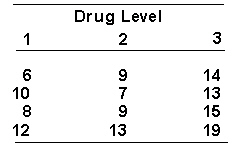 Assume you are doing post hoc testing between drug levels 2 and 3 using the Scheff test. Given the following values obtained from the ANOVA:
 ,
 ,
 , n 1 = n 2 = n 3 = 4, k = 3, df between = 2, df within = 9, MSwithin = 6.639, the value of SS between ( groups i and j) = _________.
Assume you are doing post hoc testing between drug levels 2 and 3 using the Scheff test. Given the following values obtained from the ANOVA: , , , n 1 = n 2 = n 3 = 4, k = 3, df between = 2, df within = 9, MSwithin = 6.639, the value of SS between ( groups i and j) = _________. (Multiple Choice)
4.8/5 (71)
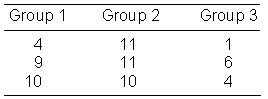
(71) Given the following data:  a. What is the value of F obt
b. What is the value of ?
c. What is the value of SS total ?
a. What is the value of F obt
b. What is the value of ?
c. What is the value of SS total ? (Not Answered)
This question doesn't have any answer yet
Is the Type I error rate higher when doing a priori comparisons or when doing the Tukey HSD test? Explain.
(Short Answer)
4.8/5 (69)
(69) The ANOVA is robust regardless of whether or not sample sizes are equal.
(True/False)
4.7/5 (70)
(70) With a priori comparisons, there is no correction for the inflated probability of making a Type I error.
(True/False)
4.8/5 (86)
(86) In general, which of the following tests is the most powerful test to detect a difference between group means?
(Multiple Choice)
4.9/5 (89)
(89) 

Filters
- Essay(0)
- Multiple Choice(0)
- Short Answer(0)
- True False(0)
- Matching(0)