



 Chat with AI
Exam 15: Introduction to the Analysis of Variance

Exam 1: Statistics and Scientific Method102 Questions
Exam 2: Basic Mathematical and Measurement Concepts110 Questions
Exam 3: Frequency Distributions116 Questions
Exam 4: Measures of Central Tendency and Variability125 Questions
Exam 5: The Normal Curve and Standard Scores105 Questions
Exam 6: Correlation139 Questions
Exam 7: Linear Regression101 Questions
Exam 8: Random Sampling and Probability123 Questions
Exam 9: Binomial Distribution121 Questions
Exam 10: Introduction to Hypothesis Testing: Using the Sign Test141 Questions
Exam 11: Power103 Questions
Exam 12: Sampling Distributions, Sampling Distribution of the Mean: the Normal Deviate Z Test135 Questions
Exam 13: Students T Test for Single Samples121 Questions
Exam 14: Students T Test for Correlated and Independent Groups145 Questions
Exam 15: Introduction to the Analysis of Variance218 Questions
Exam 16: Introduction to the Two-Way Analysis of Variance115 Questions
Exam 17: Chi-Square and Other Nonparametric Tests170 Questions
Select questions type


An investigator conducts an experiment involving the effects of three levels of a drug on memory. Subjects are randomly assigned to one of three conditions. A different drug level is administered in each condition. Memory is measured 10 minutes after each subject receives the drug. The following scores are recorded. The higher the score, the better the memory. 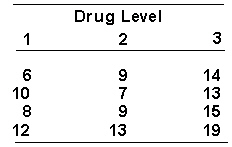 The value of F Scheff is _________.
 (Multiple Choice)
4.9/5  (83)
(83) With one-way, independent groups ANOVA, increasing N causes MSbetween to decrease, thereby producing an increase in power.
(True/False)
4.9/5 (84)
(84) If k = 2, the t test for independent groups, the F test, and the t test for planned comparisons are all essentially the same test.
(True/False)
5.0/5 (75)
(75) A clinical psychologist is interested in comparing the effectiveness of short term relaxation and cognitive-behavioral therapy in treating mild depression. An experiment is conducted in which 15 patients with mild depression are randomly selected and assigned 5 each to a relaxation therapy group, a cognitive/behavioral therapy group, and an attention placebo group. Therapy is administered until the patient is judged no longer depressed or until 10 treatment sessions have elapsed. The following data is obtained. Scores are the number of sessions for each patient.  Using a = 0.05, F crit = _________.
 (Multiple Choice)
4.8/5 (81)
(81) A clinical psychologist is interested in comparing the effectiveness of short term relaxation and cognitive-behavioral therapy in treating mild depression. An experiment is conducted in which 15 patients with mild depression are randomly selected and assigned 5 each to a relaxation therapy group, a cognitive/behavioral therapy group, and an attention placebo group. Therapy is administered until the patient is judged no longer depressed or until 10 treatment sessions have elapsed. The following data is obtained. Scores are the number of sessions for each patient.  MSbetween = _________.
 (Multiple Choice)
4.8/5 (66)
(66) The F distribution is a family of curves, each uniquely determined by df.
(True/False)
4.7/5 (91)
(91) Power is generally the same for the HSD test and the Scheffé test.
(True/False)
4.8/5 (71)
(71) In general, if the consequence of making a Type I error were much greater than making a Type II, it would be preferable to use the HSD test rather than the Scheffé test for a post hoc analysis.
(True/False)
4.7/5 (76)
(76) If F obt is significant, it is possible to tell which groups differ from which without further analysis.
(True/False)
4.9/5 (68)
(68)  ).
Doing multiple comparisons following a three group ANOVA with equal n in each group, the critical value of the inference test statistic changes from comparison-to-comparison in the _________.
(Multiple Choice)
4.8/5 (92)
(92) The alternative hypothesis in an ANOVA can be either directional or nondirectional.
(True/False)
4.8/5 (77)
(77) The null hypothesis in the one-way ANOVA asserts that _________.
(Multiple Choice)
4.9/5 (72)
(72) A clinical psychologist is interested in comparing the effectiveness of short term relaxation and cognitive-behavioral therapy in treating mild depression. An experiment is conducted in which 15 patients with mild depression are randomly selected and assigned 5 each to a relaxation therapy group, a cognitive/behavioral therapy group, and an attention placebo group. Therapy is administered until the patient is judged no longer depressed or until 10 treatment sessions have elapsed. The following data is obtained. Scores are the number of sessions for each patient.  Assume you wanted to compare cognitive/behavioral therapy with relaxation therapy, using planned comparisons and a nondirectional H 1 . The obtained value of the appropriate statistic is _________.
 (Multiple Choice)
4.8/5 (67)
(67) 
Filters
- Essay(0)
- Multiple Choice(0)
- Short Answer(0)
- True False(0)
- Matching(0)