



 Chat with AI
Exam 15: Introduction to the Analysis of Variance

Exam 1: Statistics and Scientific Method102 Questions
Exam 2: Basic Mathematical and Measurement Concepts110 Questions
Exam 3: Frequency Distributions116 Questions
Exam 4: Measures of Central Tendency and Variability125 Questions
Exam 5: The Normal Curve and Standard Scores105 Questions
Exam 6: Correlation139 Questions
Exam 7: Linear Regression101 Questions
Exam 8: Random Sampling and Probability123 Questions
Exam 9: Binomial Distribution121 Questions
Exam 10: Introduction to Hypothesis Testing: Using the Sign Test141 Questions
Exam 11: Power103 Questions
Exam 12: Sampling Distributions, Sampling Distribution of the Mean: the Normal Deviate Z Test135 Questions
Exam 13: Students T Test for Single Samples121 Questions
Exam 14: Students T Test for Correlated and Independent Groups145 Questions
Exam 15: Introduction to the Analysis of Variance218 Questions
Exam 16: Introduction to the Two-Way Analysis of Variance115 Questions
Exam 17: Chi-Square and Other Nonparametric Tests170 Questions
Select questions type


For this problem consider the following information from an experiment to compare differences between the length of time a house paint lasts before it begins to fade. The number of subjects are the same in each group.  , , , Using the HSD test, the value of Q obt for the testing the difference between and is _________.
 (Multiple Choice)
4.8/5  (88)
(88) Consider the following data from an independent groups design:
a. Is it appropriate to use parametric ANOVA to analyze these results? Why or why not?
(Short Answer)
4.9/5 (87)
(87) An investigator conducts an experiment involving the effects of three levels of a drug on memory. Subjects are randomly assigned to one of three conditions. A different drug level is administered in each condition. Memory is measured 10 minutes after each subject receives the drug. The following scores are recorded. The higher the score, the better the memory. 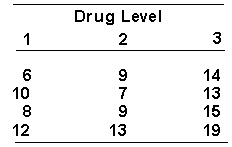 Using the Scheff test with a = 0.05, F crit = _________.
 (Multiple Choice)
4.9/5 (89)
(89) If SS total = 106 and SS within = 24, what is the value of SS between ?
(Short Answer)
4.8/5 (91)
(91) Give two conditions that should be met before doing a priori comparisons that are not independent.
(Short Answer)
4.9/5 (90)
(90) A clinical psychologist is interested in comparing the effectiveness of short term relaxation and cognitive-behavioral therapy in treating mild depression. An experiment is conducted in which 15 patients with mild depression are randomly selected and assigned 5 each to a relaxation therapy group, a cognitive/behavioral therapy group, and an attention placebo group. Therapy is administered until the patient is judged no longer depressed or until 10 treatment sessions have elapsed. The following data is obtained. Scores are the number of sessions for each patient.  The value of F Scheffé is _________.
 (Multiple Choice)
4.9/5 (78)
(78) A clinical psychologist is interested in comparing the effectiveness of short term relaxation and cognitive-behavioral therapy in treating mild depression. An experiment is conducted in which 15 patients with mild depression are randomly selected and assigned 5 each to a relaxation therapy group, a cognitive/behavioral therapy group, and an attention placebo group. Therapy is administered until the patient is judged no longer depressed or until 10 treatment sessions have elapsed. The following data is obtained. Scores are the number of sessions for each patient.  Assume you are comparing cognitive/behavioral therapy with relaxation therapy, using the HSD test. The obtained value of the appropriate statistic is _________.
 (Multiple Choice)
5.0/5 (72)
(72) A clinical psychologist is interested in comparing the effectiveness of short term relaxation and cognitive-behavioral therapy in treating mild depression. An experiment is conducted in which 15 patients with mild depression are randomly selected and assigned 5 each to a relaxation therapy group, a cognitive/behavioral therapy group, and an attention placebo group. Therapy is administered until the patient is judged no longer depressed or until 10 treatment sessions have elapsed. The following data is obtained. Scores are the number of sessions for each patient.  F obt = _________.
 (Multiple Choice)
4.8/5 (77)
(77) If s 12 = 9, s 22 = 6, s 32 = 8, and n 1 ≠ n 2 ≠ n 3 , then MSwithin equals _________.
(Multiple Choice)
4.9/5 (83)
(83) The within-groups variability increases necessarily as the between-groups variability increases.
(True/False)
4.9/5 (77)
(77) List three variables, not including beta, that affect the power of the ANOVA and state what increases in each do to the power of the ANOVA.
(Short Answer)
4.8/5 (73)
(73) Both the HSD and the Scheffé test use the Studentized Range distributions.
(True/False)
5.0/5 (77)
(77) When doing planned comparisons, the denominator of the t equation changes for each pair of means compared.
(True/False)
4.9/5 (85)
(85) 
Filters
- Essay(0)
- Multiple Choice(0)
- Short Answer(0)
- True False(0)
- Matching(0)