



 Chat with AI
Exam 15: Introduction to the Analysis of Variance

Exam 1: Statistics and Scientific Method102 Questions
Exam 2: Basic Mathematical and Measurement Concepts110 Questions
Exam 3: Frequency Distributions116 Questions
Exam 4: Measures of Central Tendency and Variability125 Questions
Exam 5: The Normal Curve and Standard Scores105 Questions
Exam 6: Correlation139 Questions
Exam 7: Linear Regression101 Questions
Exam 8: Random Sampling and Probability123 Questions
Exam 9: Binomial Distribution121 Questions
Exam 10: Introduction to Hypothesis Testing: Using the Sign Test141 Questions
Exam 11: Power103 Questions
Exam 12: Sampling Distributions, Sampling Distribution of the Mean: the Normal Deviate Z Test135 Questions
Exam 13: Students T Test for Single Samples121 Questions
Exam 14: Students T Test for Correlated and Independent Groups145 Questions
Exam 15: Introduction to the Analysis of Variance218 Questions
Exam 16: Introduction to the Two-Way Analysis of Variance115 Questions
Exam 17: Chi-Square and Other Nonparametric Tests170 Questions
Select questions type


The ANOVA is used to test the hypothesis that the group variances are equal.
(True/False)
4.8/5  (80)
(80) A company that sells honey wishes to find out if the strain of bee they use (strain 1) is the most productive bee available. To study the question the four available strains are tested at their research farm to see how much honey is produced by each type of bee. Test hives are set up and the number of ounces of honey each hive produces is recorded and given below.
a. Are any a priori comparisons appropriate and if so which ones?
b. Using a = .05 1 tail is there a difference between strain 1 and strain 2 using planned comparisons?
c. Using a = 0.05 and the HSD test, which strains are different in the amount of honey they produce?
d. Same as part c, using the Scheffé test.
(Essay)
4.8/5 (81)
(81) When doing post hoc comparisons, it is necessary to have a significant value for F obt before you can make the comparisons.
(True/False)
4.8/5 (80)
(80) When using multiple comparisons, a priori comparisons are more powerful than either the HSD or Scheffé tests.
(True/False)
4.8/5 (91)
(91) The probability of making a Type II error is the same, regardless of sample size, for the HSD test.
(True/False)
4.7/5 (81)
(81) The reason we use MSwithin based on all the groups instead of just two groups in doing multiple comparisons is because it gives us the best estimate of µ .
(True/False)
4.9/5 (73)
(73) The most powerful and most legitimate way of doing multiple comparisons is to plan to do all possible pairwise comparisons prior to the experiment.
(True/False)
4.8/5 (82)
(82) An investigator conducts an experiment involving the effects of three levels of a drug on memory. Subjects are randomly assigned to one of three conditions. A different drug level is administered in each condition. Memory is measured 10 minutes after each subject receives the drug. The following scores are recorded. The higher the score, the better the memory. 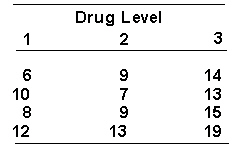 ΣSwithin = _________.
 (Multiple Choice)
4.8/5 (89)
(89) An investigator conducts an experiment involving the effects of three levels of a drug on memory. Subjects are randomly assigned to one of three conditions. A different drug level is administered in each condition. Memory is measured 10 minutes after each subject receives the drug. The following scores are recorded. The higher the score, the better the memory. 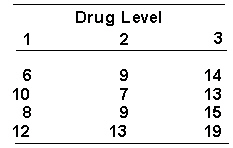 ΣS between = _________.
 (Multiple Choice)
4.9/5 (63)
(63) An investigator conducts an experiment involving the effects of three levels of a drug on memory. Subjects are randomly assigned to one of three conditions. A different drug level is administered in each condition. Memory is measured 10 minutes after each subject receives the drug. The following scores are recorded. The higher the score, the better the memory. 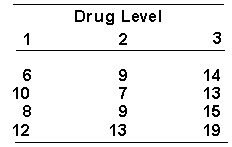 Assume you are doing planned comparisons, using a = .05. The critical value is _________.
 (Multiple Choice)
4.8/5 (95)
(95) An investigator conducts an experiment involving the effects of three levels of a drug on memory. Subjects are randomly assigned to one of three conditions. A different drug level is administered in each condition. Memory is measured 10 minutes after each subject receives the drug. The following scores are recorded. The higher the score, the better the memory. 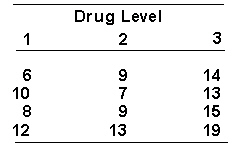 Assume you wanted to compare drug levels 2 and 3 using planned comparisons and a nondirectional H 1 . Given
 ,
 ,
 , n = 4, MSwithin = 6.639, df within = 9, df between = 2, k = 3, the obtained value of the appropriate statistic is _________.
Assume you wanted to compare drug levels 2 and 3 using planned comparisons and a nondirectional H 1 . Given , , , n = 4, MSwithin = 6.639, df within = 9, df between = 2, k = 3, the obtained value of the appropriate statistic is _________. (Multiple Choice)
4.9/5 (78)
(78) A clinical psychologist is interested in comparing the effectiveness of short term relaxation and cognitive-behavioral therapy in treating mild depression. An experiment is conducted in which 15 patients with mild depression are randomly selected and assigned 5 each to a relaxation therapy group, a cognitive/behavioral therapy group, and an attention placebo group. Therapy is administered until the patient is judged no longer depressed or until 10 treatment sessions have elapsed. The following data is obtained. Scores are the number of sessions for each patient.  MSwithin = _________.
 (Multiple Choice)
4.9/5 (74)
(74) 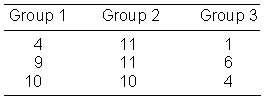
Define one-way analysis of variance, independent groups design.
(Short Answer)
4.7/5 (80)
(80) 
Filters
- Essay(0)
- Multiple Choice(0)
- Short Answer(0)
- True False(0)
- Matching(0)