



 Chat with AI
Exam 15: Introduction to the Analysis of Variance

Exam 1: Statistics and Scientific Method102 Questions
Exam 2: Basic Mathematical and Measurement Concepts110 Questions
Exam 3: Frequency Distributions116 Questions
Exam 4: Measures of Central Tendency and Variability125 Questions
Exam 5: The Normal Curve and Standard Scores105 Questions
Exam 6: Correlation139 Questions
Exam 7: Linear Regression101 Questions
Exam 8: Random Sampling and Probability123 Questions
Exam 9: Binomial Distribution121 Questions
Exam 10: Introduction to Hypothesis Testing: Using the Sign Test141 Questions
Exam 11: Power103 Questions
Exam 12: Sampling Distributions, Sampling Distribution of the Mean: the Normal Deviate Z Test135 Questions
Exam 13: Students T Test for Single Samples121 Questions
Exam 14: Students T Test for Correlated and Independent Groups145 Questions
Exam 15: Introduction to the Analysis of Variance218 Questions
Exam 16: Introduction to the Two-Way Analysis of Variance115 Questions
Exam 17: Chi-Square and Other Nonparametric Tests170 Questions
Select questions type


Assuming that the sample sizes are equal, N = 12 and that k = 3, consider the following data: s 1 = 8.113, s 2 = 8.816, s 3 = 7.258
a. What is the value of s W 2
b. What is the value of ΣS within ?
(Short Answer)
4.9/5  (75)
(75) A clinical psychologist is interested in comparing the effectiveness of short term relaxation and cognitive-behavioral therapy in treating mild depression. An experiment is conducted in which 15 patients with mild depression are randomly selected and assigned 5 each to a relaxation therapy group, a cognitive/behavioral therapy group, and an attention placebo group. Therapy is administered until the patient is judged no longer depressed or until 10 treatment sessions have elapsed. The following data is obtained. Scores are the number of sessions for each patient.  Assume you are doing post hoc testing between cognitive behavioral therapy and relaxation therapy, using the Scheffé test. Given the following values obtained from the ANOVA: , , , n 1 = n 2 = n 3 = 5, k = 3, df between = 2, df within = 12, MSwithin = 1.900, the value of SS between ( groups i and j) = _________.
 (Multiple Choice)
4.8/5 (81)
(81) The analysis of variance is used to test for differences between sample means when k ≥ 2.
(True/False)
4.8/5 (87)
(87) A dentist wants to know if the flavor of toothpaste affects how often children brush their teeth, and therefore the number of cavities. She makes up 3 flavors of toothpaste, cherry, bubble gum and spinach and observes the following numbers of cavities at a 6-month check-up:
a. State H1 .
b. State H0 .
c. What is the value of MSbetween ?
d. What is the value of MSwithin ?
e. What is the value of F obt ?
f. What is the value of F crit , a = 0.05?
g. What do you conclude using a = 0.05?
(Essay)
4.8/5 (91)
(91) The appropriate sampling distribution for the HSD test is the Studentized Range distribution.
(True/False)
4.8/5 (83)
(83) The following data were obtained from an experiment to test the effect of different levels of variable A on heart rate (beats per minute).
a. What is the value of MS 1between ?
b. What is the value of MSwithin ?
c. What is the value of F obt ?
d. What is the value of F crit , a = 0.01?
e. What do you conclude, using a = 0.01?
(Essay)
4.7/5 (79)
(79) By doing multiple t tests when there are more than 2 experimental groups we increase the risk of making what kind of mistake?
(Multiple Choice)
4.8/5 (69)
(69)  , the estimated size of effect is _________.
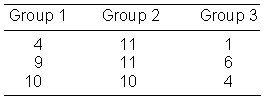
A clinical psychologist is interested in comparing the effectiveness of short term relaxation and cognitive-behavioral therapy in treating mild depression. An experiment is conducted in which 15 patients with mild depression are randomly selected and assigned 5 each to a relaxation therapy group, a cognitive/behavioral therapy group, and an attention placebo group. Therapy is administered until the patient is judged no longer depressed or until 10 treatment sessions have elapsed. The following data is obtained. Scores are the number of sessions for each patient.  Estimate the size of the effect. = _________
 (Multiple Choice)
5.0/5 (94)
(94) An investigator conducts an experiment involving the effects of three levels of a drug on memory. Subjects are randomly assigned to one of three conditions. A different drug level is administered in each condition. Memory is measured 10 minutes after each subject receives the drug. The following scores are recorded. The higher the score, the better the memory. 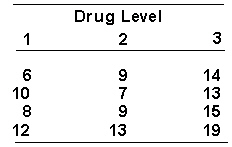 Using a = .05, what do you conclude?
 (Multiple Choice)
4.9/5 (64)
(64) As the differences between the group means increases, _________.
(Multiple Choice)
4.9/5 (79)
(79) A major limitation of a two group design is that _________.
(Multiple Choice)
4.8/5 (71)
(71) The sampling distribution of F is a family of positively skewed curves each with a mean equal to 0.
(True/False)
4.9/5 (86)
(86) Is it possible to have a significant result with k = 2 using the t test, but when reanalyzing the data using the F test obtain a nonsignificant result? Explain. (Assume a is the same, the design is the same and you don't make a calculation error.)
(Essay)
4.9/5 (75)
(75) A researcher conducts an independent groups experiment and analyzes the data with the t test for independent groups. Assume t obt = 2.23. Also assume this result is significant at the 0.05 level. Could this data have been analyzed with one-way, independent groups ANOVA? If so, what do you think the value of F obt would be? Would the result be significant with the ANOVA analysis too? Explain.
(Short Answer)
5.0/5 (97)
(97) What is the value of F crit for an experiment with k = 3, n 1 = n 2 = n 3 = 10 subjects, and a = 0.01?
(Multiple Choice)
4.8/5 (74)
(74) If = 46, = 50, = 92 and n 1 = n 2 = n 3 , what is the value of ?
(Multiple Choice)
4.9/5 (78)
(78) 
Filters
- Essay(0)
- Multiple Choice(0)
- Short Answer(0)
- True False(0)
- Matching(0)