



 Chat with AI
Exam 5: Solution Concentration

Exam 1: Measurements in Science and Medicine77 Questions
Exam 2: Atoms, Elements, and Compounds77 Questions
Exam 3: Chemical Bonds83 Questions
Exam 4: Energy and Physical Properties74 Questions
Exam 5: Solution Concentration77 Questions
Exam 6: Chemical Reactions68 Questions
Exam 7: Acids and Bases85 Questions
Exam 8: Nuclear Chemistry67 Questions
Exam 9: Hydrocarbons: an Introduction to Organic Molecules74 Questions
Exam 10: Hydration, Dehydration, and Alcohols61 Questions
Exam 11: Carbonyl Compounds and Redox Reactions71 Questions
Exam 12: Organic Acids and Bases64 Questions
Exam 13: Condensation and Hydrolysis Reactions72 Questions
Exam 14: Proteins67 Questions
Exam 15: Carbohydrates75 Questions
Exam 16: Lipids and Membranes79 Questions
Exam 17: Nucleic Acids, Protein Synthesis, and Heredity71 Questions
Select questions type


For the following questions, fill in the blank with one of the following terms as appropriate.
increase
decrease
remains constant
cannot predict
-For many ionic solids such as NaHCO3 water solubility will ___________ at higher temperatures..
(Short Answer)
4.9/5  (82)
(82) Consider two solutions, A and B, separated by a seminpermeable membrane that allows water and small molecules to pass through as shown below. 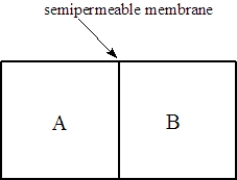 Fill the blank(s) with the appropriate terms from the list below.
right
left
osmosis
dialysis
-Solution A is pure water, and solution B is 0.05 M glucose. Water molecules will move to the ______________________compartment and glucose molecules will move to the __________________compartment.
Fill the blank(s) with the appropriate terms from the list below.
right
left
osmosis
dialysis
-Solution A is pure water, and solution B is 0.05 M glucose. Water molecules will move to the ______________________compartment and glucose molecules will move to the __________________compartment. (Short Answer)
5.0/5 (73)
(73) Consider the following structure. 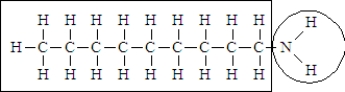 Complete the sentence using the appropriate terms given below.
hydrophobic
hydrophilic
soluble
insoluble
-This molecule is probably____________________in water.
Complete the sentence using the appropriate terms given below.
hydrophobic
hydrophilic
soluble
insoluble
-This molecule is probably____________________in water. (Short Answer)
4.9/5 (76)
(76) Lactated Ringer's solution 109 mEq/L of Cl-. What is the mass of the chloride ion in 225 mL of this solution?
(Multiple Choice)
4.8/5 (67)
(67) Consider the solutions shown in the containers below. The composition of each solution is given in the image. 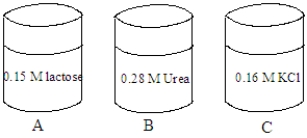 Fill the blank with the appropriate term from the list below.
isotonic
hypotonic
hypertonic
crenation
hemolysis
no change
-A red blood cell is placed in the solution in container C. The cell will undergo ____________________.
Fill the blank with the appropriate term from the list below.
isotonic
hypotonic
hypertonic
crenation
hemolysis
no change
-A red blood cell is placed in the solution in container C. The cell will undergo ____________________. (Short Answer)
4.7/5 (77)
(77) A solution contains 35.5 mg of Vitamin C in 175 mL of solution. The concentration of this solution could be expressed as:
(Multiple Choice)
4.9/5 (85)
(85) Consider two solutions, A and B, separated by a seminpermeable membrane that allows water and small molecules to pass through as shown below. Fill the blank(s) with the appropriate terms from the list below.
right
left
osmosis
dialysis
-Solution A is 0.50 M in sucrose and Solution is 1.5 M in sucrose. After one hour, the compartment on the ____________________ will have the higher osmotic pressure.
Fill the blank(s) with the appropriate terms from the list below.
right
left
osmosis
dialysis
-Solution A is 0.50 M in sucrose and Solution is 1.5 M in sucrose. After one hour, the compartment on the ____________________ will have the higher osmotic pressure. (Short Answer)
4.8/5 (78)
(78) Which of the following is associated with cells in a hypertonic solution?
(Multiple Choice)
4.8/5 (81)
(81) Putting a celery stick in distilled water results in the uptake of water by the celery.
(True/False)
4.8/5 (82)
(82) A normal saline solution is a 0.90% (w/v) aqueous solution of NaCl. This is the same as: 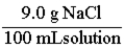
(True/False)
4.7/5 (80)
(80) The osmotic pressure of a 0.10 M NaCl solution will be the same as that of a 0.10 M urea solution.
(True/False)
4.9/5 (75)
(75) The vitamins A (retinol) and C (ascorbic acid) are shown below. All atoms other than C and H are explicitly shown. 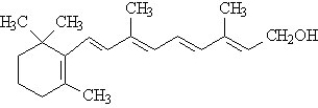
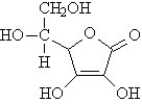 A C
Complete the following questions be entered in the appropriate letter (A or C) in the blank provided.
-The beaker below contains oil (a compound of mostly carbon and hydrogen) in the upper layer and water in the lower layer. Oil floats on top of the water because it is less dense.
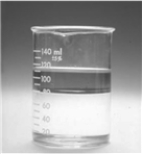 The vitamin that would be the most soluble in the upper layer is ______.
A C
Complete the following questions be entered in the appropriate letter (A or C) in the blank provided.
-The beaker below contains oil (a compound of mostly carbon and hydrogen) in the upper layer and water in the lower layer. Oil floats on top of the water because it is less dense. The vitamin that would be the most soluble in the upper layer is ______. (Short Answer)
4.9/5 (70)
(70) Based on the following graph, the solubility of this substance at 80 °C is approximately: 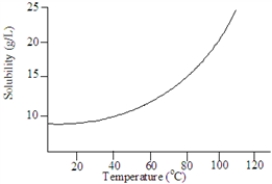
(Multiple Choice)
4.8/5 (72)
(72) Which of the following pass through both osmotic and dialysis membranes?
(Multiple Choice)
4.9/5 (86)
(86) Consider the two containers separated by a semipermeable membrane that allows both glucose and sucrose to pass through. 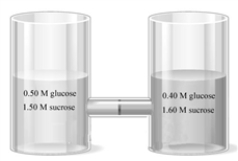 Answer the following questions as appropriate with: right, left, or no movement.
-What is the total molarity of a solution containing 25.7 g of sucrose (C12H22O11) and 16.1 g of ribose (C5H10O5) dissolved in enough water to produce 850.0 mL of solution?
Answer the following questions as appropriate with: right, left, or no movement.
-What is the total molarity of a solution containing 25.7 g of sucrose (C12H22O11) and 16.1 g of ribose (C5H10O5) dissolved in enough water to produce 850.0 mL of solution? (Short Answer)
4.8/5 (82)
(82) The vitamins A (retinol) and C (ascorbic acid) are shown below. All atoms other than C and H are explicitly shown. A C
Complete the following questions be entered in the appropriate letter (A or C) in the blank provided.
-The vitamin that would be the most hydrophobic is ______.
A C
Complete the following questions be entered in the appropriate letter (A or C) in the blank provided.
-The vitamin that would be the most hydrophobic is ______. (Short Answer)
4.9/5 (74)
(74) 
Filters
- Essay(0)
- Multiple Choice(0)
- Short Answer(0)
- True False(0)
- Matching(0)