



 Chat with AI
Exam 14: Proteins

Exam 1: Measurements in Science and Medicine77 Questions
Exam 2: Atoms, Elements, and Compounds77 Questions
Exam 3: Chemical Bonds83 Questions
Exam 4: Energy and Physical Properties74 Questions
Exam 5: Solution Concentration77 Questions
Exam 6: Chemical Reactions68 Questions
Exam 7: Acids and Bases85 Questions
Exam 8: Nuclear Chemistry67 Questions
Exam 9: Hydrocarbons: an Introduction to Organic Molecules74 Questions
Exam 10: Hydration, Dehydration, and Alcohols61 Questions
Exam 11: Carbonyl Compounds and Redox Reactions71 Questions
Exam 12: Organic Acids and Bases64 Questions
Exam 13: Condensation and Hydrolysis Reactions72 Questions
Exam 14: Proteins67 Questions
Exam 15: Carbohydrates75 Questions
Exam 16: Lipids and Membranes79 Questions
Exam 17: Nucleic Acids, Protein Synthesis, and Heredity71 Questions
Select questions type


Consider the following representation of an enzyme-catalyzed reaction. 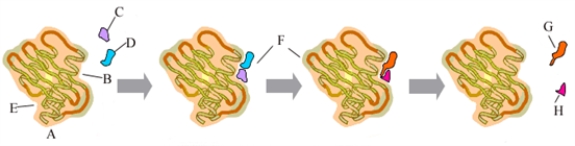 -The reactants, water and lactose, are represented in the image by __________________ and _________________.
Free
(Short Answer)
4.9/5  (79)
(79) Correct Answer: Verified
C, D
D, C
Consider the structure shown below. 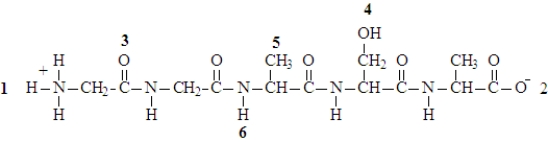 Fill in the blanks with an integer (1, 2, 3, 4, 5....) as shown in the diagram or to represent a specified number.
-The free carboxylate group is represented by the number _____________________.
Fill in the blanks with an integer (1, 2, 3, 4, 5....) as shown in the diagram or to represent a specified number.
-The free carboxylate group is represented by the number _____________________.Free
(Short Answer)
4.9/5 (92)
(92) Correct Answer:Verified
Verified2
Both isoleucine and alanine can be synthesized from other nutrients.
Free
(True/False)
4.8/5 (81)
(81) Correct Answer:Verified
VerifiedFalse
Which of the following levels of protein structure can involve covalent bond formation?
(Multiple Choice)
4.8/5 (75)
(75) The following represents the results of an experiment on a metabolic enzyme. 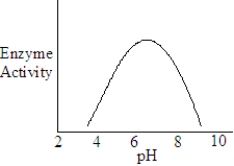 What is the optimum pH of this enzyme?
 (Multiple Choice)
4.8/5 (80)
(80) Lysine is a weak acid under physiological conditions but it is classified as a basic amino acid. Briefly explain.
(Essay)
4.8/5 (84)
(84) Consider a protein at 25 °C which is heated to 48 °C then cooled back to 25 °C. The following shows schematically the protein structure at these three temperatures, respectively. 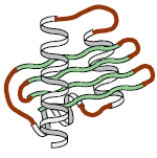

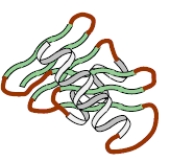 25 °C
 48 °C
 25 °C
Based on this information, the enzyme activity will return at the final temperature (25 °C).
25 °C 48 °C 25 °C
Based on this information, the enzyme activity will return at the final temperature (25 °C). (True/False)
4.9/5 (83)
(83) This image could represent the reaction in which lactase catalyzes the hydrolysis of lactose (a disaccharide) into glucose and galactose (two monosaccharides). Fill in the blanks with the appropriate letter (A, B, C, D,....) from the image.
-The enzyme-substrate complex is represented by __________________.
(Short Answer)
4.9/5 (84)
(84) The secondary structure of proteins is stabilized by covalent bonds.
(True/False)
4.8/5 (73)
(73) The reaction in the breakdown of amino acids that involves the removal of nitrogen is
(Multiple Choice)
5.0/5 (72)
(72) Nonessential amino acids are those which can be synthesized by the body.
(True/False)
4.7/5 (78)
(78) The addition of a 0.10 M solution of Mg(NO3)2 would most likely affect which type of interaction in the tertiary structure of a protein?
(Multiple Choice)
4.9/5 (79)
(79) This image could represent the reaction in which lactase catalyzes the hydrolysis of lactose (a disaccharide) into glucose and galactose (two monosaccharides). Fill in the blanks with the appropriate letter (A, B, C, D,....) from the image.
-The active site of the enzyme is represented by ___________________.
(Short Answer)
4.8/5 (78)
(78) Consider the amino acid sequence given below. Gly-Ala-Thr-Cys Ala would be considered
(Multiple Choice)
4.8/5 (84)
(84) The amino acid shown below maybe associated with ALS (Lou Gehrig's disease) and Parkinson's disease. 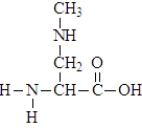 Which of the following is the zwitterion ion form of the uncommon amino acid?
 (Multiple Choice)
4.9/5 (81)
(81) The following represents the nitrogen cycle. Which of the choices correctly pairs the lettered reactions with the type of organism? 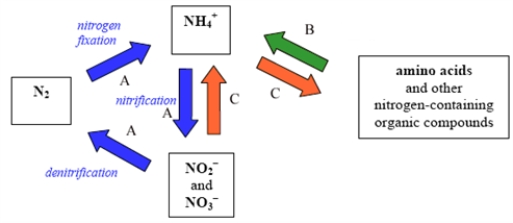
(Multiple Choice)
4.8/5 (85)
(85) When the term "essential" is applied to a substance, this means that it cannot be synthesized by an organism and must be obtained from dietary sources.
(True/False)
4.9/5 (77)
(77) Consider the two "peptides" shown below. Ala-Gly-Phe-Phe-Ala-Gly-Val
Val-Leu-Iso-Ala-Gly-Val-Phe
The side chains of these two "peptides" could form hydrophilic interactions with one another.
(True/False)
4.9/5 (79)
(79) 
Filters
- Essay(0)
- Multiple Choice(0)
- Short Answer(0)
- True False(0)
- Matching(0)