



 Chat with AI
Exam 14: Proteins

Exam 1: Measurements in Science and Medicine77 Questions
Exam 2: Atoms, Elements, and Compounds77 Questions
Exam 3: Chemical Bonds83 Questions
Exam 4: Energy and Physical Properties74 Questions
Exam 5: Solution Concentration77 Questions
Exam 6: Chemical Reactions68 Questions
Exam 7: Acids and Bases85 Questions
Exam 8: Nuclear Chemistry67 Questions
Exam 9: Hydrocarbons: an Introduction to Organic Molecules74 Questions
Exam 10: Hydration, Dehydration, and Alcohols61 Questions
Exam 11: Carbonyl Compounds and Redox Reactions71 Questions
Exam 12: Organic Acids and Bases64 Questions
Exam 13: Condensation and Hydrolysis Reactions72 Questions
Exam 14: Proteins67 Questions
Exam 15: Carbohydrates75 Questions
Exam 16: Lipids and Membranes79 Questions
Exam 17: Nucleic Acids, Protein Synthesis, and Heredity71 Questions
Select questions type


Consider the structure shown below. 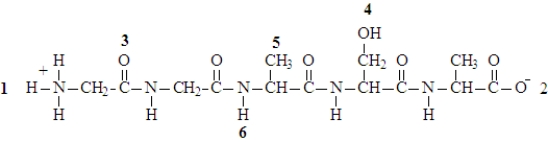 Fill in the blanks with an integer (1, 2, 3, 4, 5....) as shown in the diagram or to represent a specified number.
-The backbone contains ______________________ amino acids.
Fill in the blanks with an integer (1, 2, 3, 4, 5....) as shown in the diagram or to represent a specified number.
-The backbone contains ______________________ amino acids. (Short Answer)
4.8/5  (92)
(92) The following amino acid would be found in the interior of a protein. 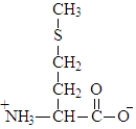
(True/False)
5.0/5 (72)
(72) The ultimate fate of the nitrogen from the metabolism of amino acids in mammals is:
(Multiple Choice)
4.9/5 (95)
(95) How many chiral carbon atoms are present in the amino acid shown below? 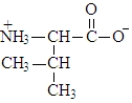
(Multiple Choice)
4.8/5 (92)
(92) Consider the structure shown below. Fill in the blanks with an integer (1, 2, 3, 4, 5....) as shown in the diagram or to represent a specified number.
-The atom represented by the number _______________________ would carry a δ- charge.
Fill in the blanks with an integer (1, 2, 3, 4, 5....) as shown in the diagram or to represent a specified number.
-The atom represented by the number _______________________ would carry a δ- charge. (Short Answer)
4.9/5 (84)
(84) Which of the following is the form that human body uses to excrete nitrogen?
(Multiple Choice)
4.9/5 (94)
(94) This image could represent the reaction in which lactase catalyzes the hydrolysis of lactose (a disaccharide) into glucose and galactose (two monosaccharides). Fill in the blanks with the appropriate letter (A, B, C, D,....) from the image.
-Galactose could be represented by __________________.
(Short Answer)
4.9/5 (91)
(91) Consider the structure shown below. Fill in the blanks with an integer (1, 2, 3, 4, 5....) as shown in the diagram or to represent a specified number.
-A hydrophilic side chain is indicated by the number__________________.
Fill in the blanks with an integer (1, 2, 3, 4, 5....) as shown in the diagram or to represent a specified number.
-A hydrophilic side chain is indicated by the number__________________. (Short Answer)
4.8/5 (77)
(77) 
This image could represent the reaction in which lactase catalyzes the hydrolysis of lactose (a disaccharide) into glucose and galactose (two monosaccharides). Fill in the blanks with the appropriate letter (A, B, C, D,....) from the image.
-___________________ represents lactase.
(Short Answer)
4.9/5 (90)
(90) Consider the structure shown below. Fill in the blanks with an integer (1, 2, 3, 4, 5....) as shown in the diagram or to represent a specified number.
-The N-terminal group is represented by the number___________________,
Fill in the blanks with an integer (1, 2, 3, 4, 5....) as shown in the diagram or to represent a specified number.
-The N-terminal group is represented by the number___________________, (Short Answer)
4.8/5 (74)
(74) What type of interaction would occur between the side chains of two molecules of the amino acid shown below? 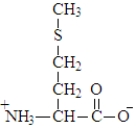
(Multiple Choice)
4.8/5 (79)
(79) Consider the following image. 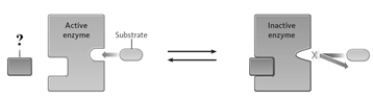 The " ? " in the image represents
 (Multiple Choice)
4.8/5 (97)
(97) Glycogen phosphorylase breaks down glycogen in the liver to produce glucose-1-phosphate. The activity of this enzyme increases in the presence of AMP. AMP is therefore a negative effector in controlling this pathway.
(True/False)
4.8/5 (90)
(90) Consider the tertiary structure of a protein containing two peptides with the segments shown below. 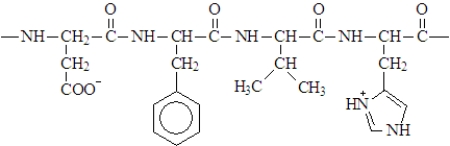 What types of interactions would be possible?
 (Multiple Choice)
4.7/5 (85)
(85) Enzymes are sensitive to agitation and will be denatured by violent stirring.
(True/False)
4.9/5 (83)
(83) What is the three-letter representation for the peptide given below? 
(Multiple Choice)
4.7/5 (74)
(74) 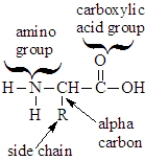
If an amino acid contained the following side chain would be classified as hydrophobic. 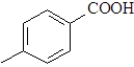
(True/False)
4.9/5 (85)
(85) 
Filters
- Essay(0)
- Multiple Choice(0)
- Short Answer(0)
- True False(0)
- Matching(0)