



 Chat with AI
Exam 8: Nuclear Chemistry

Exam 1: Measurements in Science and Medicine77 Questions
Exam 2: Atoms, Elements, and Compounds77 Questions
Exam 3: Chemical Bonds83 Questions
Exam 4: Energy and Physical Properties74 Questions
Exam 5: Solution Concentration77 Questions
Exam 6: Chemical Reactions68 Questions
Exam 7: Acids and Bases85 Questions
Exam 8: Nuclear Chemistry67 Questions
Exam 9: Hydrocarbons: an Introduction to Organic Molecules74 Questions
Exam 10: Hydration, Dehydration, and Alcohols61 Questions
Exam 11: Carbonyl Compounds and Redox Reactions71 Questions
Exam 12: Organic Acids and Bases64 Questions
Exam 13: Condensation and Hydrolysis Reactions72 Questions
Exam 14: Proteins67 Questions
Exam 15: Carbohydrates75 Questions
Exam 16: Lipids and Membranes79 Questions
Exam 17: Nucleic Acids, Protein Synthesis, and Heredity71 Questions
Select questions type


The following represents a nuclear reaction. 

Free
(True/False)
4.8/5  (79)
(79) Correct Answer: Verified
True
Which of the following correctly ranks the amount of energy produced in the reactions given from smallest to largest?
Free
(Multiple Choice)
4.9/5 (66)
(66) Correct Answer:Verified
VerifiedA
Fill in the blanks with the appropriate term from the list below.
alpha
beta
gamma
-__________________ particles have the largest WR factor.
Free
(Short Answer)
4.9/5 (85)
(85) Correct Answer:Verified
Verifiedalpha
Alpha
An exposure to equal amounts of energy from nuclear radiation occurred at two different sites. At the first site an employee was exposed to neutrons with a WR of 16 and received a dose of 33 mrem. At the second site a worker was exposed to alpha particles. What dose did this second empolyee receive?
(Short Answer)
4.9/5 (70)
(70) The following image could illustrate the process of nuclear fusion. 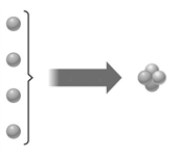
(True/False)
4.8/5 (94)
(94) In the following reaction,  another name for the ion in the product would be a radical.
 (True/False)
4.9/5 (61)
(61) Background radiation is ionizing radiation emitted from natural sources and essentially cannot be avoided.
(True/False)
4.9/5 (70)
(70) The image below is a representation of the formation of radical (X) by different types of radiation (1, 2, and 3). 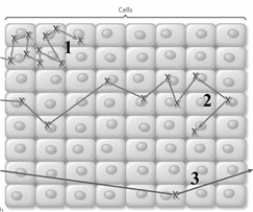 Based on this diagram answer the following questions.
-Radiation that can be represented as shown below: _____

Based on this diagram answer the following questions.
-Radiation that can be represented as shown below: _____ (Short Answer)
5.0/5 (76)
(76) Fill in the blanks with the appropriate term from the list below.
alpha
beta
gamma
-___________________produce the largest number of radicals upon tissue exposure.
(Short Answer)
4.8/5 (68)
(68) The image below is a representation of the formation of radical (X) by different types of radiation (1, 2, and 3). 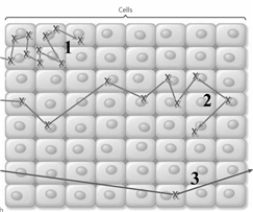 Based on this diagram answer the following questions.
-Which type of radiation is the most damaging to tissue if exposure occurs internally? Briefly explain your reasoning.
Based on this diagram answer the following questions.
-Which type of radiation is the most damaging to tissue if exposure occurs internally? Briefly explain your reasoning. (Essay)
4.9/5 (73)
(73) The half-life of 14C is 5,700 years. In a living organism the 14C content is a constant of 0.22 Bq/g. If an unknown sample contains a 14C activity of about  Bq/g , approximately how old is the sample?
 (Multiple Choice)
4.7/5 (103)
(103) The nuclear symbol for an americium atom with a mass number of 243 is:
(Multiple Choice)
4.9/5 (76)
(76) Consider the following reaction. 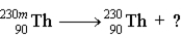 Which of the following is not true of this reaction?
 (Multiple Choice)
4.9/5 (75)
(75) Three patients receive equal amounts of energy from nuclear radiation but from different sources. Patient 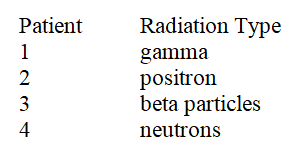
(Multiple Choice)
4.8/5 (82)
(82) Consider the process illustrated in the image below. 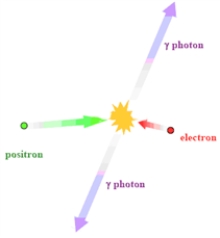 Which of the following is true of this process?
 (Multiple Choice)
4.9/5 (77)
(77) 
A sample of a radioacitive isotope has an activity of 80 μCi when produced. 60 min later when it is being used the activity has dropped to 10 μCi. What is the half-life of this isotope?
(Multiple Choice)
4.9/5 (85)
(85) A scintillation counter is more sensitive in measuring radiation than a Geiger counter.
(True/False)
4.9/5 (72)
(72) 
Filters
- Essay(0)
- Multiple Choice(0)
- Short Answer(0)
- True False(0)
- Matching(0)