



 Chat with AI
Exam 6: Chemical Reactions

Exam 1: Measurements in Science and Medicine77 Questions
Exam 2: Atoms, Elements, and Compounds77 Questions
Exam 3: Chemical Bonds83 Questions
Exam 4: Energy and Physical Properties74 Questions
Exam 5: Solution Concentration77 Questions
Exam 6: Chemical Reactions68 Questions
Exam 7: Acids and Bases85 Questions
Exam 8: Nuclear Chemistry67 Questions
Exam 9: Hydrocarbons: an Introduction to Organic Molecules74 Questions
Exam 10: Hydration, Dehydration, and Alcohols61 Questions
Exam 11: Carbonyl Compounds and Redox Reactions71 Questions
Exam 12: Organic Acids and Bases64 Questions
Exam 13: Condensation and Hydrolysis Reactions72 Questions
Exam 14: Proteins67 Questions
Exam 15: Carbohydrates75 Questions
Exam 16: Lipids and Membranes79 Questions
Exam 17: Nucleic Acids, Protein Synthesis, and Heredity71 Questions
Select questions type


Consider the following image representing an equilibrium mixture. The black spheres represent the reactant and the gray spheres the product. 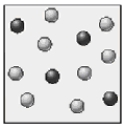 If this reaction was started with only reactants, at equilibrium about 67% of the reactant was converted to product.
 (True/False)
4.7/5  (73)
(73) Complete each of the following sentences using one of the terms listed below.
physical change
chemical change
reactant
product
coefficient
physical state
-The image below represents a________________. 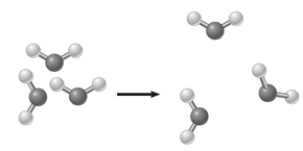
(Short Answer)
4.8/5 (83)
(83) Consider the following reaction.  How many grams of sucrose would produce 2546 kcal?
 (Multiple Choice)
4.9/5 (71)
(71) What is the name of a branch on the principal carbon chain that contains three carbon atoms?
(Multiple Choice)
4.7/5 (77)
(77) Consider the following reaction.  The mass relationship between sodium (Na) and oxygen (O2) is:

The mass relationship between sodium (Na) and oxygen (O2) is: (True/False)
4.7/5 (78)
(78) Copper reacts with nitric acid as given in the following reaction.  Predict the effect of the given change on the rate of the reaction by filling in the blank with one of the following terms.
increase
decrease
no effect
-A catalyst is added to the reaction mixture. ____________________
Predict the effect of the given change on the rate of the reaction by filling in the blank with one of the following terms.
increase
decrease
no effect
-A catalyst is added to the reaction mixture. ____________________ (Short Answer)
4.9/5 (70)
(70) Consider the following energy diagram showing a reaction with and without a catalyst. . 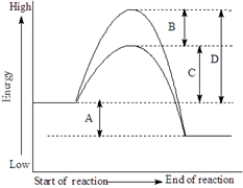 Fill in the blank with the appropriate letter (A, B, C, etc.).
-The activation energy of the catalyzed reaction is represented by_____________________.
Fill in the blank with the appropriate letter (A, B, C, etc.).
-The activation energy of the catalyzed reaction is represented by_____________________. (Short Answer)
5.0/5 (93)
(93) When 15.0 g of sucrose is burned during metabolism in the body according to the following equation, what mass in grams of oxygen is needed? 
(Short Answer)
4.9/5 (86)
(86) In the equation for an exothermic reaction, the word "energy" appears
(Multiple Choice)
4.9/5 (71)
(71) The following represents a typical energy diagram. 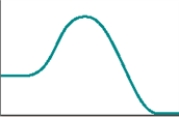 The reaction represented by this energy diagram is endothermic.
 (True/False)
4.9/5 (78)
(78) Copper reacts with nitric acid as given in the following reaction. Predict the effect of the given change on the rate of the reaction by filling in the blank with one of the following terms.
increase
decrease
no effect
-The copper metal is ground into a very fine powder. ______________________
Predict the effect of the given change on the rate of the reaction by filling in the blank with one of the following terms.
increase
decrease
no effect
-The copper metal is ground into a very fine powder. ______________________ (Short Answer)
4.9/5 (96)
(96) Draw the energy diagram for the following reaction which represents the burning of the amino acid alanine.  Indicate on the diagram the activation energy and the heat of reaction.
 (Essay)
4.8/5 (79)
(79) If the reaction given below occurs and pure A and B were mixed, which of the following would take place as equilibrium was established? A + B  C
C (Multiple Choice)
4.9/5 (72)
(72) Complete each of the following sentences using one of the terms listed below.
physical change
chemical change
reactant
product
coefficient
physical state
-The image below represents a________________. 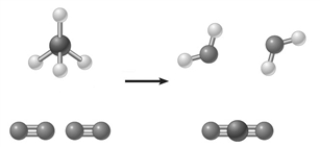
(Short Answer)
4.7/5 (76)
(76) The combustion of glucose per gram produces more energy than the combustion of an equal mass of triolein (a fat).
(True/False)
4.7/5 (78)
(78) How many moles of N2 are required to completely react with 3.53 grams of H2 for the following balanced chemical equation? N2 + 3H2 → 2NH3
(Multiple Choice)
5.0/5 (81)
(81) Consider a sample of water in a closed container. When the reaction H2O(l)  H2O(g)
Has reached equilibrium, what can we say about any specific water molecule?
H2O(g)
Has reached equilibrium, what can we say about any specific water molecule? (Multiple Choice)
4.9/5 (83)
(83) When natural gas (predominantly methane, CH4) burns in air. The following reaction occurs. How much energy is involved in the combustion of 13.0 g of methane? 
(Multiple Choice)
4.7/5 (90)
(90) According to the law of mass conservation, which of the following may NEVER occur as a result of a chemical reaction?
(Multiple Choice)
4.8/5 (77)
(77) Consider the following generic reaction. 2 A(s) + 3 B(l) → C(g) If 58.0 g of A reacted completely with B to produce 100.8 g of C, what mass of B reacted?
(Multiple Choice)
4.9/5 (76)
(76) 
Filters
- Essay(0)
- Multiple Choice(0)
- Short Answer(0)
- True False(0)
- Matching(0)