



 Chat with AI
Exam 2: Some Tools of the Economist

Exam 1: The Economic Approach185 Questions
Exam 2: Some Tools of the Economist204 Questions
Exam 3: Demand, Supply, and the Market Process339 Questions
Exam 4: Supply and Demand: Applications and Extensions268 Questions
Exam 5: Difficult Cases for the Market, and the Role of Government134 Questions
Exam 6: The Economics of Political Action161 Questions
Exam 7: Taking the Nations Economic Pulse222 Questions
Exam 8: Economic Fluctuations, Unemployment, and Inflation182 Questions
Exam 9: An Introduction to Basic Macroeconomic Markets219 Questions
Exam 10: Dynamic Change, Economic Fluctuations, and the Ad--As Model193 Questions
Exam 11: Fiscal Policy: The Keynesian View and the Historical Development of Macroeconomics112 Questions
Exam 12: Fiscal Policy: Incentives, and Secondary Effects154 Questions
Exam 13: Money and the Banking System198 Questions
Exam 14: Modern Macroeconomics and Monetary Policy204 Questions
Exam 15: Stabilization Policy, Output, and Employment170 Questions
Exam 16: Creating an Environment for Growth and Prosperity125 Questions
Exam 17: Institutions, Policies, and Cross-Country Differences in Income and Growth115 Questions
Exam 18: Gaining From International Trade182 Questions
Exam 19: International Finance and the Foreign Exchange Market148 Questions
Exam 20: Special Topics274 Questions
Select questions type


Which of the following would be most likely to increase your opportunity cost of attending college?
(Multiple Choice)
5.0/5  (80)
(80) Even countries that depend primarily on market forces to resolve the basic economic questions will usually rely on the collective decision-making process to
(Multiple Choice)
4.9/5 (76)
(76) Figure 2-10 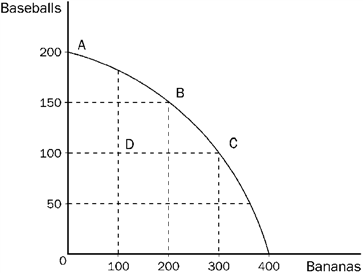 Refer to Figure 2-10. What is the opportunity cost of the movement from point A to point C?
 (Multiple Choice)
4.7/5 (90)
(90) Explain the idea of capital investment by using the story of Robinson Crusoe. What is sacrificed, and what is gained?
(Essay)
4.8/5 (76)
(76) Use the production possibilities data below to answer the following question(s). Table 2-3
 Refer to Table 2-3. The opportunity cost of 1 pound of meat for the farmer is
 (Multiple Choice)
4.8/5 (88)
(88) It can be said that, ultimately, consumers are the driving force in answering the three basic economic questions. Explain the consumer's role in providing these answers.
(Essay)
4.9/5 (76)
(76) Abigail wishes to spend more time this week studying for her classes. Using the idea of a production possibilities curve, and assuming Abigail is currently spending all of her time efficiently, Abigail can spend more time studying this week only if
(Multiple Choice)
4.9/5 (75)
(75) Darryl can build picnic tables twice as fast as Trevon. Darryl can assemble swing sets three times as fast as Trevon. The law of comparative advantage suggests that
(Multiple Choice)
4.9/5 (75)
(75) Statistical data provided by the U.S. Department of Transportation shows that the median income of individuals traveling on the nation's bus systems is $18,000 compared to $65,000 for those who normally travel by air. This finding is best explained by which of the following statements?
(Multiple Choice)
4.8/5 (81)
(81) Use the production possibilities data below to answer the following question(s). Table 2-3
 Refer to Table 2-3. The rancher has a comparative advantage in
 (Multiple Choice)
5.0/5 (77)
(77) The law of comparative advantage implies that a nation, individual, or region should produce those economic goods for which it
(Multiple Choice)
4.8/5 (83)
(83) Sophia is an architect and she is trying to decide whether to hire Jacob, a draftsman, to assist with her work. Sophia could hire Jacob at $20 per hour but it would take him three times as long to complete a task as it takes Sophia. Sophia is able to earn $90 per hour and has more architectural jobs than she is able to handle. Which of the following is true?
(Multiple Choice)
5.0/5 (81)
(81) If an economy uses its resources inefficiently, this situation would be illustrated on a production possibilities diagram as
(Multiple Choice)
4.8/5 (85)
(85) Retired persons travel by bus and automobile more frequently than do business executives, who more commonly use air travel. An economic explanation for this would be that
(Multiple Choice)
4.7/5 (83)
(83) Figure 2-8 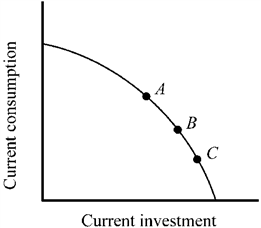 Points A, B, and C in Figure 2-8 indicate consumption and investment for three economies. Other things constant, which of the economies is likely to grow more rapidly in the future?
 (Multiple Choice)
4.9/5 (83)
(83) Given freedom of movement for both goods and resources, if Florida producers specialize in oranges and Georgia producers specialize in peaches, it would be reasonable to conclude that
(Multiple Choice)
4.9/5 (80)
(80) Which of the following activities describes the opportunity cost of attending an economics class?
(Multiple Choice)
4.8/5 (86)
(86) 
Filters
- Essay(0)
- Multiple Choice(0)
- Short Answer(0)
- True False(0)
- Matching(0)