



 Chat with AI
Exam 2: Some Tools of the Economist

Exam 1: The Economic Approach185 Questions
Exam 2: Some Tools of the Economist204 Questions
Exam 3: Demand, Supply, and the Market Process339 Questions
Exam 4: Supply and Demand: Applications and Extensions268 Questions
Exam 5: Difficult Cases for the Market, and the Role of Government134 Questions
Exam 6: The Economics of Political Action161 Questions
Exam 7: Taking the Nations Economic Pulse222 Questions
Exam 8: Economic Fluctuations, Unemployment, and Inflation182 Questions
Exam 9: An Introduction to Basic Macroeconomic Markets219 Questions
Exam 10: Dynamic Change, Economic Fluctuations, and the Ad--As Model193 Questions
Exam 11: Fiscal Policy: The Keynesian View and the Historical Development of Macroeconomics112 Questions
Exam 12: Fiscal Policy: Incentives, and Secondary Effects154 Questions
Exam 13: Money and the Banking System198 Questions
Exam 14: Modern Macroeconomics and Monetary Policy204 Questions
Exam 15: Stabilization Policy, Output, and Employment170 Questions
Exam 16: Creating an Environment for Growth and Prosperity125 Questions
Exam 17: Institutions, Policies, and Cross-Country Differences in Income and Growth115 Questions
Exam 18: Gaining From International Trade182 Questions
Exam 19: International Finance and the Foreign Exchange Market148 Questions
Exam 20: Special Topics274 Questions
Select questions type


Use the production possibilities data below for Austria and Italy to answer the following question(s). Table 2-1

 Refer to Table 2-1. Which of the following would be a mutually agreeable rate of exchange?
 (Multiple Choice)
4.7/5  (80)
(80) If the citizens of a country were to work harder and take less leisure time, it would
(Multiple Choice)
4.9/5 (84)
(84) Figure 2-2 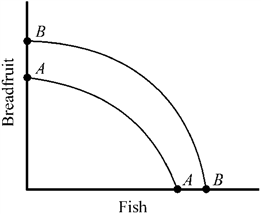 Which of the following would most likely cause the production possibilities curve for breadfruit and fish to shift outward from AA to BB in Figure 2-2?
 (Multiple Choice)
4.9/5 (87)
(87) When private ownership rights are well-defined and enforced, owners of physical assets and resources
(Multiple Choice)
4.8/5 (84)
(84) A form of economic organization that relies primarily on private ownership of productive assets, freedom of exchange, and market prices to allocate goods and resources is often called
(Multiple Choice)
4.8/5 (83)
(83) Figure 2-9 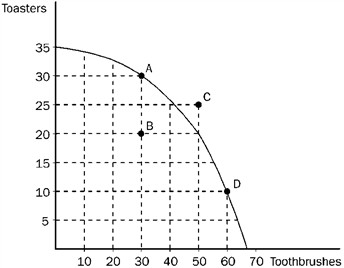 Refer to Figure 2-9. If the economy moves from point A to point D, the opportunity cost is
 (Multiple Choice)
4.9/5 (91)
(91) Using a production possibilities curve, a technological advance that increases the amount of output for the same amount of inputs would be illustrated as
(Multiple Choice)
4.9/5 (80)
(80) Which of the following most accurately states the economic significance of exchange?
(Multiple Choice)
4.8/5 (72)
(72) Production possibilities curve are usually bowed outward. This is because
(Multiple Choice)
4.8/5 (84)
(84) In economics, the term that refers to the time, effort, and other resources needed to search out, negotiate, and consummate an exchange is
(Multiple Choice)
4.9/5 (77)
(77) A production possibilities curve indicates that when resources are being used efficiently,
(Multiple Choice)
4.8/5 (88)
(88) The law of comparative advantage applies to exchange between
(Multiple Choice)
4.9/5 (74)
(74) Suppose the price of an airline ticket from Dallas to Boston costs $600. A bus ticket costs $150. Traveling by plane takes 6 hours compared with 51 hours by bus. Other things constant, an individual would gain by choosing air travel if, and only if, his time were valued at more than
(Multiple Choice)
4.8/5 (84)
(84) Which of the following most accurately reflects the opportunity cost to a pharmacist who drives a taxi?
(Multiple Choice)
4.7/5 (79)
(79) Which of the following is true with regard to value and exchange?
(Multiple Choice)
4.8/5 (85)
(85) 
Filters
- Essay(0)
- Multiple Choice(0)
- Short Answer(0)
- True False(0)
- Matching(0)