



 Chat with AI
Exam 2: Some Tools of the Economist

Exam 1: The Economic Approach185 Questions
Exam 2: Some Tools of the Economist204 Questions
Exam 3: Demand, Supply, and the Market Process339 Questions
Exam 4: Supply and Demand: Applications and Extensions268 Questions
Exam 5: Difficult Cases for the Market, and the Role of Government134 Questions
Exam 6: The Economics of Political Action161 Questions
Exam 7: Taking the Nations Economic Pulse222 Questions
Exam 8: Economic Fluctuations, Unemployment, and Inflation182 Questions
Exam 9: An Introduction to Basic Macroeconomic Markets219 Questions
Exam 10: Dynamic Change, Economic Fluctuations, and the Ad--As Model193 Questions
Exam 11: Fiscal Policy: The Keynesian View and the Historical Development of Macroeconomics112 Questions
Exam 12: Fiscal Policy: Incentives, and Secondary Effects154 Questions
Exam 13: Money and the Banking System198 Questions
Exam 14: Modern Macroeconomics and Monetary Policy204 Questions
Exam 15: Stabilization Policy, Output, and Employment170 Questions
Exam 16: Creating an Environment for Growth and Prosperity125 Questions
Exam 17: Institutions, Policies, and Cross-Country Differences in Income and Growth115 Questions
Exam 18: Gaining From International Trade182 Questions
Exam 19: International Finance and the Foreign Exchange Market148 Questions
Exam 20: Special Topics274 Questions
Select questions type


In Africa, which of the following policies has been most successful at increasing elephant populations?
(Multiple Choice)
4.8/5  (83)
(83) Figure 2-10 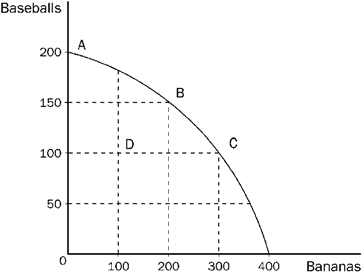 Refer to Figure 2-10. If the economy moves from point C to point B, then which of the following statements is correct?
 (Multiple Choice)
4.8/5 (66)
(66) Which of the following appropriately applies the law of comparative advantage?
(Multiple Choice)
4.9/5 (82)
(82) A department store buys a wool coat for $120 and sets its retail price at $300. The coat costs $85 to produce. When the coat doesn't sell, the store marks the price down to $200, then $100, and finally $70. At $70, Amy buys the coat. What was the coat's true value? Why?
(Essay)
4.8/5 (84)
(84) Other things constant, which of the following would you expect to increase the output growth rate of a country?
(Multiple Choice)
4.8/5 (60)
(60) A production possibilities curve graphically represents the maximum quantities of two products produced when all resources in the economy are being used efficiently. If an economy operates at a point inside its production possibilities curve,
(Multiple Choice)
4.9/5 (69)
(69) Suppose an airline ticket from Charlotte to Dallas costs $525. A bus ticket is $325. Traveling by plane will take 5 hours, compared with 25 hours by bus. Thus, the plane costs $200 more but saves 20 hours of time (Hint: Note how we are "thinking at the margin" here by looking at the changes). Other things constant, an individual will gain by choosing air travel if, and only if, each hour of her time is valued at more than
(Multiple Choice)
4.8/5 (75)
(75) Use the production possibilities data below for Austria and Italy to answer the following question(s). Table 2-1

 Refer to Table 2-1. Which of the following is true?
 (Multiple Choice)
4.8/5 (72)
(72) If an economy is operating at a point inside the production possibilities curve,
(Multiple Choice)
4.8/5 (83)
(83) Ashley is an attorney and also an excellent typist. She can type 120 words per minute, but she charges attorney fees at $100 per hour. Benjamin would like some typing work but can only type 60 words per minute. According to the law of comparative advantage, Ashley should hire Benjamin to do her typing if and only if his wage rate is less than
(Multiple Choice)
4.8/5 (77)
(77) If the resources of an economy are being used inefficiently, it would be
(Multiple Choice)
4.7/5 (83)
(83) 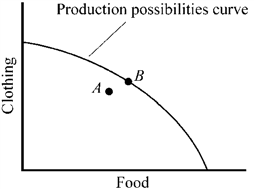 In Figure 2-1, point A is
The number of cattle slaughtered every year for meat far exceeds the number of elephants slaughtered every year for their ivory. Despite this, cows can be found everywhere while elephants are on the verge of extinction in some countries. Which of the following best explains this difference?
(Multiple Choice)
4.7/5 (86)
(86) The production possibilities curve illustrates the basic principle that
(Multiple Choice)
4.9/5 (86)
(86) According to the law of comparative advantage, a particular task is performed most efficiently by the individual with the lowest
(Multiple Choice)
4.9/5 (70)
(70) Which of the following attributes of trade explain why it is important for economic prosperity?
(Multiple Choice)
4.9/5 (84)
(84) Use the production possibilities data below to answer the following question(s). Table 2-3
 Refer to Table 2-3. The opportunity cost of 1 pound of meat for the rancher is
 (Multiple Choice)
4.9/5 (78)
(78) Which of the following will be most likely to cause the production possibilities curve for a country to shift inward?
(Multiple Choice)
4.8/5 (78)
(78) Maurice can drive or fly from Jacksonville, Florida to Atlanda, Georgia, for a one-day business trip. If he drives, he will be able to work three hours once he arrives in Atlanta, whereas traveling by plane will enable him to work eight hours. His expected income from each hour of work in Atlanta is $30. If Maurice is a rational decision maker, he will fly if and only if the price differential (air cost minus driving cost) is less than
(Multiple Choice)
4.8/5 (85)
(85) 
Filters
- Essay(0)
- Multiple Choice(0)
- Short Answer(0)
- True False(0)
- Matching(0)