



 Chat with AI
Exam 2: Some Tools of the Economist

Exam 1: The Economic Approach185 Questions
Exam 2: Some Tools of the Economist204 Questions
Exam 3: Demand, Supply, and the Market Process339 Questions
Exam 4: Supply and Demand: Applications and Extensions268 Questions
Exam 5: Difficult Cases for the Market, and the Role of Government134 Questions
Exam 6: The Economics of Political Action161 Questions
Exam 7: Taking the Nations Economic Pulse222 Questions
Exam 8: Economic Fluctuations, Unemployment, and Inflation182 Questions
Exam 9: An Introduction to Basic Macroeconomic Markets219 Questions
Exam 10: Dynamic Change, Economic Fluctuations, and the Ad--As Model193 Questions
Exam 11: Fiscal Policy: The Keynesian View and the Historical Development of Macroeconomics112 Questions
Exam 12: Fiscal Policy: Incentives, and Secondary Effects154 Questions
Exam 13: Money and the Banking System198 Questions
Exam 14: Modern Macroeconomics and Monetary Policy204 Questions
Exam 15: Stabilization Policy, Output, and Employment170 Questions
Exam 16: Creating an Environment for Growth and Prosperity125 Questions
Exam 17: Institutions, Policies, and Cross-Country Differences in Income and Growth115 Questions
Exam 18: Gaining From International Trade182 Questions
Exam 19: International Finance and the Foreign Exchange Market148 Questions
Exam 20: Special Topics274 Questions
Select questions type


Suppose a country attempts to be self-sufficient and doesn't trade with any other countries. From an economic perspective, citizens of this nation can be expected to
(Multiple Choice)
4.9/5  (85)
(85) Compared to a situation where transaction costs are zero, the existence of transaction costs
(Multiple Choice)
4.8/5 (78)
(78) Figure 2-7 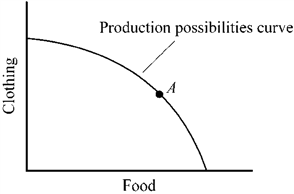 If an economy operates at point A on the production possibilities curve shown in Figure 2-7,
 (Multiple Choice)
4.8/5 (75)
(75) Market economies are often criticized for how they answer the basic question, "For whom are goods produced?" This criticism usually comes from people who believe that the distribution of income is not "fair." Is there some way to separate production from distribution so that we can leave production just as it is but make the distribution of income "fairer"?
(Essay)
5.0/5 (71)
(71) If Terrell can produce more bagels in one day than Zori can produce in one day, then
(Multiple Choice)
4.9/5 (94)
(94) 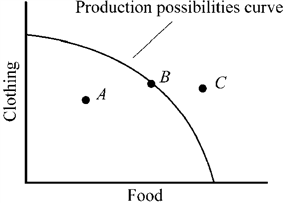 In Figure 2-5, which of the following is true?
Figure 2-9 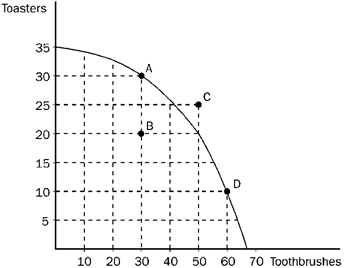 Refer to Figure 2-9. Suppose the economy is producing at point B. Which of the following statements would best explain this situation?
 (Multiple Choice)
4.8/5 (70)
(70) If a firm or a nation desires to maximize its output, each productive assignment should be carried out by those persons who
(Multiple Choice)
4.8/5 (82)
(82) Use the production possibilities data below for Honduras and Nicaragua to answer the following question(s). Table 2-2

 Refer to Table 2-2. Which of the following would be a mutually agreeable rate of exchange?
 (Multiple Choice)
5.0/5 (74)
(74) A production possibilities curve graphically represents the maximum quantities of two products produced when all resources in the economy are efficiently utilized. An economy that operates inside this production possibilities curve
(Multiple Choice)
4.8/5 (96)
(96) For most students attending state universities, the largest cost component of going to college is
(Multiple Choice)
4.9/5 (67)
(67) Melanie decided to sleep in today rather than attend her 9 a.m. economics class. According to economic analysis, her choice was
(Multiple Choice)
4.9/5 (83)
(83) In economics, the term for a person who reduces transaction costs by arranging trades for buyers and sellers is
(Multiple Choice)
4.9/5 (79)
(79) Use the table below to choose the correct answer. The table outlines the production possibilities of Robinson Crusoe and Joe Friday.  If Crusoe and Friday want to maximize their consumption possibilities,
 (Multiple Choice)
4.9/5 (82)
(82) Figure 2-9 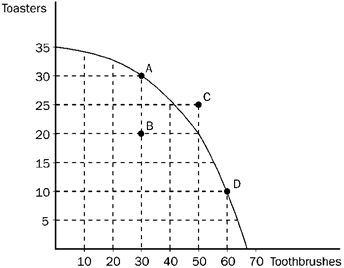 Refer to Figure 2-9. The opportunity cost of obtaining 10 additional toasters by moving from point B to point A is
 (Multiple Choice)
4.8/5 (72)
(72) If a motorist is stranded in front of a pay phone and has only dollar bills, and he ends up buying a quarter from a passerby for $1,
(Multiple Choice)
4.8/5 (83)
(83) Which of the following is true of a production possibilities curve?
(Multiple Choice)
4.8/5 (76)
(76) 
Filters
- Essay(0)
- Multiple Choice(0)
- Short Answer(0)
- True False(0)
- Matching(0)