



 Chat with AI
Exam 2: Some Tools of the Economist

Exam 1: The Economic Approach185 Questions
Exam 2: Some Tools of the Economist204 Questions
Exam 3: Demand, Supply, and the Market Process339 Questions
Exam 4: Supply and Demand: Applications and Extensions268 Questions
Exam 5: Difficult Cases for the Market, and the Role of Government134 Questions
Exam 6: The Economics of Political Action161 Questions
Exam 7: Taking the Nations Economic Pulse222 Questions
Exam 8: Economic Fluctuations, Unemployment, and Inflation182 Questions
Exam 9: An Introduction to Basic Macroeconomic Markets219 Questions
Exam 10: Dynamic Change, Economic Fluctuations, and the Ad--As Model193 Questions
Exam 11: Fiscal Policy: The Keynesian View and the Historical Development of Macroeconomics112 Questions
Exam 12: Fiscal Policy: Incentives, and Secondary Effects154 Questions
Exam 13: Money and the Banking System198 Questions
Exam 14: Modern Macroeconomics and Monetary Policy204 Questions
Exam 15: Stabilization Policy, Output, and Employment170 Questions
Exam 16: Creating an Environment for Growth and Prosperity125 Questions
Exam 17: Institutions, Policies, and Cross-Country Differences in Income and Growth115 Questions
Exam 18: Gaining From International Trade182 Questions
Exam 19: International Finance and the Foreign Exchange Market148 Questions
Exam 20: Special Topics274 Questions
Select questions type


Which of the following is true regarding private ownership?
(Multiple Choice)
4.8/5  (74)
(74) When property rights are clearly defined and enforced, private owners will
(Multiple Choice)
4.9/5 (84)
(84) Which of the following sayings best reflects the concept of opportunity cost?
(Multiple Choice)
4.9/5 (69)
(69) Which of the following will most likely occur under a system of clearly defined and enforced private property rights?
(Multiple Choice)
4.8/5 (76)
(76) The economic principle that states that individuals or nations can gain by specializing in the production of goods that they produce cheaply and exchanging for other desired goods that they could only produce at a higher cost is
(Multiple Choice)
4.8/5 (76)
(76) A point outside the production possibilities curve represents a combination of goods that is
(Multiple Choice)
4.9/5 (73)
(73) In Zimbabwe and Botswana, elephants can be owned by local tribes and trade in ivory is legal, while in countries such as Kenya, it is illegal to trade in ivory and elephants cannot be privately owned but are protected by the government. Which of the following is true regarding the change in the elephant populations since 1979 in these countries?
(Multiple Choice)
4.9/5 (78)
(78) The successful introduction and adoption of a new product or process is known as
(Multiple Choice)
4.7/5 (74)
(74) Which of the following is an implication of the law of comparative advantage?
(Multiple Choice)
4.8/5 (80)
(80) If Mia can either wash 10 cars or wax 2 cars during a day, and Daniel can either wash 17 cars or wax 2 cars during a day, then according to the law of comparative advantage,
(Multiple Choice)
4.9/5 (95)
(95) A system of economic organization in which the ownership and control of productive capital assets rests with the state and in which resources are allocated through central planning and political decision making is called
(Multiple Choice)
4.8/5 (71)
(71) When the production possibilities curve is bowed out, resources are
(Multiple Choice)
4.9/5 (78)
(78) Figure 2-10 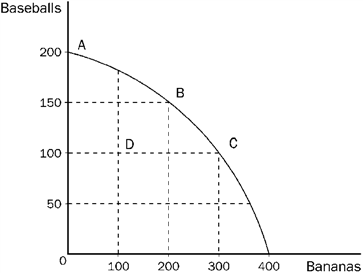 Refer to Figure 2-10. If this economy put all available resources into the production of bananas, it could produce
 (Multiple Choice)
4.9/5 (77)
(77) A nation with cheap, efficient communications is likely to be
(Multiple Choice)
4.8/5 (69)
(69) Given your knowledge of the incentives created by private ownership, which of the following would you expect to be false?
(Multiple Choice)
4.8/5 (69)
(69) 
Filters
- Essay(0)
- Multiple Choice(0)
- Short Answer(0)
- True False(0)
- Matching(0)