



 Chat with AI
Exam 9: The Family of Stars

Exam 1: Here and Now50 Questions
Exam 2: A Users Guide to the Sky68 Questions
Exam 3: Moon Phases and Eclipses68 Questions
Exam 4: Origins of Modern Astronomy64 Questions
Exam 5: Gravity76 Questions
Exam 6: Light and Telescopes69 Questions
Exam 7: Atoms and Spectra73 Questions
Exam 8: The Sun70 Questions
Exam 9: The Family of Stars70 Questions
Exam 10: The Interstellar Medium51 Questions
Exam 11: Formation and Structure of Stars44 Questions
Exam 12: Stellar Evolution51 Questions
Exam 13: Deaths of Stars74 Questions
Exam 14: Neutron Stars and Black Holes69 Questions
Exam 15: The Milky Way Galaxy72 Questions
Exam 16: Galaxies75 Questions
Exam 17: Supermassive Black Holes and Active Galaxies68 Questions
Exam 18: Modern Cosmology71 Questions
Exam 19: Origin of the Solar System and Extrasolar Planets69 Questions
Exam 20: Earth the Active Planet71 Questions
Exam 21: The Moon and Mercury70 Questions
Exam 22: Venus and Mars67 Questions
Exam 23: Jupiter and Saturn68 Questions
Exam 24: Uranus Neptune Pluto and the Kuiper Belt68 Questions
Exam 25: Meteorites Asteroids and Comets65 Questions
Exam 26: Astrobiology68 Questions
Select questions type


Remember Kepler's third law, which relates the period of revolution to the average distance to a planet. How do we modify that law to use with binary stars?
(Multiple Choice)
4.7/5  (76)
(76) Recently discovered brown dwarfs have spectra similar to cool O-type stars.
(True/False)
5.0/5 (89)
(89)  The horizontal axis in the accompanying figure is labeled _____.
 (Multiple Choice)
4.9/5 (79)
(79) The Hertzsprung-Russell Diagram is a plot for stars using absolute magnitude versus temperature.
(True/False)
4.9/5 (74)
(74) S tars of low luminosity will always have large positive absolute magnitude.
(True/False)
4.8/5 (81)
(81) If luminosity depends on radius and temperature, what does flux depend on? _______________
(Short Answer)
4.7/5 (67)
(67) A star has a parallax angle of 0.019 seconds of arc. How far away is this star from Earth?
(Essay)
4.9/5 (77)
(77) The Balmer series of hydrogen absorption lines in stars is located in what part of the electromagnetic spectrum?
(Multiple Choice)
4.8/5 (70)
(70) Recent discoveries of two types of brown dwarfs have placed these stars near which spectral type of star?
(Multiple Choice)
4.8/5 (88)
(88) Th e apparen t magnitud e o f a sta r observe d fro m a distanc e o f 1 0 pc is called _____.
(Short Answer)
4.8/5 (95)
(95) 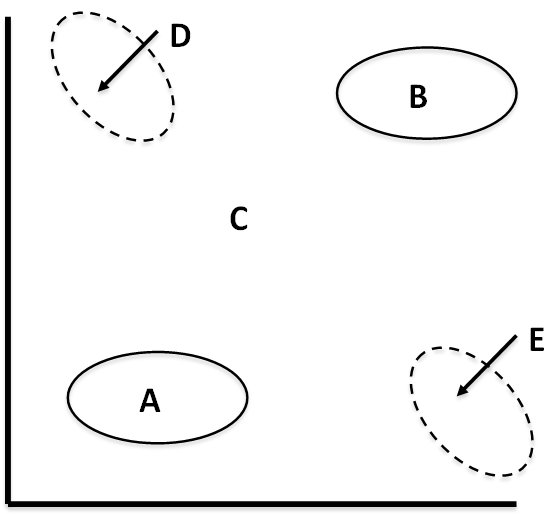 In the accompanying figure, which region represents stars that are extremely bright and emit most of their radiation as ultraviolet light? Note: (C) represents the entire main sequence while (D) and (E) represent only small parts of the main sequence?
 (Short Answer)
4.8/5 (73)
(73) Explain why it would be better to obtain stellar parallax for stars if we could observe from the planet Mars instead of the Earth.
(Essay)
4.9/5 (79)
(79) In which spectral sequence are the hottest stars categorized?
(Multiple Choice)
4.9/5 (91)
(91) The luminosity class is assigned to a star by studying the absorption lines in the spectrum of the star.
(True/False)
4.8/5 (80)
(80)  The sloped lines from top left to bottom right in the accompanying figure are labeled ____.
 (Multiple Choice)
4.8/5 (82)
(82) The stellar parallax limit for ground-based telescopes is accurate for stars closer than ____.
(Multiple Choice)
4.8/5 (92)
(92) 
Filters
- Essay(0)
- Multiple Choice(0)
- Short Answer(0)
- True False(0)
- Matching(0)