



 Chat with AI
Exam 9: The Family of Stars

Exam 1: Here and Now50 Questions
Exam 2: A Users Guide to the Sky68 Questions
Exam 3: Moon Phases and Eclipses68 Questions
Exam 4: Origins of Modern Astronomy64 Questions
Exam 5: Gravity76 Questions
Exam 6: Light and Telescopes69 Questions
Exam 7: Atoms and Spectra73 Questions
Exam 8: The Sun70 Questions
Exam 9: The Family of Stars70 Questions
Exam 10: The Interstellar Medium51 Questions
Exam 11: Formation and Structure of Stars44 Questions
Exam 12: Stellar Evolution51 Questions
Exam 13: Deaths of Stars74 Questions
Exam 14: Neutron Stars and Black Holes69 Questions
Exam 15: The Milky Way Galaxy72 Questions
Exam 16: Galaxies75 Questions
Exam 17: Supermassive Black Holes and Active Galaxies68 Questions
Exam 18: Modern Cosmology71 Questions
Exam 19: Origin of the Solar System and Extrasolar Planets69 Questions
Exam 20: Earth the Active Planet71 Questions
Exam 21: The Moon and Mercury70 Questions
Exam 22: Venus and Mars67 Questions
Exam 23: Jupiter and Saturn68 Questions
Exam 24: Uranus Neptune Pluto and the Kuiper Belt68 Questions
Exam 25: Meteorites Asteroids and Comets65 Questions
Exam 26: Astrobiology68 Questions
Select questions type


Explain the difference between apparent visual brightness and absolute visual brightness.

Free
(Essay)
4.8/5  (79)
(79) Correct Answer: Verified
Apparent visual brightness is the perceived energy we see from the Earth without consideration of distance; whereas absolute visual brightness is the energy we receive if the star was at a distance of 10 parsecs.
One type of binary star is _______________ binary.
Free
(Short Answer)
4.8/5 (77)
(77) Correct Answer:Verified
Verifiedvisual,spectroscopic,eclipsing
Veg a i s a n A 0 main sequence star . Base d o n thi s informatio n, whic h statement is true?
Free
(Multiple Choice)
4.8/5 (67)
(67) Correct Answer:Verified
VerifiedB
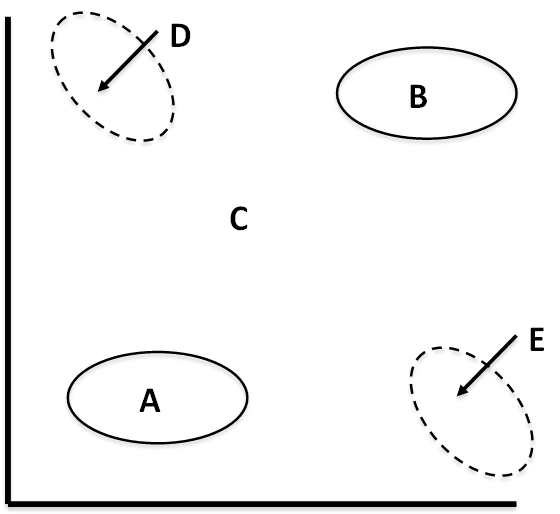 In the accompanying figure, which region represents stars that have ceased ongoing nuclear fusion? Note: (C) represents the entire main sequence while (D) and (E) represent only small parts of the main sequence.
 (Short Answer)
4.8/5 (80)
(80) 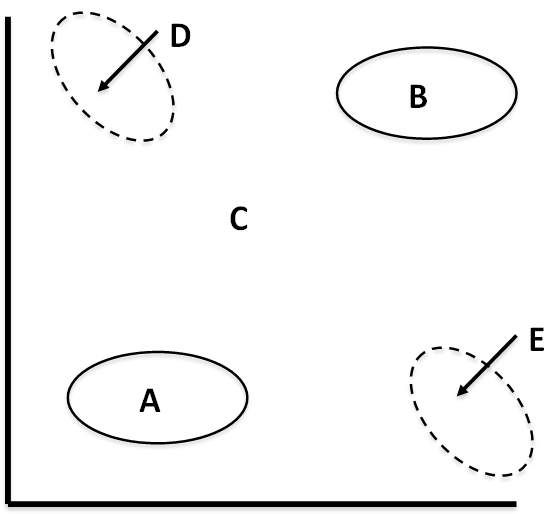 In the accompanying figure, which region represents the largest diameter stars? Note: (C) represents the entire main sequence while (D) and (E) represent only small parts of the main sequence.
 (Short Answer)
4.7/5 (85)
(85) Absolute visual magnitude is calculated at a standard distance of ____.
(Multiple Choice)
4.9/5 (82)
(82) Star B has an apparent visual magnitude of +5 and is at a distance of 330 pc. What is the absolute visual magnitude of Star B?
(Essay)
4.9/5 (89)
(89) 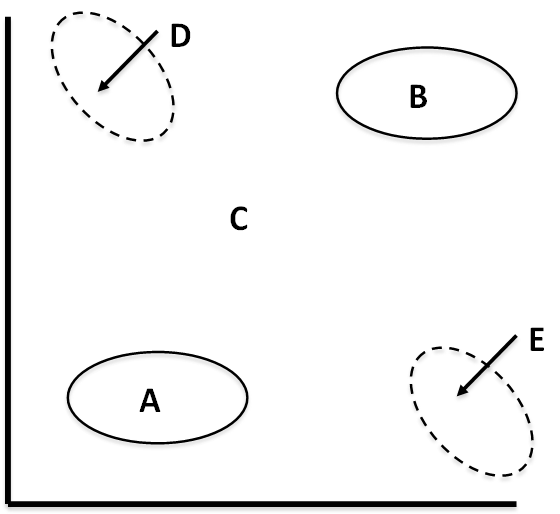 In the above, which figure represents stars with the longest main-sequence lifetimes? Note: (C) represents the entire main sequence while (D) and (E) represent only small parts of the main sequence.
 (Short Answer)
4.9/5 (83)
(83) How did astronomers discover the relationship between spectral type and mass for main sequence stars?
(Multiple Choice)
4.7/5 (92)
(92) Hydrogen lines are weak in the spectra of hot O-type stars because ____.
(Multiple Choice)
4.9/5 (76)
(76) The hydrogen lines of spectral type A main sequence stars are ____.
(Multiple Choice)
4.8/5 (75)
(75) The classification of stellar spectra started with the amount of hydrogen in the star's spectrum; however, now a better scheme uses the star's _____.
(Multiple Choice)
4.9/5 (72)
(72) If two stars are emitting the same amount of light, the star that is farther will appear dimmer.
(True/False)
4.9/5 (72)
(72) 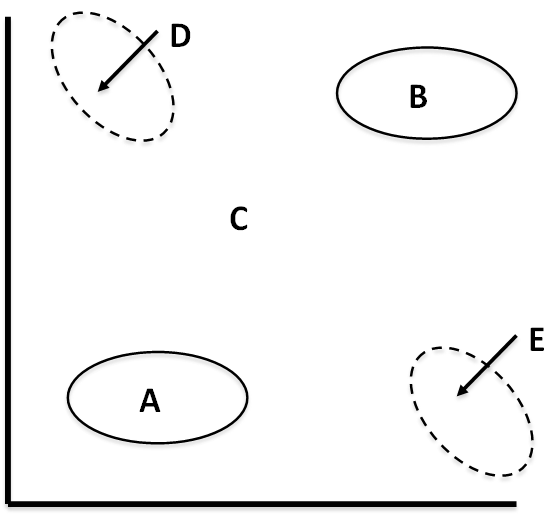 In the accompanying figure, which region represents white dwarfs? Note: (C) represents the entire main sequence while (D) and (E) represent only small parts of the main sequence.
 (Short Answer)
4.8/5 (91)
(91) Determine the mass of a theorized black hole from the following information. The mass of the companion main sequence star is 6 solar masses. The observed period and semi-major axis of the binary system are 3.5 years and 5.5 AUs, respectively.
(Essay)
4.9/5 (69)
(69) Any star that is more luminous than the Sun, but has the same temperature as the Sun, is a(n) ____.
(Multiple Choice)
4.8/5 (82)
(82) 
Filters
- Essay(0)
- Multiple Choice(0)
- Short Answer(0)
- True False(0)
- Matching(0)